
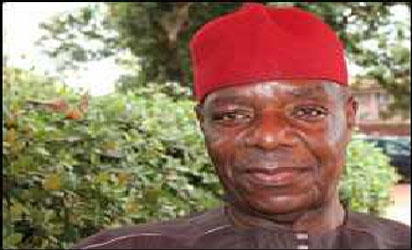
Late Prof Ben Obumselu
By Japhet Alakam
Professor Benedict Ebele Obumselu, a distinguished leader, scholar and one of the highly respected literary icon is dead. Obumselu who was widely regarded by his contemporaries as one of the most cerebral literary critics in the African continent of 20th Century, whose rare outputs attained global circulation because of their philosophical, intellectual and oracular powers died at the age of 86.
Born in Oba, Anambra state in 1930, Obumselu died in the early hours of March 4, 2017. With his death, Africa, the world and literary community have been robbed of one of the most formidable minds in recent times.


Late Prof Ben Obumselu
In a tribute by Evangelist Elliot Ugochukwu-Uko, founder of The Igbo Youth Movement, IYM, described his death as a great loss. His demise of Prof. Obumselu, “A man of history, A man of letters, leaves us all in a state of shock,” stressing that “If there ever was an Igbo man who made sacrifices for a better tomorrow for our people, while remaining a patriotic Nigerian, he truly was.”
According to him, they would treasure Prof. Obumselu’s support, advice and guidance “in full knowledge that we would not have become what we are today without him.”
Obumselu, regarded as one of the founding fathers of African literary criticism served as the first Black and African lecturer in the English Department of the University of Ibadan. The literary icon who is highly respected in the literary circles, was a confidant and close friend of the late Christopher Okigbo as well as a contemporary of Nobel laureate, Professor Wole Soyinka. Described as the greatest African literary scholar of his generation by poet, critic and university administrator, Michael J.C. Echeruo, as a Nigerian, lived through and helped define revolutionary changes in the literary circle and his country, Nigeria.
He was the first president of the association of Nigerian university students and the first English graduate of the University College, Ibadan. He was studying for a Bachelor of Arts (general) degree at Ibadan which was then affiliated to the University College, London, when the degree programme in English was introduced in the 1950s, so he switched to the new course because the single honours programme was very prestigious in those days in Nigeria. He had yet to graduate when he was offered admission at Oxford to study for the Doctor of Philosophy degree without reading for a Master’s. It was based on the strong recommendations of his lecturers at Ibadan.
He later returned to Ibadan in the 1960s, where he taught the likes of Stanley Macebuh, Dan Izavbeye, Ken Saro-Wiwa, Jim Nwobodo, Theo Vincent, Molara Ogundipe and others.
A man of many parts, in the wake of Nigeria’s political crisis of the late 1960s, Obumselu, joined his Eastern Nigerians outside their homeland, fled home and became one of Biafran leader Emeka Ojukwu’s closest advisers. He played an integral role in producing Ojukwu’s famous Ahiara Declaration of 1968, which was ‘The Principles of the Biafran Revolution.
Obumselu travelled to Oxford where he got a job offer as one of its brightest alumni, thus making him one of the few Africans ever to be given an academic position at the most prestigious British university. But due to the fact that the post would not be available till the next academic session, he settled for the University of Birmingham, another very prestigious institution. He then moved to the Sorbonne, Europe’s second oldest university and the most prestigious in France.
As a true patriot, not satisfied with the global attention to African affairs, Obumselu returned to Africa where he became practically a peripatetic scholar. He taught at universities in Zaire (now the Democratic Republic of Congo), Zambia and Botswana.
When the then Imo (now Abia) State University was established, Professor Obumselu was one of the able hands that gave the college of arts the desired fillip it needed to grow. He was their until 1988 when he retired as the dean of the arts school.
Due to his love for his Igbo people, he devoted much of his time to the Igbo cause, where he played prominent roles and served Ohanaeze Ndigbo in various capacities. His patriotic zeal inspired and influenced almost three generations of students, activists and political actors from all sides. He was the Ohanaeze candidate for the post of Secretary to the Government of the Federation in 2011, but President Goodluck Jonathan eventually settled for Pius Anyim.
He retired from the Imo (now Abia) State University as the dean of the arts school in 1988, but was still publishing in some of the world’s greatest academic journals up to the time he took ill recently.
He wrote scintillating essay for Johns Hopkins University’s journal on literary ideas on the sources of James Cary’s work. His article on African writing and the influence of Marxism has been published in several books and journals, including World Literature. Obumselu was an authority on Russian and South African literatures.
The Responsible Critic, a critical anthology was written as a tribute to him, as a founding father of African literary criticism. The collection of seventeen scholarly articles examines the state of literary studies in Africa (with particular emphasis on Nigeria) and covers a period spanning well over a hundred years of creative writing in Africa. The collection was edited by Dr Isidore Diala, an award-winning poet and dramatist with two critically acclaimed books, The Pyre and The Lure of Ash.
Also as a mark of honour,in 2014, notable Igbo leaders, including former Abia State Governor Theodore Orji and Secretary General of Ohanaeze Ndigbo, Dr. Joe Nwaorgu, were in Enugu to celebrate Obumselu’s 84th birthday.
Disclaimer
Comments expressed here do not reflect the opinions of Vanguard newspapers or any employee thereof.