
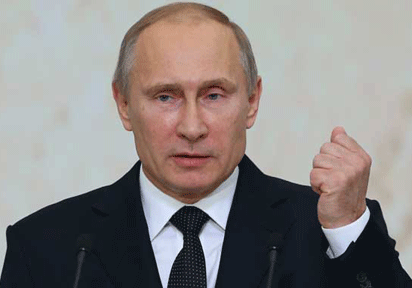
Russian President Putin
By Yinka Odumakin
THE Soviet state was born in 1917 when the revolutionary Bolsheviks overthrew the Russian czar and established a socialist state in the territory that had once belonged to the Russian empire. In 1922, Russia proper joined its far-flung republics in the Union of Soviet Socialist Republics. The first leader of the Soviet state was the Marxist revolutionary Vladimir Lenin,one of the greatest thinkers of the last century

Russian President Putin
The Soviet Union was supposed to be “a society of true democracy,” but in many ways it was as repressive as the czarist autocracy that preceded it. It was ruled by a single party–the Communist Party–that demanded the allegiance of every Russian citizen. After 1924, when the dictator Joseph Stalin came to power, the state exercised totalitarian control over the economy, administering all industrial activity and establishing collective farms.
Political and social life
It also controlled every aspect of political and social life. People who argued against Stalin’s policies were arrested and sent to labour camps or executed.The most famous of the lot was Leon Trosky who was murdered in exile.
After Stalin’s death in 1953, Soviet leaders denounced his brutal policies but maintained the Community Party’s power. They focused in particular on the Cold War with Western powers, engaging in a costly and destructive “arms race” with the United States while exercising military force to suppress anti-communism and extend its hegemony in Eastern Europe.
They continued the central planning that killed all local initiatives running the lives of every Russian from Kremlin the way Abuja maintains what it calls “Federal Roads” across Nigeria with and controls every mineral resource in every city and village all over the country today.
Gorbachev’s glasnost and perestroika: In March 1985, a longtime Communist Party politician named Mikhail Gorbachev assumed the leadership of the Soviet Union.He inherited a stagnant economy and a political structure that made reform impossible because of the evil grip of command and control.
Gorbachev came up with two sets of policies that he hoped would help the USSR become a more prosperous and productive nation. The first of was known as glasnost, or political openness. Glasnost eliminated traces of Stalinist repression, such as the banning of books and the ubiquitous secret police, and gave long -denied freedoms to Soviet citizens. He released political prisoners and allowed Newspapers to print criticisms of the government. For the first time, parties other than the Communist Party could participate in the electoral process.
The second leg of his reforms was known as perestroika, or economic restructuring. The best way to revive the Soviet economy, Gorbachev reasoned was to loosen the government’s grip on it. He believed that private initiative would lead to innovation, so individuals and cooperatives were allowed to own businesses for the first time since the 1920s. Workers were given the right to strike for better wages and conditions. Gorbachev also encouraged foreign investment in Soviet enterprises.
The reforms were too slow to bear fruit. Perestroika had torpedoed the “command economy” that had sustained the Soviet , but the market economy took time to mature. As Gorbachev noted in his farewell address: “The old system collapsed before the new one had time to begin working.”
Rationing, shortages and endless queuing for scarce goods seemed to be the only results of Gorbachev’s policies. As a result, people grew more and more frustrated with his government.The long years of Stalinist repression had created too much damage the way over 50 years of unitary rule has made Nigeria ungovernable.
Gorbachev believed that a better Soviet economy depended on better relationships with the rest of the world, especially the United States. Even as President Reagan called the USSR the “Evil Empire” and launched a massive military build up, Gorbachev vowed to bow out of the arms race.
He announced that he would withdraw Soviet troops from Afghanistan, where they had been fighting a war since 1979, and he reduced the Soviet military presence in the Warsaw Pact nations of Eastern Europe.
Break-up of the republic
This policy of non-intervention had important consequences for the Soviet Union–but first, it caused the Eastern European alliances to, as Gorbachev put it, “crumble like a dry saltine cracker in just a few months.” The first revolution of 1989 took place in Poland, where the non-Communist trade unionists in the Solidarity movement bargained with the Communist government for freer elections in which they enjoyed great success. This, in turn, sparked peaceful revolutions across Eastern Europe. The Berlin Wall fell in November; that same month, the “velvet revolution” in Czechoslovakia overthrew that country’s Communist. A firing squad executed Romania’s Communist dictator, Nicolae Ceaucescu, and his wife.
This atmosphere of possibility soon enveloped the Soviet Union itself. Frustration with the bad economy combined with Gorbachev’s hands-off approach to Soviet satellites, inspire a series of independence movements in the republics on the USSR’s fringes. One by one, the Baltic states (Estonia, Lithuania and Latvia) declared their independence from Moscow.
Remaining republics
Then, in early December, the Republic of Belarus, the Russian Federation and Ukraine broke away from the USSR and created the Commonwealth of Independent States. Weeks later, they were followed by eight of the nine remaining republics with Georgia joining two years later. At last, the mighty Soviet Union had fallen.
On Christmas Day 1991, the Soviet flag flew over the Kremlin in Moscow for the last time.
A few days earlier, representatives from 11 Soviet republics (Ukraine, the Russian Federation, Belarus, Armenia, Azerbaijan, Kazakhstan, Kyrgyzstan, Moldova, Turkmenistan, Tajikistan and Uzbekistan) met in the Kazakh city of Alma-Ata and announced that they would no longer be part of the Soviet Union. Instead, they declared they would establish a Commonwealth of Independent States.
Because the three Baltic republics (Latvia, Lithuania and Estonia) had already declared their independence from the USSR, only one of its 15 republics, Georgia, remained. The once-mighty Soviet Union had fallen, largely due to the consequences of running a multi-ethnic nation along unitary lines of central planning and control.It was a peaceful end to a long, terrifying and sometimes bloody epoch in world history.
We have reproduced this lesson from history for the benefit of those who still mouth such words like “indissoluble ” and what have you when talking about a country like Nigeria that was never made.
Federating units and dictatorship
Shahid Raja in his work Why Nations Break Up gave some suggestions to countries to avoid disintegration.Two of them are key for Nigeria to note: Democracy Works:Democracy has been much maligned for its alleged shortcomings such as corruption, mismanagement, economic disruptions and slow economic growth etc.
However despite all these allegations, democracy is still the best form of governance humanity has ever experimented with. Let it run its course. Frequent, free and fair elections will ultimately prop up capable leadership over a period of time, accountable to the public.
Only genuine leaders elected through popular universal franchise are capable of holding the federating units together; dictatorship always leave the countries broken and in a mess.
Cultures Evolve: You cannot force cultural homogeneity through the barrel of the gun or state edicts. Evolution of a peculiar national culture takes time in which each federating unit contributes. Let the hundred flowers of different varieties and huesbloom rather than having a garden full of roses only.
Unity in diversity is the hallmark of a true federation. Give respect to every major language spoken and let a national language evolve over a period of time”
Events are moving at such a speed that “restructuring ” may become obsolete like perestroika and glasnost if we tarry much longer than necessary on this point where most of the constituent units have nothing but frustration.
Postscript
Re: The Northern Star called Dangiwa
MY Brother Yinka, another gboza for you for your apt description of Dangiwa, the people’s general. All the statements and contentions in your analysis are
very accurate.
I was admitted for my post graduate studies into the Faculty of Engineering for my Masters degree in Land Surveying at Ahmadu Bello University, Zaria in 1985.
I completed the M.Sc programme in 1987/1988. So I witnessed first hand the brutal religious crises in southern Zaria during the time.
Those of us in Samaru Campus were not spared of the bestiality of this conundrum.
But for the efforts of Col. Abubakar Dangiwa Umar as the Military Governor of Kaduna State then, things could have gone awry.
Col. Umar curtailed the situation in support of General Ademokhai, who was the GOC of the 1st Mechanised Division of the Nigerian Army to deploy troups from this army formation in a Code Red fashion. Yinka, one can never say enough of this young and fine officer, right from his time at the FHA in Lagos.
Though, I have never met him, but I have always loved his character of nationalism. Abubakar Umar is one leader who can unify and unite this country. With Umar as president, southerners can go to sleep with their two eyes closed. If this young man is appointed as our EFCC Czar, I bet you, Yinka, there will be no unhunhun hanhanhan from any quarter in the country. And Nigeria will be better for it. Thanks.
-Chief JVE Puegeren, Warri – Nigeria
Disclaimer
Comments expressed here do not reflect the opinions of Vanguard newspapers or any employee thereof.