
BY CHARLES KUMOLU
SATURDAY Vanguard in this report examines the critical issues surrounding the recent protests in some major Nigerian cities within the context of what it means to live in Nigeria at a time like this
THE news announcing it surfaced passively on various social media platforms like one of the countless messages of its kind that are full of sound and fury but signify nothing.
Within a few days in the public domain, it gained popularity across the country attracting many protagonists and a few antagonists.
While the opposing camps it engendered were locked in controversy over the correctness of the initiative, the police barked furiously at the initiator, Tuface Idibia.
Every attempt at ensuring that the proponent, who is one of the famous Nigerians, dropped the plan, which sought to challenge perceived bad governance, made the idea more attractive to Nigerians.
While a people, known for docility in the face of social challenges relished the prospects of protesting against bad governance on February 6, 2017, the scheduled event produced a tragic hero in Tuface, who infamously canceled the event.
An idea whose time had come
While the intent of dropping the idea remained unclear, it was a no going back situation for hapless citizens, who considered the protests an idea whose time had come.
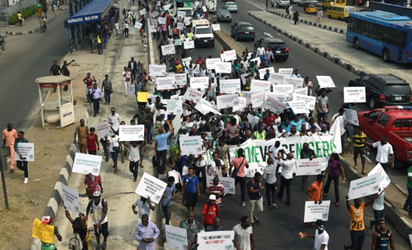
From Abuja to Ibadan, Lagos to Ijebu Ode, Nigerians took to the streets protesting against the hardship that had been the lot of the citizenry since 2015.
It was one of the extraordinary days in the life of Nigerians, who are known to habitually suffer bad governance.
In a display of a new-found gut, many defied earlier threats by the Police to demand a better life for the citizenry.
Given the numerous warnings against such gathering, going ahead with it truly showed the depth of the underlying factors necessitating the protests.
Even without laborious findings, the sights and sounds of the socio-economic realities in the country explained why Nigerians took to the streets.
That rare display of courage was reminiscent of a quote by Frantz Fanon in one of his numerous revolutionary books.
The late Algerian pre-independence nationalist famed for his authorship of the Wretched of the Earth had stated thus: “When we revolt it’s not for a particular culture. We revolt simply because, for many reasons, we can no longer breathe.”
Truly, the protests, irrespective of a few contrary opinions, were simply because the hardship in the country had become strangulating for Nigerians, Saturday Vanguard gathered.

Accordingly, the following among others were observed as immediate and remote causes of the one-day protest by angry Nigerians: High cost of living/grinding hunger, harsh economic policies, collapse of the power sector, alleged double standards by government, absence of defined response to recession, crashed value of the naira/volatility in exchange rate, rising unemployment rate, handling of rampaging herdsmen, dysfunctional legal system , slow pace of making decisions and polarisation of Nigeria along ethnic lines.
These, combined to create one of the most difficult times in the history of the country.
High cost of living/grinding hardship
For anyone living in the country at the moment, life has been reduced to a harrowing experience as a result of the escalating prices of goods and services.
This situation has brought about widespread hunger especially among middle-income earners, low-income earners, and commoners.
Virtually every commodity has witnessed over 100 percent increase in price since 2015, resulting in low purchasing power.
Even staple food items that are locally produced, are affected by the escalating prices.
Since virtually everyone is a victim, it was not surprising that many apart from those in positions of authority, their supporters and hangers-on supported the protests.
The role this factor played in provoking the exercise was better articulated by the Acting President, Prof Yemi Osinbajo in a speech acknowledging the grouse of protesters.
“We are in a serious economic situation and the President was particularly concerned about the lot of the common man. And I quote him, “Recession today for many, for some its means not being able to pay school fees, for others not being able to afford the high cost of rice and millet and for most of our young people recession means joblessness, ’he stated.
Harsh economic policies
Before now, experts and non-specialists had frowned at some economic policies of the present administration, with the consensus that it was accentuating the economic crisis.
For instance, the World Bank and the International Monetary Fund, IMF, had in October 2016 urged the Federal Government to come up with an economic blueprint.
Latching on its understanding of the dynamics of the Nigerian economy, a leading global financial magazine, The Economist dismissed the fiscal policies of the administration.
The surprising disposition of the UK-based magazine, which supported Buhari in the 2015 presidential election, came a few days after Financial Times termed the same fiscal policies as the height of foolishness.
Two former governors of Central Bank of Nigeria, CBN, Prof Charles Soludo and Emir of Kano, Alhaji Mohammadu Sanusi had reasoned in that direction.
Soludo had said that the President’s economic policies, since 2015, were still based on campaign promises.
However, some policies Saturday Vanguard found not have been widely accepted include fixed exchange rate, forex restrictions, implementation of Treasury Single Account, TSA, politics of naira devaluation and banning of some items the country had no comparative strength of producing among others.
Delay in making key decisions
In the estimation of most Nigerians, this administration is famed for not being apt in the area of making critical decisions.
Analysts have argued that some policy actions of the government often come belated when the issues they were expected to have addressed had become complex.
Those easily referenced are the delay in the appointment of ministers and heads of parastatals, delay in the appointment of ambassadors, delay in the appointment of National Commissioners of Independent National Electoral Commission, INEC and delay in 2016 budget presentation among others. More disturbing is their failure to take decisions that can improve the economy. All calls to higher or engage a sound economic team have been ignored.
This trend is believed to have resulted in the seeming lack of pace in the business of governing Nigeria.
Collapse of power sector
Currently, power generation and distribution is still a challenge as most cities, towns, and villages are in darkness, the billions of money spent on the sector nothwitstanding.
Instructively the highest generation so far recorded was the generation of 5074.7MW February 2, 2016, while the highest maximum daily energy wheeled nationwide was 109,372MWH on the same day.
Unfortunately, that achievement meant nothing till date as the generation level has continued to hoover between 3,730.5 MW as of February 9, 2017, and 2,662MW(the amount recorded on January 2, 2017.
Saturday Vanguard learnt that the generation is not the core problem, but distribution as a result of obsolete transmission equipment.
The worsened power challenge has increased the fuel consumption rate of most people, who spend much now to power their generators at homes and offices.
Another worrisome aspect of the energy crisis in Nigeria is the high tariff being charged for the insignificant electricity supplied.
Rising unemployment rate
In nearly two years, the unemployment rate in the country has witnessed a steady rise in percentage.
The National Bureau of Statistics had in December 2016, stated that Nigeria’s unemployment rate rose from 13.3 percent in the second quarter to 13.9 percent in the third quarter of 2016.
The report stated that the number of unemployed increased by 555,311 persons.
However, the trend which is a common social challenge in Nigeria became more alarming with the loss of jobs brought about by the recession.
Many Nigerians were thrown to the streets by their employers as a cost cutting measure.
The seriousness of the scourge was evident from the inscription of unemployment among the challenges listed on the placards of most protesters.
Even though the Federal Government had cautioned companies against sacking their workers, most organizations are still laying off workers in large numbers.
Absence of defined response to recession
Most Nigerians are alarmed by the absence of an economic blueprint aimed at tackling the country’s economic woes.
Harping on historical experiences where nations had used concretized fiscal road-maps to emerge stronger from a downturn, there are concerns that the government is yet to have a blueprint in the face of the worst economic crisis in Nigeria’s history.
At the moment, the vehicle through which the government intends surviving the meltdown is still unclear, as experts keep demanding a work plan.
That the government had recorded some gains in some areas did not stop observers from maintaining that its fiscal policies were less holistic and impactful.
The list of those, who hold this view is endless, as many had spoken to Saturday Vanguard in confidence and others made theirs public.
For instance, the World Bank and IMF, an investigation by this paper, revealed, mounted pressure on the government to come up with an economic blueprint, if its drive for foreign loans was not to be stalled.
This delay in coming up with a plan is believed to be accentuating the economic woes thereby prolonging the lifespan of the recession.
At the moment, the economy is reportedly growing at two percent with a high inflation rate of 18.5 percent.
Crashed value of the naira/Inflation
Nigeria’s currency which used to be among the strongest in Africa has lost over 100 percent of its value.
With the 2017 budget pegging the exchange rate at 305 to 1$, the naira has continued to crash in the parallel market.
The currency had in January crashed further to N500 to a dollar at the parallel market after it had remained stable for nearly three weeks.
The Pound Sterling and the Euro also crashed to N616 and N530 respectively at the open market.
Since 2015, the rate of inflation has been on the rise successively.
Today, virtually most Nigerians are groaning given that the valueless state of the naira has brought extreme hunger and other forms of hardship in the country.
The fact that this is happening unabated leaves the populace frustrated about what the days ahead hold.
Handling of rampaging herdsmen
Most Nigerians are alarmed by the manner the disposition of the administration towards the mass killings being done by Fulani herdsmen across the country.
For a government that had excelled in decimating the capacity of Boko Haram insurgents to commit mass murder, its seeming silence on most murderous activities being perpetrated by Fulani herdsmen, leaves most people surprised and irritated.
For instance, the administration’s handling of the massacres in Agatu and Southern Kaduna was mostly considered unimpressive.
Unfortunately, such attitude is giving rise to the notion that the government had applied double standards in responding to some national challenges.
Polarisation of Nigeria along ethnic lines
The pulse of a cross section of Nigerians is that the present administration had in policies and appointments, favoured some ethnic groupings against others.
Those, who hold this position, maintain that the North is more favoured in this dispensation in manners that rubbished the contents of the Federal Character Principles.
This is one factor that Saturday Vanguard found to be irritating the larger South, especially the South East extraction.
This feeling which had long existed was recently re-echoed by a former Military Administrator of Kaduna State, Col Umar Dangiwa, retd, who claimed that the administration’s pro-North disposition was dividing Nigeria.
Dangiwa, who said this against the backdrop of the delayed appointment of Justice Walter Onnoghen as the substantive Chief Justice of Nigeria, said: ‘’The unity of the nation has already been pushed to the precipice by the recruitment and appointment policies of a government which tends to favour the north in violation of the Federal Character provision of the constitution.”
Disclaimer
Comments expressed here do not reflect the opinions of Vanguard newspapers or any employee thereof.