
By Muyiwa Adetiba
I have been around long enough to know that protests and demonstrations—like coups— are not always what they seem on the surface. More often than not, they go beyond the altruistic or love of country which they often profess. Many exploit the sentiments, disaffection and divisions in the polity to promote private agenda. Many of the interests might be short term to blackmail the powers that be into accepting or rejecting a project or a policy in which they stand to gain position, money or power.
Some, a few though, just want to be known as the defender of the downtrodden. Some on the other hand, make a living out of being part of different demonstrations. But the shrewd ones, the grandmasters, use them to test the waters and gauge the public mood. To these masters of violence, protests are just a part of the arsenals they use in their quest for ultimate control and like all good chess players, are adept at planning several moves ahead.
Protests can be distracting at best. But on a bad day, they can lead to violence and a disruption of law and order. The line, as we are aware, between a peaceful protest and a violent one is often very thin. The master puppeteers who pull the strings know this and can, fully aware of the consequences, play brinkmanship on the line between violence and peace depending on their goal.
Added to this is the fact that demonstrations are not cheap. There are logistics to take care of like transportation, protest messages, mobilisation and entertainment. That is why in many cases, the people on the streets are not main beneficiaries. They are mere pawns who are in the first line of attack. They are the ones who get bruised and sometimes lose their lives while leaving the big officers and grandmasters in the background to plan and fund the strategies. Make no mistake; not all protests are in the public interest.
But protests have their uses. They are an indispensable part of democracy because they serve as a way of talking back to authority. They are also cathartic; allowing people to vent their anger and voice their frustrations. For a listening government, they are a way of gauging the mood and hearing the specific demands of its people. And sustained, they often cause the authorities to make uncomfortable concessions.
For reasons that are not too difficult to understand, most governments don’t like protests. They expose the underbelly of bad administrations and bring to light, those dark things they would want to keep away from the people. Protests can also get out of hand and lead to an unforetold outcome as we witnessed during the Arab Spring. It is for these reasons among others, that most authorities will do everything to avert a protest and when not possible, to de-escalate it.
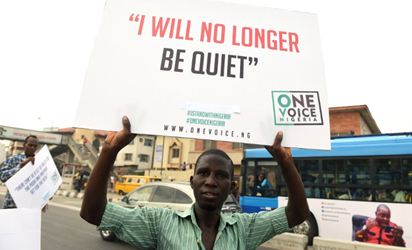
This week’s protest would probably be described as a success story for the police because they were largely in control and it was a protest that almost wasn’t. The face of TuFace was to be used to win the minds and hearts of youths. The authorities went to work on him and TuFace caved in. We might never know in what way the authorities were able to lean on him.
He might have been told some of the far reaching implications of such a protest and the consequences to him. He might even have been given a glimpse of some of the ‘faceless’ sponsors and didn’t like what he saw. He might have been threatened with some skeletons in his cupboard. In any case, Mr Innocent Idibia had seen enough reasons to ‘turn his face’ and back out.
You can accuse him of being naïve because planning a protest is a serious business—it certainly goes beyond singing a few protest songs. But the sheer venom and vitriol that accompanied his pull-out in the social media were uncalled for. What he put on the line—his name and his brand—were personal to him and if he felt they were going to be abused, he has a right to withdraw them.
He is also smart enough to know that he would lose ‘face’ because of his decision to pull out. Many of those calling for his head have never done anything worthwhile in their lives. Many would probably stay home on the day or stay far away from the scene of protest if they had to go out. It is so easy to criticise and to condemn without bothering to find out what the other guy must be going through.
That the protest still took place in spite of his withdrawal showed it was not all about TuFace. His was probably just an expedient face. The message of the protests which the presidency ‘heard loud and clear,’ is a message of hunger in the land; of an economy that keeps heading south despite government’s best effort; of an appalling power situation which makes any attempt at entrepreneurship pretty difficult; of insecurity whichever way you look at it; and of a rising cost of living.
Added to this was Dr Odinkalu’s message of lack of empathy from government—a message I tend to agree with judging from the body language of government. There is nobody who lives in Nigeria today that will disagree with the overall thrust of the protest message. What we might disagree on is how to apportion the blame. This administration has made many mistakes, some honest and some disingenuous.
It has been ponderous and reactive. Especially on the economy. But it came in at the onset of an inevitable economic burst and was overwhelmed by what it met. The Niger-Delta militants who brought the economy to its knees through economic sabotage and plunged the nation into further darkness by starving the turbines of gas also have their share of the blame.
But we must never ever forget those who mismanaged the economy during the years of boom when oil sold over a hundred dollars per barrel for over two years. Those who looted and plundered the treasury. But the greatest blame must go to those of us who applaud and covet them. Instead of naming and shaming those who led us into poverty, we put garments of honour on them and put them on a pedestal.
It is hard not to pity the country when we look at those we choose to call our heroes. Or can we deny that James Ibori, judging from the reception he’s received so far, is not one of our heroes?
In protesting the state of the nation, the youths should also protest against those who got us there in the first place.We celebrate corruption,only to protest the consequencies of it later on.
Disclaimer
Comments expressed here do not reflect the opinions of Vanguard newspapers or any employee thereof.