
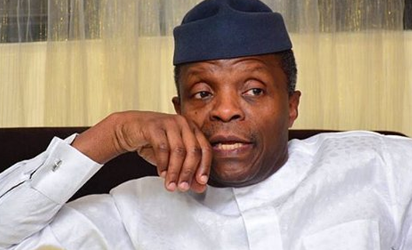
Acting President Osinbajo
By Sonny Atumah
It was 18th century French writer Nicolas Chamfort who said that: “Living is an illness to which sleep provides relief every 16 hours. It’s a palliative. The remedy is death.” Palliatives treat symptoms only; they alleviate pains and symptoms without eliminating the cause. Most developed and emerging nations thoroughly and properly study complex problems to come up with lasting solutions. Serious nations go the smart way in carrying out research to solve problems. Even water that seems to follow the line of weak resistance does so after surveying the terrain.
Last week, the Acting President, Professor Yemi Osinbajo who was in Rivers State as part of his conciliatory moves to overcome anger, suspicion and hostility of the Oil producing Niger Delta region. He said that the Federal Government would establish modular refineries to engage those that are now involved in illegal refining in the region. He said: “Our approach to that is that we must engage them by establishing modular refineries so that they can participate in legal refineries. We have recognised that young men must be properly engaged.”
Nigeria he said needs to provide work for people who make a living from illegal refining of oil in the Niger Delta in order to achieve peace. He also said that the government will make more provisions for the amnesty scheme for former militants who laid down arms in 2009 in exchange for cash stipends and job training. Illegal refining is one of the few businesses flourishing in an otherwise desolate region, as petrol is scarce in Nigeria due to the country’s derelict state refineries.
To be candid the visits to the enclaves of quasi-military groups were joker cards by the Acting President. He must be commended for reaching out to citizens of that aggrieved region for peace to reign. It proved that cannonades, deployment of bombardiers and arsenals to a highly tensed zone would never solve the problem. Many conflicts in the mold of might’s are right never achieved genuine settlement.
But he must do more to save Nigeria. What has made the proliferation of boiling containers for dangerous petroleum products in the name of illegal refineries thrive in the rivulets, creeks, inlets and islands of the Niger Delta? Apart from poverty the unavailability of petroleum products even to power out-board transport boats is a major problem. From one’s study, at the best of times, a litre of PMS or petrol sells for N250. In the distribution of products the region is never considered as deserving of products even when the hinterland enjoys subsidies from the petroleum equalization fund.
It becomes attractive for nefarious acts
on insecure pipelines to get crude. Of course the process of distillation is similar to that of illicit gin commonly processed in the riverine areas. Yes to integrating these refiners into government run process plants, but are the refineries there? Process plants management has also been the bane of Nigeria for the past two decades that our four refineries were run down and nobody gets punished. We must put our existing complex refineries and petrochemical plants to work and possibly upgrade them. Modular refineries are mere palliatives.
The Acting President described the region as desolate. The people are wretched and lacking physical and social infrastructures from the government or the international oil companies, IOC that ravage the region’s ecosystem through oil exploration and production. Undertake a tour of Rivers State and have welcomes of soot from the atmosphere. Soot is a black powdery form of carbon produced when gas is flared or oil is burned, and rises up in fine particles with the flames and smoke blighting the environment.
Authorities had originally cut the budget for cash payments to militants to end corruption but later resumed payments to stop surging pipeline attacks crippling vital oil revenues. “We have made more provisions for amnesty and provisions for social intervention,” Osinbajo told his audience in Port Harcourt. The Niger Delta interventionist amnesty programme may barely be the lasting solution. Although it has developed a lot of human capital in the region the scheme has become a circus with thousands of highly trained professionals that are left unemployed, becoming hopeless, helpless, and restive as it is today.
The army of occupation is a ready tool for vandalism of pipelines and flow stations that crisscross the length and breadth of the region. Since February 2016, covert activities of militiamen have taken its toll on a government that is bleeding revenue. The current talks with militants to end oil pipeline vandalism which reduced the country’s output by 700,000 barrels a day for several months is quite commendable.
But why have we consistently on ad hoc
agencies like the NNDC to solve the problems of development in the Niger Delta even when we know that leaders’ proxies benefit from projects execution? The cosmetic approach has caused an upsurge of crony capitalism. It is instructive that Professor Osinbajo while in Imo State read the riot act for people that abandoned their contracts to complete them or face prosecution.
The idea of government going into modular or mini refineries is not the way to go. Complex refineries are still better; the advantages over mini plants are fewer staff per Effective Distillation Capacity, EDC, scale and operating efficiency is better, and has more volume and high value products. Experts believe that the economics of a modular refinery often times one product are not comparable to a full conversion complex refinery.
A lot of government incentives and generous conditions from credit agencies are required for profitable investments in modular refineries. Modular refineries are topping units which viability depends on sites close to petroleum feedstock to reduce logistics and nearness to markets is required to reduce distribution costs. Many marginal field beneficiaries in the past were on the basis of downstream investments but they became speculators in the industry. If the marginal field beneficiaries are refining we may not have been entangled in product scarcity, an issue the present administration must address.
Modular refineries advantages are that they are faster to construct from 12 to 18 months and so improves engineering quality. They are flexible to meet demand changes so more modules can easily be added. Modular refineries may be in units from 4000 to 30,000 bpd, though some are as low as 1000 bpd capacity. Lubricating oil, waxes, asphalt and many more products may not be produced in a modular mini refinery.
One reminds the Acting President that 23 modular refinery licences were issued to private investors in October, 2015. The validity of a licence to establish a refinery or plant is two years. One hopes the licences have not gone the way of 18 private refineries by former President Olusegun Obasanjo in 2005. The Obasanjo’s licencees who could not achieve any result constituted themselves into the Association of Private Petroleum Refinery Owners of Nigeria.
Disclaimer
Comments expressed here do not reflect the opinions of Vanguard newspapers or any employee thereof.