
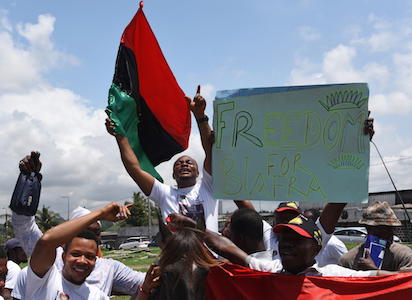
Demonstrators wave flags and hold a sign reading “Freedom for Biafra” during a protest calling for the release of pro-Biafra leader Nnamdi Kanu, on September 23, 2016, in the Abidjan suburb of Treichville. Near one hundred Biafran Nigerians protested on September 23 in Abidjan, calling for the release of their leader, Nnamdi Kanu, according to an AFP photographer.
On the day Mr. Donald John Trump was inaugurated in Washington as President of the United States, IPOB, at best a fissiparous group of Biafran separatists organized a solidarity rally in Port-Harcourt to celebrate. For some odd and inexplicable reasons, the IPOB seems to align Trump’s victory in America with its own triumph in Nigeria.
It might be for the ideological bent that current watchers of Trump associate with a kind of nationalist isolationism which seems to speak to the IPOB separatists, although I do not recall the same full range of outpouring of enthusiasm by IPOB with the electoral victories of Theresa May and the Tories in the UK. But, “k’osinadi,” as some Igbo wit would put it, and that is, be that as it may, the IPOB rolled out their drums, and unfurled their flags, and chose Port-Harcourt, the city Igbo nationalists call, “IgweOcha” after its traditional name, and sought to rally in celebration of Trump and all that his triumphs stood for them.
The reports were that the rally was, as rallies go, peaceful. It was a street rally, and it was bound certainly to have all the tripping and trimmings of street theatre, and possibly nothing much else beneath the straw and all that huff. But the Nigerian security services did not think so. They came out in full force, and in full battle gear, and did great battle with an unarmed crowd of jubilant youth armed only with their flags, clenched fists that pawed the air liberally, and hot breath.
I hope readers get my hint of irony here, for how else can one convey the terrible travesty of armed security personnel ploughing through a party of unarmed young street protesters in the most heavy-handed way, resulting in what should clearly be defined unequivocally as premeditated murder of innocent civilians, simply on account that they are protesting, and they are IPOB, seeking separation from Nigeria? I’d like to register the following, just simply to establish my own stake in this matter as a conscientious citizen and one with the added responsibility of mediating opinion through public commentary on the platform of a national newspaper: I have long held that IPOB is largely on their own on this matter of Biafra.
As a group, its ideological frame has tended towards fascism and other right-wing tendencies, and they do not agree with me personally. At some level, I feel a deep disagreement with IPOB’s version of the Igbo and of Biafra. It has been very clear that the group appropriates the Biafran idea and has refused to comprehend the real meaning and significance of Biafra, and the imperative that Ojukwu himself described as “Biafra of the mind;” a more strategic, more sustainable, longer view of that question mediated by a different set of the principles of autonomy.
I have also understood that the fact that any group can come out and mouth “Biafra” and “Biafra sovereignty” does not guarantee that we speak the same Igbo-language, or that we fed of the same nipples, or that we agree on the same methods and principles. It only means that we must pay very close attention and listen, and verify that what is being said reflects a totality of the “minutes of our last meetings.”
But I, as have a vast swath of really conscientious Igbo, have listened closely and paid particular attention to IPOB, and what I hear and discern of both its methods and ideology does not reflect my worldview or ambitions. I do not subscribe to Igbo-Zionism, nor to the particularism of an “elect people” who can only make progress by isolationism; nor with the fascist and fundamentalist undertow propelled by false religion, and a movement framed in language that very closely mirrors the language of some of the most despicable right-wing movements in Europe today.
I shudder at the kind of Biafra that will emerge from the kind of ideology which IPOB reflects. Yet, at another level, IPOB raises some of the fundamental questions that speak in a visceral way to the contradictions of the Nigerian state currently as it affects me and many of those who have felt dispossessed and disempowered in Nigeria.
In my own case however, I take the Zikist anthropological view in his response to some of these tendencies as they began to emerge, particularly with the rise of the Action Group in the 1940s, that the African is a race of people – not the Igbo, or Yoruba, or Hausa, or Akan, or Fante, and so on. More things connect us as people than make us fundamentally different.
European colonialists chose to emphasize the artificial stuff that make us seem different. But strip it all to the bare bones, we find the very startling truth that the Kanuri, for instance, have close cultural linkages with the Igbo than many ignorant people think possible.
The connections between the Jukun and the Aro-Igbo, or the fact that the Olua family whose diasporic wing fought Umu Eze Chima in the Idu wars, still exist to date in Abriba, may not make much sense to ignorant folk who begin to disinter historical corpses from the legs on the matter of this nation, and the historical formation of nations as products of both organic will and organic accidents.
Revolutions are dialectical processes, and are usually anchored on a profound awareness of the materiality of history. On these grounds alone, I disagree with IPOB. Yet, these disagreements must be allowed as part of the debate of nation, and nation-formation. It is on these grounds that I find the routine and mindless killing of IPOB protesters and supporters unconscionable and criminal. Nigeria makes itself a criminal enterprise by engaging in these killings.
Reports of the killing of members of the IPOB who were staging street rallies in Port-Harcourt in support of Donald Trump is wrong and it is criminal and unconstitutional.
As the IPOB has constantly made clear, they are unarmed. They make their arguments based on the powerful sentiments that they invoke, and these sentiments include that they have a right to seek self-determination as guaranteed under international law. When people feel themselves so oppressed that they do not see any recourse other than to seek their independence, they must not be criminalized.
Nigerian nationalists sought independence from the British colonial empire and chose to leave the British Commonwealth in a movement led largely by Igbo intellectuals and agitators from 1935. They were not criminals. They were nationalists. IPOB seeks to re-enact the same sovereignty movement. Many states in Africa, like the Senegambia federation or the Union of Tanganyika were granted independence from colonialism as single nations; they agreed thereafter to separate.
Nigeria nearly broke up with the civil war in Biafra, and it is the haunting effects of that war that places groups like IPOB under the orbit of antinomy. But there is nothing that stops any group from seeking its own independence from a larger group, and particularly if they use peaceful means, as groups like the IPOB have continuously pledged.
The arrest and arraignment of 45 members of the group for treason is not only questionable, it is a joke, because seeking political freedom is not treason. Plotting to overthrow an established government of a legitimate state is what constitutes treason.
IPOB is not seeking to overthrow the government of Nigeria. It is seeking to leave Nigeria and establish an autonomous government separate from Nigeria where its members argue that their future and humanity may be more protected and guaranteed. They have demanded for a plebiscite to establish their exit claims. It is their rights to make such political demands.
The response of the Federal government should never be to use force to stop IPOB, because that will embolden them, secure greater legitimacy for its claims, and create more sympathies. The use of violence against IPOB in Port-Harcourt supports their claim that Nigeria is a barbaric state that has created a culture of violence and intimidation, and that has targeted rather than protected its citizens, and that has militarized some of the most routine forms of civic life.
The Federal government’s job in the contested space should be to prove IPOB wrong; secure greater support for the continuity of the republic through visible progress, the assurance of safety and the guarantee of the political rights of those to whom IPOB makes its greatest appeals. Shooting and killing IPOB agitators on the flimsiest of grounds makes the Federal government look stupid rather than powerful. You cannot bully people determined to go.
You can only convince them with greater truth. It is right that the representatives of the South-East in the National Assembly, and the new leadership of Ohaneze has spoken up against these targeted killings. They must go further: they must ensure that whoever gave that order to shoot be brought to justice. These killing must stop. IPOB has, for as long as its agitations remain peaceful, a right to their political conscience. They have committed no crimes. Enough is enough!
Disclaimer
Comments expressed here do not reflect the opinions of Vanguard newspapers or any employee thereof.