
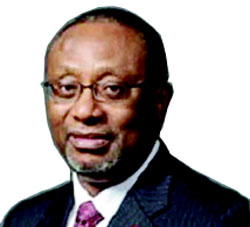
•Ambassador Joe Keshi
By Simon Ebegbulem
BENIN—DIRECTOR-GENERAL of the BRACED Commission, the regional institution established to drive the process of cooperation and integration among the South-South states, Ambassador Joe Keshi, has expressed optimism that the current six governors of the region will give a kiss of life to the commission to actualize its mandate for the states.
Keshi, who spoke to NDV, in Benin City, amid report of politics that tore the governors apart, said: “So our hope is that these new governors, who are now preparing to meet, will really take up this challenge and allow the commission deal with its mandate.”
He revealed that despite the lull in the last few years, the commission did not lay comatose, saying: “The commission is still working hard and right now, we are working with a number of agencies to put up some things for this governors so we can move forward.”

•Ambassador Joe Keshi
According to him: “BRACED Commission, an acronym for Bayelsa, Rivers, Akwa Ibom, Cross River, Edo and Delta states, was set up by the previous governments in the region. Of course, then Governor Liyel Imoke, who served for about four years as chairman, after that Governor Amaechi, Governor Uduaghan of Delta State, Akpabio of Akwa Ibom and Sylva of Bayelsa, later Seriake Dickson came on board and Oshiomhole of Edo State, who was the last chairman.
Fire, enthusiasm at the beginning
“When they started, there was a lot of ambition, desire and determination to bring the atmosphere that will enable them work together and achieve the objectives of the commission. But along the line, politics got involved, especially the politics of 2015 and the rest is history in the sense that one of the founding fathers left the boat and others were very upset and angry and left a situation where it became very difficult for the caucus to meet and work together.
“This continued even after the election because as I speak to you, the governors under the chairmanship of Oshiomhole had attempted to meet about twice or thrice and it did not work. But right now, there are renewed efforts for them to meet very soon and we are working on that to ensure that they all meet in due course. So that is the back ground as to why they have been unable to meet, it is political and it is a big challenge and my hope is that Nigerian leaders should be able to separate politics from economics. I know it is very difficult but they should be able to do that.”
Framework for agriculture, education
On the achievement of the Commission, he said: “Let me also say that within this period we are looking at, the commission itself achieved a lot in areas of agriculture and education because we were able to put together a frame work for cooperation in education. We were able to put together a frame work for agricultural development in the South -South, which enjoined the states to focus on agriculture as a way of reducing independent on oil.
“This was taken more than three years ago even before the oil prices collapsed. People were certain that with the trajectory of oil prices, there will be a bust somewhere along the line, and so to prepare for that bust, we tried to advise the states to focus on agriculture and we held series of meetings with the state governments, development partners, banks and we came to the conclusion that the best way forward for the South- South, was for the zone to have two groupings in terms of agriculture.
“Number one, the principle that we operated upon was that before oil was discovered, the whole of the South South as part of Eastern Nigeria, except of course Edo and Delta States, but the rest as part of Eastern Nigeria, survived on oil palm. So we came up with the plans that the six South South states should go back and grow oil palm.
No political will: “Believing that if they grow oil palm, they will sell at the international market and then they have a big market in Nigeria today. So we were cognizance of the fact that if all the six states are able to focus on oil palm, they will be able to contribute to Nigeria’s ability and capacity to meet the demands at home.”
His words: “Secondly, we now said that in addition to oil palm, each of the states should take two other products that they have the capacity to produce. In other words, a state like Bayelsa has the capacity to grow rice and probably aquaculture. A state like Cross River has the capacity to grow cocoa, so we held more than five meetings while the states went back to find out about these products.
Difficult places to do business
“And they made their choices and we took it up to the governors’ meeting and the governors approved. Unfortunately, these were not implemented at the state level because of the absence of political will. We have to admit that throughout the federation, the civil service is getting weaker and weaker, not the fault of the officers, but the political leaders need to have the political will to make reforms. And the challenge still remains that the South remains one of the most difficult places to do business.”
Aborted inauguration: The director general disclosed: “We also recommended that there should be a law to advise the state government on business, investment and how to ensure that the region develops a right atmosphere for investment. Again this was approved and the governors were expected to execute it. Three people each came from the states to represent the governors. But unfortunately that committee was not inaugurated before the last governors left.”
Disclaimer
Comments expressed here do not reflect the opinions of Vanguard newspapers or any employee thereof.