
Nigerian Stock Exchange
*New Issues market in comatose
*PwC, other analysts forecast better 2017
By Emeka Anaeto, Economy Editor
NIGERIAN stock market ended the year 2016 in bad shape as fortune nose-dived in equities’ secondary market while primary markets went blank.
Though year-to-date, YtD, returns had begun to reverse its adverse numbers in the last month of the year from the year’s peak of -11.9%, it still closed in the negative territory of -6.1% with investors losing over N600 billion. Market capitalization closed the year at N9.25 trillion as against N9.85 trillion 2016 opening figure. Nigerian Stock Exchange All Share Index also declined 6.2 per cent to close at 26,874.62 as against 2016 opening figure of 28,642.25.

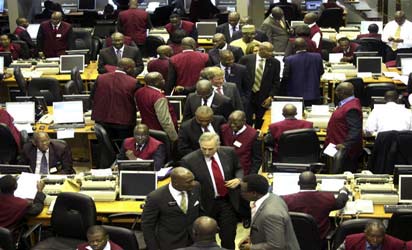
File photo: The floor of Stock exchange
The primary market recorded zero activity on both Initial Public Offer, IPO, and Further Public Offer, FPO, segments. The only attempt at an IPO was Interswitch Limited, which backed out towards end of the pre-offer meetings, citing foreign exchange crises.
PwC expects improvements in 2017
Reacting to this situation analysts at PriceWaterHouse, PwC, stated: ‘‘Equity markets tend to decline in periods of recession and Nigeria is no exception. Companies’ stock valuations drop, hitting stock market performance, and as a result, a reduction in the number of new entrants.
‘‘There have been no Initial Public Offerings (IPOs) or Further Offers (FOs) on the Nigerian Stock Exchange, or by Nigerian companies on foreign exchanges, to date, in 2016. Unlike bond markets, equity capital markets tend to bear the initial brunt of a recession, as seen in the absence of IPOs and FOs in 2016. However, we expect to see activity pick up in the equity capital markets in 2017 as the Naira begins to stabilize, investors regain confidence, and issuers who paused their plans due to uncertainty, access the market again. We particularly expect to see renewed activity in the Nigerian telecommunications sector. In the medium and long term, we expect that government stimulus packages in the form of agriculture, manufacturing and social intervention funds and the proposed increase in capital projects spending will stimulate growth.
‘‘Economic growth coupled with improved business climate is expected to attract foreign investment, promoting growth in the capital markets in due time.” All the various segments of the market had witnessed some bumper activities peaking in 2008, but the global meltdown began to force Portfolio Investors’ exit precipitating a huge and long decline in equities and dearth of action in PO’s.
Activities within this market dropped significantly between 2009 and 2012 but it began to pick up in 2013 with a few number of POs between 2013 and 2015.“Again, with the onslaught of oil price crash and a Nigeria-specific melt-down 2016 became another locust year for the capital market on all fronts.“A review of the performance of 47 stocks listed between 2008 and now reveals that seven out of such stocks currently traded above their listing prices while 38 traded below their listing prices. The remaining two remained flat.
The good performers include United Capital and African Prudential which led gainers at +143.1 per cent and +88.7 per cent respectively. On the other hand Caverton and DAAR Communications led losses with -90.53 per cent and 90.5 per cent respectively.
Financial services dominate the list of the 38 underperforming stocks with 17 stocks. Services sector follow closely with seven stocks and ICT with six stocks. Consumer and Industrial goods have four each while Construction/Real Estate, Oil & Gas, Healthcare and Agriculture have three, three, two and one respectively. In 2007 and 2008, IPOs were common before the market witnessed a downturn and companies began avoiding IPOs, embracing mostly rights issues and bonds.
Negative market sentiments
Seplat Petroleum Development Company Plc and Transcorp Hotels Plc were the last POs seen in the Nigerian Stock market which occurred in mid 2015. While Seplat’s, which was a global IPO, was 100 per cent successful, that of Transcorp Hotels Plc recorded 50 per cent subscription. Analysts believe that the overall weak macroeconomic scenario, the sustained negative market sentiments in the year, coupled with other factors such as falling oil prices, and the tension in the socio-political space, have not encouraged successful primary market activities.
But an investment analyst, Johnson Chukwu, Managing Director of Cowry Asset Management Limited, explained that IPOs cannot thrive in an environment where the secondary market is not vibrant. “Several reasons entice companies to list on the Exchange. One, that they expect that the market will appropriately buy them and that the market has a premium to the intrinsic worth as to justify investors having to trade their equities. Again, that there is liquidity in the equities market so that people can actually buy and trade their shares. Lastly, that the listing will give them better access to credit.’’
Chukwu, argued that the stock market has become unattractive to companies because of the absence of these three factors. “Unfortunately, in a bearish and dampened equities market, these factors are not present. Until there is a significant recovery in the secondary market, one should not expect a re-launch in IPO. The economy is weak and the market pricing reflects earning capacity of companies and these earning capacities has been weakened by inflationary period the economy is witnessing.”
The Managing Director of Capital Bancorp Plc, Aigboje Higo explained that for the capital market to attract any IPO, government must establish a national savings strategy to ensure a large pool of long-term investment funds for companies. According to him, the investment fund would serve as a window for listed companies that want to raise capital to boost operations.
He, however, noted that the investment fund would not work in a country that is besieged with such macroeconomic challenges like Nigeria. “The economy must grow, good macroeconomic policies must be in place like tax incentives, reduction of transaction costs.”
The Managing Director of NASD OTC Plc, Bola Ajomale explained that for issuers to approach the market to raise capital, there must be some reasonable level of recovery. He pointed out that there was need for government to initiate strategic policies that would grow businesses in Nigeria adding that stockbrokers must also ensure that issuers raise money in a manner that is competitive and less expensive.
“We need an economy where issuers can see growth. The growth must impact on their businesses; it is when the business expands that companies can approach the market to raise capital. Issuers must also see a market that is growing. They must see that the market is right for an issuer to come.”
Other factors that affected market growth in spite of enhanced regulatory framework embarked upon by regulators were hike in inflation, increase in Cash Reserve Requirement by the Central Bank of Nigeria as well as increase in Monetary Policy Rate. The market was also negatively impacted by the instability in the Naira exchange rate against other international currencies, crash in global oil price, Niger Delta unrest, delay in the presentation and passage of the 2016 budget as well as insecurity issues.
According to Mr Glenn Prince-Abbi, Executive Consultant and the Chief Executive Officer, Espera Global Corporation, said that optimistic paradigms for 2016 built by players and analysts were dashed due largely to diminishing foreign reserves occasioned by dwindling oil revenue.
Prince-Abbi says that at the opening of 2016 in less than two weeks into the year, the market registered a woeful loss of N1.7 trillion within just ten trading days.
He stated that manifestations of stormy weather remained essentially prevalent in varying degrees through a good part of this year, serially wiping out wealth across varied asset classes.
“Generally, these are bad times for most emerging and developing economies. From South America to Asia, to the Middle East and Africa, the experiences are similar. The state of the capital market is often an index to the general macroeconomic situation. The capital markets in commodity-dependent economies such as Nigeria remain turbulent or at best unhealthy.”
Prince-Abbi notes that there can never be “a robust and high-performance capital market if the fundamental brickwork that is at the base of the economy is wobbling.” But, the South Africa’s JSE All Share Index has performed relatively well posting a one year gain of 5.12 per cent with the index range from 45,975.78 to 54,704.22. This is not surprising since South Africa’s economy is a lot more diversified than that of Nigeria and depends less on commodity prices.
Going into 2017, analysts believe that market performance will be determined by Donald Trump’s economic policies in the U.S. as well as how quickly the legal issues surrounding Brexit are resolved. On the domestic scene, they will be shaped by policies and measures put in place to exit the recession.
Disclaimer
Comments expressed here do not reflect the opinions of Vanguard newspapers or any employee thereof.