
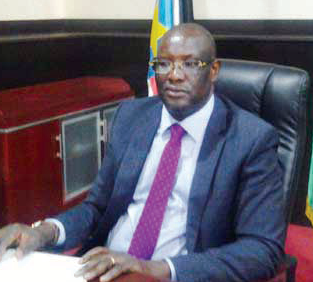
Paul Molong Akaro
By Victoria Ojeme
The United Nations Commission on Human Rights in South Sudan reported recently that a steady process of ethnic cleansing is underway in the country, involving massacres, starvation, gang-rape and destruction of villages. But the country’s Ambassador to Nigeria, Mr Paul Molong Akaro, in this interview, denies the UN report, describing it as false.
In July 2016, there was a resurgence of conflict in South Sudan between government forces and rebels. What is the current situation in the country?
As you are aware, in July, barely two months after the formation of the government, we came into another crisis which was created by then Vice-President Riek Machar, who again took us into the crisis in the process of implementing the peace agreement.
The population of South Sudan as a whole does not worth any war. We have had enough of it. Therefore, the people of South Sudan want peace; they want to go about their normal business like many other people around the world.
The experience in this continent is that when the political elite disagree over issues, they resort to this kind of action, subjecting people to unnecessary suffering. And our government, of course, is fully committed to the peace agreement. President Muhammadu Buhari is very clear on this issue and has assured me that Nigeria will continue supporting the peace process in South Sudan.
This is what we expect from a big brother like Nigeria. However, our government is on track to implement the peace agreement. As you know, Taban Deng Gai, the current vice president, took over from Dr. Riek Machar because they come from the same organization. And his leadership has decided to continue with the peace process instead of dragging the country back to war. He took a very bold decision to remain with President Salva Kiir to implement the peace agreement.

Paul Molong Akaro,
So, our government is now implementing the peace agreement with the help of the Joint Monitoring and Evaluation Commission. This is what is happening in South Sudan as I speak, and our government is on track to ensure that the peace agreement is fully implemented.
What is your reaction to the UN report that a steady process of ethnic cleansing is underway in South Sudan?
The UN Commission is not really saying there is ethnic cleansing. I think the report which was coming from the UN Human Rights division says there is a potential for such a thing to happen. But, of course, as a government, there is no such thing. The UN may get a different view based on the information they are getting but to us, there is no such thing. For ethnic cleansing, I think every leader in Africa tries to avoid the experience of Rwanda.
And I don’t think we will be in a position to subject our people to such a thing. Our government is working very hard. There is going to be a conference soon in South Sudan to talk about reconciliation as part of the peace agreement, because there is a provision in that agreement that calls for reconciliation of all the communities in the country. At all levels, that is going to be implemented soon. You know, our peace agreement also involves the civil societies.
The peace process is not only between the government and the rebels but also include the civil societies as part of the stakeholders. They will play a very key role to ensure that this particular provision in the agreement is implemented by organizing the bigger conference to talk about reconciliation and the way forward.
There has been a call on the UN Security Council to impose arms embargo on South Sudan to prevent the ethnic violence from escalating into genocide. Do you think that is a right decision to take?
We have been very clear on the issue of arms embargo because it has a very negative impact as far as protection and integrity of South Sudan is concerned. Imposing arms embargo on us would never help anything. You have good examples whereby some countries where arms embargo was imposed yet the conflicts continue. So what we need from the international community is for them to be with us.
The government has taken a very bold decision with the Sudan People’s Liberation Movement (SPLM-IO) led by the vice president, Taban Deng Gai to implement the peace agreement. And I think this is the only best option available for us to ensure that our people would not continue to suffer. But imposing arms embargo will never solve any problem because it will create a lot of instability in terms protecting our people. I don’t think it will be a wise idea for them to pursue.
There is a move for the deployment of more AU troops to South Sudan. Do you welcome that?
It is actually called the Regional Protection Force. Of course, we don’t have any objection to that. We have already agreed to the deployment of the force. But their mandate is very much limited. The details would have to be worked on at some point between our security and the forces coming into the country. This is to ensure that they don’t tamper with our sovereignty.
What are the mechanisms put in place to ensure the safety of foreign nationals in South Sudan?
It is the responsibility of the government of South Sudan to provide security to foreign nationals. Be rest assured that the government will do all it can to ensure that nothing happens to foreign nationals working in the country.
There was an allegation of corruption in the country’s oil industry. What is your government doing to ensure that the rich oil wells are used for the benefit of the population?
The oil money would be used for infrastructural development as well as other areas like education, health and agriculture. We have got huge potential in agriculture. We really want to use the oil revenue to develop the agriculture sector, so that we get sufficient food security and if possible, export to other countries. In South Sudan, unlike the other part of the continent, the land is still very much virgin and fertile.
Which area of the Nigeria-South Sudan bilateral relations do you plan to improve upon?
The diplomatic relations between Nigeria and South Sudan has crossed the threshold of four years. I’m fully aware of the great task and responsibility ahead of me, but I assure you that I will spare no effort to further strengthen and promote the friendly relations between the two countries and our people in all fields and at all levels of bilateral relations in order to promote global peace and security. Technical support is an area we would want Nigeria to help. Nigeria is already contributing to South Sudan in terms of training our prison warders.
The other area is meeting relevant institutions in the oil sector for us to see how best we can also benefit from their experience. Education and health sectors will also be explored. My minister of health was here two weeks ago.
We have already drafted MoU and once it’s been agreed and finalized, it will be signed between our ministries of health. The purpose is to have a technical exchange programme, so that we can benefit from the capacity and manpower Nigeria has. We will also be looking into areas that we have not yet explored to see how best we can share ideas for the benefit of the two countries.
Disclaimer
Comments expressed here do not reflect the opinions of Vanguard newspapers or any employee thereof.