
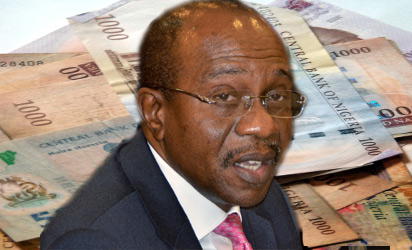
Governor, Central Bank of Nigeria (CBN), Mr Godwin Emefiele
*CBN sells N147.5bn TBs
By Babajide Komolafe
Financial Derivatives Company (FDC) has projected 18.4 percent inflation rate for November.

Governor, Central Bank of Nigeria (CBN), Mr Godwin Emefiele
Meanwhile, the Central bank of Nigeria (CBN) will today sell N147.5 billion treasury bills (TBs) in a bid to mop up excess liquidity in the interbank market.
According to the National Bureau of Statistics (NBS), inflation rate has been on the upward trend since December 2014. In October, the inflation rate rose to eleven years high of 18.3 percent from 17.9 percent in September.
In its Economic Bulletin released yesterday, FDC predicted that the increase in inflation rate persisted in November to 18.4 percent. The company also said there is public pessimism about the inflation figures published by the NBS and other research firms.
The company stated, “Headline inflation, the malignant tumor that is eating up the purchasing power of Nigerians, is expected to inch up marginally to 18.4 per cent. This will be the highest level in 11 years. The good news though is that if this forecast is correct, the incremental change in the price level is now down to a mere 0.1 percent. This means that the base year effect of 2015 is now losing steam and that we might witness a marginal decline in January.
“A further decomposition of the inflation survey reveals a decline in the month-on-month inflation to 0.74 percent (annualized 9.30 percent). This trend validates the notion of a withering base year effect on inflation and a likely convergence of the monthly and yearly rates of inflation.
“The Nigerian public is becoming more skeptical about inflation data released by the NBS and surveys by economists, including the FDC Think Tank. This is because anecdotal evidence conflicts with the published evidence. Many Nigerian consumers and manufacturers believe that inflation in Nigeria is more like 40 percent, almost double that of the empirical evidence.
“The inconvenient truth is that, inflation due to supply shocks has been reinforced by structural bottlenecks that strangulate supply increases. This blunts the impact of increases in quantity supplied. On the price level, the other factor for this divergence in data is the composition and weighting of the retail basket. A basket of mainly price inelastic goods will show a higher rate of inflation than a composite basket of elastic and inelastic commodities.
“The urban index continues to mirror the transportation/logistics differential. It also reflects the relative price inelasticity of the urban elite who have limited time for bargaining. The FDC Lagos urban inflation index increased marginally to 12.45 percent in November.
This is an increase of 0.03 percent from the October rate of 12.42 percent. The year-on-year food index increased to 15.49 percent from 15.16 percent in October while the non-food year-on-year index decreased to 10.92 percent from 11.03 percent.”
Disclaimer
Comments expressed here do not reflect the opinions of Vanguard newspapers or any employee thereof.