
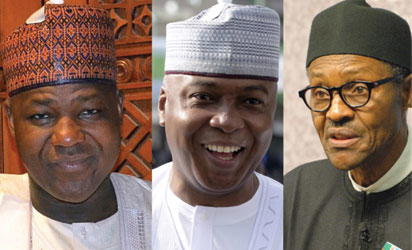
Speaker of the House of Representatives, Hon. Yakubu Dogara; Senate President, Dr. Bukola Saraki and President Muhammadu Buhari
By Dele Sobowale
HOPE RETURNS WITH 2017 BUDGET – IF WE BELIEVE IN OURSELVES.
“We should not allow ourselves to be discouraged by those who say we can’t find the money to fund the spending required to implement this budget. We must and we can, find the resources.” Senator Udoma Udo
Udoma, Honourable Minister of Budget and National Planning. “Ideas are capital; the rest is money.” Anonymous.
Distinguished Senator Udoma placed his fingers on the major point of disagreement between the vast majority of commentators who argue that the 2017 budget cannot be funded and the tiny minority, mostly in government, who are optimistic that the budget, in spite of the challenges faced by the country, still has a chance to reverse our fortunes and be ultimately regarded as a success by this time next year. “It is simply a matter of cash”, as we were told in the early 80s in one of the popular television series. If the price of crude oil were to suddenly fly up to $200 per barrel and the demand is up to 2 million barrels per day, Buhari will be an instant hero – just as Gowon was in 1973 when the price went from 30 cents a barrel to $3 a
barrel in one week and rested temporarily at $5 per barrel. Gowon’s government experienced such a deluge of dollars that the young Head of State pronounced that “money is not our problem, but how to spend it.”
Gowon did not create the dollar rain. The same global forces over which no President has control have also reversed themselves in the last three years brining the price of crude oil down to levels last experienced in 2004-5. Buhari did not create the situation. But, like Gowon, he has the problem – the reverse problem. In fact, Buhari might also declare that “Money is not our problem, but how to get it.” And, he will be perfectly correct.
Given the current pervasive economic pessimism resulting in every commentator telling Nigerians that “the 2017 is useless or cannot be implemented”, it is a dangerous risk, bordering on foolhardiness for anybody to raise his hand, in the midst of the pessimists, and say “I beg to disagree”. That is, precisely, what this series of articles are designed to do. They are designed to get those Nigerians who have not yet closed their minds and brains to consider the heroic possibilities which can make 2017 a glorious year for all of us. In this endeavor, there is an underlying strong belief that no Nigerian can hate his country so much as not to wish for the return of auspicious circumstances such as we have known in the past. But, if there be such people, this article is not meant for them. This is for those who still can hope and who are willing to work for a better future.
Still on the risk associated with swimming against the tide of public opinion on Budget 2017, I recollect a statement by the late Dr Martin Luther King, Jr, on March, 31, 1965, at the National Cathedral, in Washington, DC, USA.
“Cowardice asks the question – is it safe? Expediency asks the question – is it politic? Vanity asks the question – is it popular?
But, conscience asks the question – is it right? And, there comes a time when one must take a position that is neither safe, nor politic, nor popular; but one must take it because it is right.”
What follows is not safe, not politic, least of al popular. But, it is right. We need hope to survive the trying time ahead. What Nigeria needs now, more than ever, are people who believe in hope for the future – starting from 2017. But, just in case the reader gets away with the impression that this is some sort of a religious exercise in which readers are asked to have only faith, let it be made clear that nothing can be further from the truth. The arguments advanced are going to be based on economics, the budget as presented, the possibilities which the pessimists are overlooking and the signs of progress.

Speaker of the House of Representatives, Hon. Yakubu Dogara; Senate President, Dr. Bukola Saraki and President Muhammadu Buhari
The best place to start is with the point made by Senator Udoma about not allowing “ourselves to be discouraged by those who say we can’t find the money.” Literally, thousands of people have made the same point such that you would imagine it was divine revelation. So, I took the budget, left Lagos and went into a three day personal retreat with one question in mind: Is it true that we can’t find the money? Don’t forget this argument is mostly about money, or its synonym “resources”; and how much we can mobilize in 2017.
The best known author of the “can’t find the money doctrine” is HRH Lamido Sanusi, Emir of Kano and former Governor of the Central Bank of Nigeria, CBN. Sanusi had made the point that with three or four exchange rates operating in Nigeria, nobody will lend us the funds we need to borrow. Predictably, this had become the gospel for those seeking for an argument to shoot down the entire 2017 budget. But, is it true that with multiple exchange rates nobody will lend?
Unfortunately for the chorus singers, nothing can be further from the truth. The verdicts of history and our experience don’t support that blanket dismissal.
Since Nigeria hit “gold” with crude oil money in the 1970s there had never been any time we operated with a single exchange rate. Those of us working for multi-nationals, who were able to collect travel allowances (Travelers’ Cheques) knew we were privileged. In fact, the first set of “currency runners”, called ARRANGEES, opened shop in those days and even though the Naira was officially non-convertible, it was available in all the major centres of the world – London, Paris, Saudi, Lebanon and throughout ECOWAS. The rates were never the same. Yet, Nigeria never failed to raise funds when needed.
The partial liberalization of foreign exchange transactions, during the Structural Adjustment Programme, SAP, under Babangida, brought in the era of round-tripping and continued the regime of multiple exchange rates. That also did not stop lending to Nigeria. The sooner we stopped behaving as if an “oracle has spoken” on contentious issues, when “those who should know” talk, the better for all of us.
To the best of my knowledge, all the lender wants to know is that he stands a reasonable chance of getting his money – capital plus interest — back as and when due. So far, Nigeria has a good track record of repayment; there had been no threats of defaults since the days of SAP. The more pertinent question is: what does government want to do with the money? That, however, is a question for another day. As Udoma said “we must, and we can, find the resources.”
At this point the reader is probably asking: how then do we find the money?
The answer to that question can be long or short. But, part of the answer was only briefly touched upon by the Minister in his presentation. When the Minister talked about “Broadening the tax base, improve effectiveness of revenue collecting agencies, improve tax compliance etc”, he probably did not have the latest figures from the Federal Internal Revenue Service, FIRS, revealing that only 13 million individuals and organizations pay taxes in Nigeria – with a population
of at least 80 million adults. Of the 67 million others still outside the tax net, at least half earn more income than civil servants whose taxes are deducted at source. In Lagos State, several thousand developers earn far more from rent than their tenants without paying a kobo; hotels and guest houses operate without licences and religious organizations engage in business which has nothing to do with worship (e.g. they buy shares and make capital gains; establish housing estates, etc. etc). The scope for increased tax revenue is so vast given the low compliance rate that the question should be: how quickly can the states and the Federal government get to the tax dodgers and criminal defaulters with mansions at Banana Island, Asokoro etc.
Furthermore, money comes in several forms – local currency, foreign currency, credit lines, grants, gifts and loans. The money required depends on the purpose for which it is being raised. Most salaries and entitlements in Nigeria are paid in Naira; so the critical thing is to raise the Naira revenue, better tax collection being one of them. Increase of the Value Added Tax,
VAT, from five per cent – which is below global rates – to 7.5 per cent could increase VAT revenue by at least forty per cent. Even the 7.5 per cent is still low. Return of toll gates should not only provide significantly increased income to governments, it will provide the funds for highway maintenance on a sustainable basis. Some of these are adequately captured, although in muted tones, by the Honourable Minister. But, those who were predisposed to rejecting the budget even before the first lines were written are not reading and thinking. It is extremely difficult to read the entire presentation with an open mind without agreeing with some of it. Don’t get me wrong; it is not perfect. But, it is not dustbin material either.
Let me close this first part by pointing out that the budget was largely prepared in draft form long before the current exchange rate escalation occurred. Thus, the N305/$1 presents another opportunity for increased naira revenue. Currently, the exchange rate is racing towards N500/$1. Obviously, when the budget implementation begins in 2017, the CBN rate will shift upwards. Even a shift to N400/$1 will generate thirty per cent more naira revenue for government.
That still leaves the question: where will the dollars come from? Or better still, will anybody ever lend Nigeria $30 billion? Wait till next week for that answer.
But let us talk about those in government and the enormous challenges they faced since May 29, 2015. A Minister under IBB once suggested how circumstances beyond control can make extra-ordinarily capable people look incompetent in public
service. He summarized the situation this way. “As you know, I was a successful manager when appointed Minister. But, I had spent years with the organization before reaching the top. So, I knew the organization well.

Udoma-Adeosun-Emefiele
“Reaching government, I felt like someone who had walked from bright sunshine into a dark room. At first, I couldn’t see anything. I knew nobody on the staff; I did not know who was reliable and who was not.
The Head of State told me he wanted the place straightened out, but, the people I have to work with are the same people who created the mess. For at least six months, I was a captive of those people. It took a full year for me to begin to understand all the units under me and to start thinking of the changes to make. Meanwhile, people in the media were demanding for results. I didn’t know what the problems were; how could I provide solutions? On the eighteenth month, just as I was putting together a grand plan for reform, the cabinet was changed and I found myself in a new Ministry.
“It was darkness all over again. In all fairness to the Ministers and the entire team appointed in late October 2015, they have been operating in the dark for twelve months. They are now just beginning to see some light at the end of the various tunnels in which they found themselves. And for that reason alone, things will be better next year.
Disclaimer
Comments expressed here do not reflect the opinions of Vanguard newspapers or any employee thereof.