
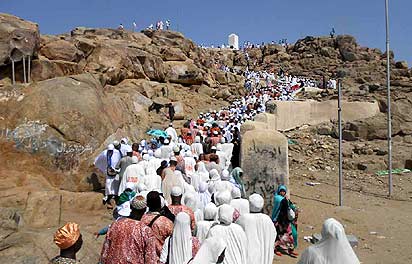
*Ogun Pilgrims at Mount Jabalithaor one of the holy sites in Makkah
By Haroon Balogun
The Islamic month of Rabi ul Awwal has begun. Prophet Muhammad, peace and blessings be upon him, was born on the twelfth day of this month, and a number of Muslims around the world often celebrate with songs, poetry, special events, and various other tributes. In Nigeria here, it is a season of maolid meant only to make money for groups and societies. The fundamental aspect of what we should reflect on are repeatedly missing.
Sadly, instead of sober reflection, teaching people how to make the Holy Prophet come alive, people organise celebrations in the name of the birth of the Prophet to do other things throughout the year; from Rabiul Awwal to Shaaban. If not the reverence of f the month of Ramadan, it would still have continued even to Zhul-Hijjah.
The question is that, are we actually reflecting on his examples? Are we following his legacies? And are we really inspired by what we have read about him or are we fashioning our lifestyles the way he lived his? His he our role model?
At a time of economic and emotional upheaval, a time when Muslims struggle to deal with pressures in and outside the home, when Islamic identity has become a rare phenomenon, we need look at the Prophet’s life style and pick a few things to better our lives and the hereafter.
It is at this time that Prophet Muhammad, peace and blessings be upon him, becomes especially relevant as a role model, the “beautiful example” to humanity, as he is described in the Quran (33:21).
We sent you not except as a mercy for the worlds. (Q 21:107)
Kindness to all
May Allah guide us to emulate the truly inspirational Prophet, the man who was a mercy to the worlds (Quran 21:107) and a beautiful example in times of hardship and ease in this temporary world of ups, downs, and everything in between.
Some of the things we can imbibe from his lifestlyes which are relevant to the harsh realities we are going through include
The Prophet Muhammad taught love, kindness and compassion to his people, and was seen to be the most loving, kind, and compassionate of all of them. The Quran mentions his kind and gentle behavior in these words: “O Messenger of Allah! It is a great Mercy of God that you are gentle and kind towards them; for, had you been harsh and hard-hearted, they would all have broken away from you” (Q3:159)
There are many instances that show his kindness and gentleness, especially to the weak and the poor. Anas, who was his helper, said: “I served Allah’s Messenger for ten years and he never said to me, ‘Shame’ or ‘Why did you do such-and-such a thing?’ or ‘Why did you not do such-and-such a thing?’” (Bukhari, 2038).
Once he said to his wife: “0 ‘A’ishah! Never turn away any needy man from your door empty-handed. 0 ‘A’ishah! Love the poor; bring them near to you and God will bring you near to Him on the Day of Resurrection”. He also went much further on to say: “Seek me among your weak ones, for you are given provision, or you are given help only by reason of the presence of your weak ones”. (Rahman, Encyclopedia of Seerah, VOL. VIII, p. 151) God Almighty is Kind, and the Prophet imitated Allah’s example in its perfection by showing kindness to his servants and all creatures without any regard for their beliefs, color or nationality. The Prophet said: “God is kind and likes kindness in all things” (Bukhari, 6601).
Feed the hungry
Feeding the hungry was one of the Prophet’s regular tasks, even as he and his Companions suffered unbearable hunger. Make it a point of duty to find out who is hungry and the person is fed. This is a good cause in making the society better. If you are fed, remember those without food in your area. Never go to bed fed while your neighbour is hungry. This is a practical way to connect with the Prophet. If possible, organize a day and volunteer to feed those in need, as the Prophet did.
Manage your Anger
Control your temperament. Sometimes, issues that will make you too furious and act irrationaly will come up, but toe the line of the Prophet and dismiss all attempts to provoke you into doing something bad. No matter the offence, forgive and say: “I seek refuge in Allah from the accursed Shaytan.”
Eat together with your family
The Prophet said, “Eat together and not separately, for the blessing is associated with the company” (Tirmidhi). Studies have shown that when families eat together, everyone’s nutrition improves, along with communication between family members. Although it may be somewhat difficult going by how men in this part of the world stay away from home fending for their families, but once we make it a priority, we will achieve it within the little time that we have with them.
Treat women kindly
In his Farewell Sermon to the people, the Prophet said: Treat women kindly, since they are your helpers; . . . you have your rights upon your wives and they have their rights upon you. Your right is that they shall not allow anyone you dislike to enter your bed or your home, and their right is that you should treat them well.
Once a number of women complained to the Prophet’s wives about their ill-treatment by their husbands. On hearing of this, the Prophet said: “Such persons among you are not good persons.” (Abu Dawud, 1834). This condemnation by the Prophet himself was an indication that no one will be accepted before God who, while on earth, decided to be unkind to women.
Another person said to the Prophet: “O Messenger of Allah! My relatives are such that although I cooperate with them, they cut me off; I am kind to them but they ill treat me.” The Prophet said this in reply: “So long as you continue as you are, God will always help you and He will protect you against their mischief” (Muslim, 4640). This was not only a way of bringing comfort to the mind of the worried person but one of the communicative techniques of the Prophet to assure who ever found himself in that situation to look up to God to be consoled and protected. So it was pointless to preach vengeance to this kind of people suffering from this similar fate. Indeed, Prophet Muhammad was nothing short of a competent counselor.
Disclaimer
Comments expressed here do not reflect the opinions of Vanguard newspapers or any employee thereof.