
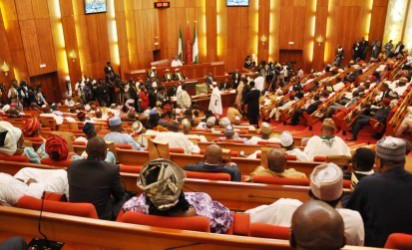
SENATE CHAMBER
By Tonnie Iredia
Not many Nigerians have faith in their legislators. This is because the level of education of the average Nigerian legislator is so low that many of them have no business in the law making body. If so, why are they able to get in there? First, our funny constitution allows it.
According to Section 106 (c) of the Constitution of the Federal Republic of Nigeria (1999) any Nigerian citizen can be a member of a State House of Assembly provided such a citizen “has been educated up to at least the School Certificate level or its equivalent.” There is no additional information as to what the constitution means by “school” which suggests that persons educated up to the primary school level qualify.
Indeed, anyone who did not go to any formal school but can read and write may qualify as persons whose education can be said to be equivalent to at least the primary school level. Whether or not kindergarten graduates also qualify is arguable. Interestingly, the same nebulous provision which opens doors to every Tom, Dick and Harry is reproduced for membership to the National Assembly in Section 65(2a) of our constitution.
Perhaps because virtually anybody can qualify to be a member of the legislature in Nigeria, wealthy citizens sponsor their spouses, children, relations, house helps, cooks errand boys and other malleable persons to the legislature to be used for dirty jobs. For such fronts, the content of a bill or motion on the floor of the legislature is not their business; theirs is to vote in favour of the sponsor’s position on any subject.
This is perhaps the best way to understand the overwhelming culture of irrationality in our law making bodies. Only last week for instance, legislators in Edo State began to scheme (not to discuss) in this period of recession, the allocation of no less than N300 million to build mansions for the state’s former governor and his deputy.
The House did not consider the high degree of suffering occasioned by unemployment and non payment of staff salaries as well as pension and gratuity of retirees in the state. No, what matters to the members is a befitting farewell package to their erstwhile sponsors. The premise of this article therefore is that a better educated body would have taken time to articulate and examine the issues at stake and how insensitive the subject might look like with respect to the plight of those whose votes are often appropriated during elections.
If we are not careful, the subject might soon degenerate into palpable violence in line with the tradition of the House. This is because our law makers have successfully developed a trait of unwittingly putting themselves up for sale. Once compromised, they are never painstaking enough to add a bit of logic to their bizarre conduct thereafter.
The goal is always to do what the Oga at the top desires. In February 2010 for example, the legislators violently ousted Speaker Zakawanu Garuba. The event was seen in some circles as materially influenced more so with the presence of law enforcement officials within the Assembly complex along with ambulances and medical doctors who had been arranged there to administer first aid.
The violent removal of officers happened again in Jun 2014. In May this year, the legislators wanted to change their leaders once more. According to reports, 16 out of 24 members of the House wanted the change, but curiously such a majority could not peacefully have its way. Instead, hoodlums who were on standby in the premises released gunshots as an institutional statement which suggests that the assembly was teleguided.
We cannot distance this approach from the standard of education of the legislators more so as the approach is at play across the nation. In 2012 when somebody wanted the deputy governor of Taraba State, Sani Abubakar Danladi out of office, he merely mobilized legislators to do the job.
The alleged misconduct of Danladi which was serious enough to warrant his impeachment by the legislators was that he used his office to attract favours and development to his local community. Meanwhile it is difficult to find a university established by a governor in any location other than his own place of origin in Nigeria.
What happened in Taraba was therefore an excuse by a compromised legislature to engage in political rascality. In 2013, Imo State Deputy Governor Jude Agbaso was impeached for corruption perpetuated by his governor’s trading partner. Deputy Governor Onyebuchi suffered the same fate in Enugu State in 2014.
Although State Governors often dissociate themselves from such acts, they are never able to disabuse the minds of the public over rumours of how much each legislator got to function like an over-grown house-boy. Painfully, their alleged inducement often runs into millions of naira from the public treasury- a recklessness which is part of what has brought our economy to its current poor state.
Why for instance did the Enugu State Government attempt to buy Prado jeep cars for its legislators at a whooping sum of N11.5million per car? Does it have anything to do with the public perception that once our law makers are induced materially they can take to fighting to achieve the sponsor’s goal? Does such an empowerment explain how at the beginning of Governor Fayose’s tenure, only 7 Ekiti legislators were able to chase away 19 of their colleagues? Can such material benefit also explain what happened in Niger State during the tenure of the Chief Servant when legislators removed a speaker from office after 48 hours of his appointment with the charge of poor performance? Can it also be why Speaker, Momoh Jimoh Lawal, was removed from office by 5 legislators in Kogi State?
Whatever is the motivation, Edo legislators need to note that their citizens who need help cannot include a governor and his deputy who for 8years had an opportunity to save their salaries while being cared for by the state. It is thus ludicrous for our legislators to lavishly care for such favoured citizens at a time like this when even the federal government is reportedly unable to pay salaries and allowances of former Presidents. May be we need to agitate for the amendment of the constitution which opens the door for any person to be a legislator.
Disclaimer
Comments expressed here do not reflect the opinions of Vanguard newspapers or any employee thereof.