
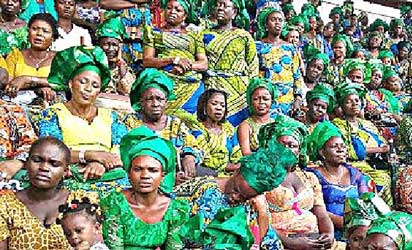
women
By Denrele Animsaun
“Educating the mind without educating the heart is no education at all.”—Aristotle
No child should be left behind” is often a charge decried by many progressives. Mostly, it is often merely words unless it is backed with actions. The United Nations has issued a desperate warning that 75,000 children in Northern Nigeria are at risk dying in “a few months” due to hunger as a direct result of the Boko Haram insurgency. Millions have left their land, livelihood and lost their businesses as insurgents have left tens of thousands dead in its wake.
The UN have declared that the crisis is “unfolding at high speed”. Currently, it is estimated that 14 million people are urgently in need of humanitarian assistance and 400,000 children are in critical need of assistance, while 75,000 mentioned could die “in (the) few months ahead of us”, according to the UN spokesperson in Abuja.
Right now, the Nigerian government and affluent citizens could and should help to reduce the catastrophe. The UN does not have enough money to avert this disaster without the help of international partners, the private sector and they are appealing to Nigerian philanthropists to “join hands” to enable the UN to tackle the problem.
Every second counts, in a matter such as this, and it is about time that those that have the means to help are morally motivated to help and that they do so, most urgently. This is a national disaster, a humanitarian tragedy so it is not beyond the help of many well-heeled Nigerians to help their fellow Nigerians. So why are they not coming forward and offering truckloads of food, camp materials and medical equipment for the displaced? I would like to think that there are many decent affluent Nigerians across the religious and tribal divide who are capable of charity and common decency.
Their reluctance does not help and people outside Nigeria would find it difficult to comprehend why in a country full of billionaires and millionaires that they are not coming forward nor is its government actively committed to stemming the pending disaster. Why are there no national drive to help the hungry and the displaced? This reflects badly on Nigerians and the protracted non-action speak volumes; that Nigerians cannot help their own without whipping out the obligatory cap and go begging for money that is often misappropriated by the greedy not spent on this desperately in need.
UN went on: We will ask international partners to step in because we can only solve this situation if we actually join hands.” Can the NIMBYs (not in my backyard) , This is your backyard! Nobody ever becomes poor by giving and life has a way of a rewarding random act of kindness.
The UK wants to reduce Maternity Tourism
The UK is clamping down on health tourism and they are more determined than ever to plug the loop hole for those whose sole purpose is to visit the UK, to use its free health services. The lawmakers are proposing that prior to non-UK or non-European Union citizens presenting for treatment in any UK health organisation, potential patients have to show two forms of identification including a passport to prove they are eligible for free treatment.
This proposal is not new but it is quite controversial in a country that prides itself on its health systems that it is free at the point of delivery. This free treatment now comes with a condition, if you are not British or from the EU nations, it will cost you. As you know, many Nigerians do come to the UK to have their children so that the child automatically becomes a British Citizen. Childbirth in the UK hospital does not come cheap, it costs over £6,000 for every non-complicated birth and with the UK in recession and it has financial implications on the high costs of the National Health Service. Therefore the government is seeking to tackle those abusing the system. This method is quite familiar in many other countries, except in those places, money is presented first before treatment. The issue here is that the move is mainly directed in areas where there are a high number of immigrants, so one wonders if there is more to meet the eye but I do think there will be a lot of stereotypes and racial profiling to ascertain who is entitled to free treatment and who is not.
Chris Wormald, the Department of Health’s permanent secretary, told the lawmakers that “On the general question of are we looking at whether the Trusts should proactively ask people to prove their identity to come with two forms of identity, passport and address, and they use that to check whether people are eligible. It is quite a controversial thing to do, to say to the entire population you’ve got to prove your identity.” It is quite controversial and may prove divisive.
There are also ethical issues where health professionals in the UK have registered their concerns and they do not see themselves as passport officers when people are seeking medical intervention. It will be difficult to see how this will be implemented. They argue, that the move contradicts their Hippocratic oath that compels them to do no harm. A spokesperson for the British Medical Association said: “Ensuring eligibility for NHS services is always important, but these proposals go much too far and it is unlikely they could ever be turned into a serious policy that would be accepted by patients and the public, that is, showing your passport before undergoing treatment.”
However, there are some hospitals already piloting the scheme in areas where it is deemed that “maternity tourism” is prevalent. In a South London hospital, expectant mothers are told to provide papers or documents that indicate their eligibility for free treatment on arrival for scans and those who are unable to provide adequate papers are reported to relevant authorities and they could face deportation. And for those Nigerians who are considering a British birth, be warned that changes are afoot.
International Day for the Elimination of Violence against Women
“For every woman and girl violently attacked, we reduce our humanity” – Nelson Mandela
The 25th of November is the International Day for the Elimination of violence against women. Nigeria has got an uphill battle to help reduce the high rates of violence against women. Nigeria is not the only country that should clean up its act, but the statistics on domestic violence in Nigeria is indicative that Nigeria is far worse than many countries and according to National Population Commission (NPC) [Nigeria] and ICF Macro. 2009, Nigeria has one of the highest rates of domestic violence in Africa.
This is not the case but we will have to shine a light on what we can do better to improve the lots of women and girls in Nigeria.
Two-thirds of Nigerian women are believed to experience physical, sexual and psychological abuse at the hands of their husbands.
A small scale study conducted in Oyo and Lagos states indicated that 65% of educated women are abused about 56% blue collar or market women experience similar attacks.
The African Journal of Reproductive Health in 2005 referring to Nigerian men: “a husband has the liberty to “violate and batter” his wife if he feels she has not adequately fulfilled her obligations”.
Amnesty International calls Nigeria’s rate of domestic violence “shocking,” and it has called on the government to do something to stem the violence that: “On a daily basis, Nigerian women are beaten, raped and even murdered by members of their family for supposed transgressions, which can range from not having meals ready on time to visiting family members without their husband’s permission.
Domestic violence affects not just the victim but indirectly all those who witness the violence; children, family, relatives and witnesses to the physical abused and violence. It predisposes the children to trauma and other psychological problems throughout their lives and alarmingly, they may learn to become future or victims abusers later on in life and hence, the cycle of violence and aggression continues. Incidences of domestic violence cuts across the social and economic backgrounds and although women are mainly victims and men, mainly are perpetrators of domestic violence, women, are increasingly becoming perpetrators of domestic violence too. According to the National Demographic and Health Survey in 2010, over a quarter of the population of all women in Nigeria have experienced domestic violence. Yes, over a quarter, that is 1 in 4!
Time to stop pussy footing around the subject; Nigeria has a problem and one that is embedded in everyday attitude and behaviour so normalised that people assume that it is no big deal. Violence does not solve anything; in fact being violent is a sign of a weak person, a bully, someone who lacks self-esteem and often someone who lacks control.
The relevant ministries, departments, educational bodies, enforcement, legal and health services have to review and implement a robust plan to curb the rates of violence and seriously promote public education aimed at institutions, households, hairdressers, barbers, workplaces and all educational institutions that there the government is committed to reducing and eliminating violence against women. Talk is indeed cheap and a top to bottom approach is the key to its success.
Too many women and girls have died and many, more are scarred emotionally and physically due to this endemic violence that plagues women and girls in Nigeria.
Disclaimer
Comments expressed here do not reflect the opinions of Vanguard newspapers or any employee thereof.