
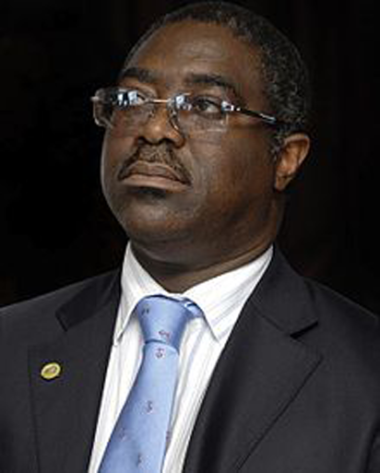
Babatunde Fowler
By Henry Umoru
ABUJA—THE Senate, yesterday, rejected the 2016 budget of Federal Inland Revenue Service, FIRS, forwarded to it by the Executive for approval, citing questionable inclusion of capital projects which it declared had been a yearly ritual of revenue generating agencies of government.
It also warned Ministries, Departments and Agencies, MDAs, ahead of presentation and defence of 2017 budget, that the days of partially prepared budget were over, adding that it would no longer be business as usual.
The action of the upper Chamber came four months after President Muhammadu Buhari forwarded the 2016 budget of FIRS.


Babatunde Fowler
It would be recalled that President Buhari forwarded the budget to the Senate on July 21, and was, thereafter, referred to the Finance Committee, led by Senator John Enoh, PDP, Cross River Central, for further legislative action on July 25, 2016.
Senate said it refused to pass the N146.16 billion budget of FIRS because of the shady exercise of the Committee on Finance.
Presenting the report, Enoh said that the committee recommended that a total expenditure of N143.722 billion be approved for FIRS in 2016.
But the Senate rejected the report of the committee due to the poor preparation of the document.
The Senate believes the report submitted for consideration yesterday supported the committee’s position that more oversight of the budget was necessary and that supporting budget justification information was sorely needed.
Some senators were concerned that the FIRS budget submission was poorly compiled and, therefore, incomplete.
Already the Senate has rejected the request for $30 billion international loan by executive arm of government due to lack of supporting documentation and details of where the expenditures would be allocated.
Giving a breakdown of the proposed FIRS budget for 2016, Chairman, Senate Committee on Finance, Senator John Enoh said: “The Federal Inland Revenue Service, FIRS, projected to collect tax revenues to the tune ofN4.082 trillion in 2016. This comprises of N484 billion oil revenue and N3.597 trillion non-oil revenues.
‘’The projected 4% cost of collection on non-oil revenue is N143,904,640,000 billion. The total projected available fund for 2016 budget is N146,165,108,293, comprising 4% cost of collection and N2,260,468,293, 20% of 2015 operating surplus.
“The summary of HRS proposed 2016 total expenditure is as follows: Personnel N64,491,130,526; overhead N46,363,000,000; capital N32 868 300 000; total expenditure N143,722,430,526.
“The committee made the following observations: That in compliance with Section 15 (a) of FIRS Act, 2007, the Service submitted its 2016 budget proposal to the Senate and House of Representatives Committees on Finance and appeared before the joint committee for budget defence,
“That the projected non-oil revenue collection has increased from the 2015 collection, thereby increasing 4% cost of collection to the Service to N143, 904, 640, 000 from N104,723,880,000 in 2015;
“That the total personnel costs are for salaries, wages, allowances, performance bonuses, and social contributions. The 8,000 staff are proposed to be on the payroll during the 2016 financial year, which accounts for the increase of 19% above actual staff strength of 6,748. The projection presumes a recruitment of new staff in 2016;
“The overhead cost is very vital in driving the achievement of FIRS core objectives of tax revenue generation. The provisions in 2016 budget give more emphasis on availability of office materials, training, consulting and professional services and publicity.
“That the capital cost estimates proposed includes ongoing projects, which are to be completed during the 2016 financial year, as well as new projects to be carried out.
‘’These projects include new corporate headquarters and other prototype offices, construction of new offices nationwide, ICT projects.”
Enoh’s explanation did not go down well with some lawmakers, particularly the Senate Deputy Leader, Senator Bala Ibn Na’Allah, APC, Kebbi.
Na’Allah, who stood in for the Senate Leader, Senator Ali Ndume, moved that the report be stepped down as that would give the committee more time to correct the observed lapses.
In his remarks, Senate President, Bukola Saraki, who took a swipe at late submission of budgets of government departments and agencies, especially revenue generating agencies as the FIRS, however, warned that going forward, budgets of special agencies not included in the yearly budget must be submitted not later than the first quarter of the year.
Saraki said: “I will partly blame these things on the late submission of budgets. This practice where government agencies send their budgets late to the National Assembly and expect them to be passed immediately will not be tolerated.
“They must submit their budgets early so that we can have enough time to work on their proposals. If we do that, these issues we have here will not arise. The relevant committees should take note of that and ensure that the right thing is done.”
Saraki, thereafter, ruled and returned the report to Senator Enoh’s committee to tidy it up and report back within one week.
The FIRS, established in 2007 by an Act of the National Assembly, is one of the federal government’s revenue generating agencies and its overall mandate is to collect taxes for the federation and enforce compliance with tax laws across the federation.
Disclaimer
Comments expressed here do not reflect the opinions of Vanguard newspapers or any employee thereof.