
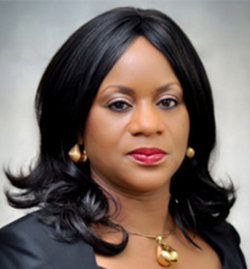
Audrey Joe-Ezigbo
By Morenike Taire
“The gas lady” is the nickname Audrey Joe-Ezigbo, co-founder and executive director, Falcon Corporation Ltd., is hailed by many of her friends and associates. Yet, it would surprise many to discover her entry into the oil and gas sector was by accident. Confronted by the reality of gas flares while executing a project in South-Eastern Nigeria, almost two decades back, she stumbled on the resource that would come to define the organization she leads and represents.
Nevertheless, it is an industry to which she is not only committed but one upon which she firmly believes the solution to our electricity woes is hinged.
A chat with Joe-Ezigbo has the tendency to soon turn from a lifestyle inquiry into an unprecedented insight into the subject about which she is most passionate. And this is exactly the case just barely weeks after the Nigerian Gas Association 2016 annual conference, which rose from Abuja recently.
The winner of the ‘Ernst & Young Entrepreneur of the Year West Africa 2014’ award who holds four academic degrees.
Coming from outside of the oil and gas industry, what drove your choice of the industry to invest in? Moreso, the oil and gas industry has been dominated by multi-nationals.
We were a bit naive but it was also something that has worked for us over the years because as we began to understand the industry more in those early days, one thing that stood out for us was that, in a lot of strategic management positions, you will see the expatriates handling things but the real work was actually being done by our people and that sort of spoke to us in terms of what we can do and we made our own commitment back then that whatever we will achieve in the industry, we will achieve it with Nigerians through Nigerians. It was a position that cost us many opportunities back then so, it was a bit slow in the beginning because we just maintained that Falcon was going to be completely indigenous and that was 1994, 1995. It has been validated and now having legislation mandating for that to happen.

Audrey Joe-Ezigbo
Falcon participated in the recent Nigeria Gas Association conference in Abuja. What was the takeaway for Falcon? And how are you harnessing the opportunities that emerged from the meetings?
I have been sitting on the NGA Exco for the last 8 years and so our engagement has been both in terms of inner workings of the council and as a player in the industry. We have come to a point, where the industry is almost at a standstill. All our aspirations as a nation in terms of diversification are hinged on one key thing and that is the power sector. Whether we have all sorts of innovative technologies, they are not going to take away from the fact that gas to power is the critical link in the chain.
As the minister announced the draft for the National Gas Policy was also released and speaks particularly to a restructuring of the entire industry, creating room for a segregation of the upstream, midstream and the downstream and allowing for private sector investment to come into all those various spaces with government regulations but not the way it is now. Therefore, the conference opened our eyes to how we can progress some of the strategic opportunities that we had already identified.
Falcon has made its marks in the industry but not without attendant challenges.
There are some kind of businesses that we refused to do but we hold ourselves as a company that is very strict on the ethics of the business and unfortunately the landscape has been riddled with all sorts of corrupt practices, sharp practices.
(Cut in) What would you attribute those to?
It is not isolated from what is going on in the country. In places where you see that people are well remunerated and they wouldn’t need to do certain things but you will still find out that there are people who have what they call “my day job and my night job”. The day job is a job with an IOC, the night job is the private business they do to compete for the same projects that you the independents are competing for.
On the technical side of things, it is the constraint of not manufacturing what we need locally, so with your best local content aspiration, there are still some things we need to rely on in the international market. A lot of training, development has to go into that space. We have some banks, which are doing what they consider long-term funding, which is a joke – for instance, a bank is telling you 3 – 5 years. 3 – 5 years in oil and gas is short-term. Talking about the foreign exchange aspect of it from the aspect of our business where we are acting as a government agent, it is a bit untidy but I see streamlining of that as the industry is trying to move itself forward.
Falcon Corporation was appointed into a Lagos State Government Special Committee on Power called Light up Lagos Committee under the leadership of Governor Akinwunmi Ambode. Could you let us into how your firm made the committee membership?
What Governor Ambode tried to do was to look at who are the strategic players in the space. Government has a huge aspiration in terms of powering up Lagos and this is an offshoot of what former Governor Fashola started and I’m happy to see that consistency and continuity. Falcon is the LDC that is in charge of the Ikorodu gas franchise and that has been identified as one of the key points to enable gas supply that will back all the plants around power. It makes sense that we be on the committee. A lot of work has gone on and I can’t speak beyond that, except you see that there is a robust roadmap that has been developed, a lot of technical validation is going on currently. But certainly, we understand our role as enablers in that process to make sure that the gas requirement is met.
Do you see more of that happening in other states of the federation?
I believe so. For instance, if I am an investor that has identified a niche that I feel that I can deliver power to, I should be able to do that and make it attractive for others to want to buy. It increases competitiveness which will ultimately bring down prices and then the objective is for us to have a vast power technical base so that every other thing can flow. Government should be an enabler but ultimately it is not achievable without the private sector.
What is the nature of the reforms in the oil and gas sector by the current administration?
Have we really moved forward? If you look at the tangibles, are they well worthy of the large pronouncements that have been made? Or is it too early to tell?
A lot of strategic think tanks that were set up to look into the reformation of the oil industry, look into the gas industry, the segregation of those industries, the clear segregation of the upstream, mainstream, downstream, to see how to streamline it, take away this undue government interference in that industry and create a very private sector-driven landscape that is competitive. We are not just seeing policies being pushed at you.
The bigger challenge now becomes the implementation and that is where time will tell. Currently in the power sector, one of the biggest challenges we are facing is that of illiquidity and everybody is blaming the Discos, but when you begin to roll back along the value chain, you will see that the issues that will make it possible for the Discos to default, if that is the case, actually stem from way back. From the MYTO framework, what are the benchmarks? Even the dollar rate that is used there is 196/197.
The current administration under Kachikwu has separated gas from oil. Now they are saying, we are going to have gas sector and there is $51billion worth of investments that is available.
We had taken position before we got to this point and I am sure with a lot of seasoned investors, that has been the situation. Therefore, the things we tried to do have been ahead of the policies and the policy is only validating that this is the direction we should go. In the LPG space, it was very clear to us that this is the direction. Ultimately, that kerosene subsidy must go because it is not sustainable, it does not make economic sense, environmental sense and so on. The question then is, who are those investors who are savvy enough to take position ahead of what will certainly be a transformation? Hopefully those who know what they are doing come into the space because we don’t want a situation where money is just chasing opportunities without technical know-how to back it up.
How do you think that could be prevented?
It is looking at the framework that has been set. Who is coming to the table? What are they brining apart from the dollar? How does the nation benefit? We are signing billion dollar deals with the Chinese government but nobody is looking at training more people to speak Mandarin. They bring in their people, they don’t understand us, we don’t understand them and when they are going they are taking everything back
If you want to do any exploration, you have your gas development plan already. There is a clause that if you have not actualised those gas development plans, by the time you need to do a renewal round, you will lose your licence. We want to hang on to those local content demands that we are placing so that no matter what happens, we are assured that that institutional knowledge is not lost.
Several global reforms are pushing for clean energy. How does that portend for growth in natural gas demand and revenue opportunity from that sub-sector?
Natural gas plays that key role because we know the environmental benefits. I also believe as a nation, we need to start paying more than lip service to the issue of carbon credit. Once you can translate it directly to their own business bottom line, then you will see we will begin to aspire.
There seems to always be a controversy on natural gas pricing in Nigeria. Is there a thing like appropriate price for natural gas for the country?
What I think is the appropriate is that it has to be market-driven. I should be able to negotiate directly with you as a gas seller for what works from the project point of view. Now people argue about the end cost to the end user and I agree it is not easy. Already, the power pricing is an issue; mind you, the dollar rate in the pricing framework, is not realistic. Let us wear the shoes of the investor; where are they supposed to get their returns from? Yes, if they bring it up to the realistic pricing at the current rate, will the man on the street be able to pay? That is the conversation you hear at the other end. We have spent decades destroying value and unfortunately, every time you want to recreate a system that has been grossly eroded, what happens is that some people will suffer and it is not just the man on the street. The deregulation of the downstream petroleum sector, for instance, is a case in point. Now, it is a case of the players removing N1 to make a sale. But now, we are dealing with our current prices, everybody has made the adjustment and that sector is moving forward. We need to just undertake that same mind-set as far as every other sector is concerned.
You seem very much in gas administration in the country. What has been the advantage?
We are coming from an era where even our regulators, many of them don’t understand the industry. You are not able to just step back and say I’m just running my company and many things are going on and you are not able to advocate for what should make sense. At the Nigerian Gas Association advocacy is the number 1 out of the 4 value pillars that we are standing on. I’m not building a business that will die with me. I want a business that lasts well after I am gone and is still ready to survive and thrive and add value. When you look at the National gas master plan, the ideals were lofty but were actually achievable with concerted effort – how do we optimize our gas resources on the domestic front; how do we make Nigeria the most attractive gas market for export? How do we build up infrastructure network? They actually made provisions that supported the local content. Very robust. The country is currently littered with power plants that have no gas. interconnectivity only happens on the backbone of the master plan so if I go to wherever and I want to start a power plant I can visualize my nearest connect for gas supplies.
There has been some controversy regarding the PIB bill. The National Assembly while waiting for the executive to present the bill, they just started their own version and now the Petroleum reform bill. What is your take on all this?
I’m glad the conversation is on. This comes to the point we have been raising about putting the national interest first. It is looking at the content of the bill versus the reality of the day and the landscape we want to have tomorrow. Collaboration should be the order of the day. Yes they can have their arguments but I am hoping they can still come back to the table and harmonize a version that comes out and makes sense for the future . Perhaps there will be people who are being – for want of a better word – partisan but I know that things are coming to a head .There are gas producers who have said maximum 6 months I am shutting down because liquidity is so volatile it’s unbelievable Investments have been suspended . Everybody is talking agriculture, but let me ask a question. Where is storage, where is transport? Processing and those things are backed by power and even to be able to develop products for exports which is what will earn us forex. Don’t try to package ugwu and sell to me. You want to export to the standard that pulls the revenue back in here while also encouraging us to grow local, eat local and so on. Processing, storage, greenhouses and the rest need power. If we don’t get certain things right diversification will be a conversation that is just in the air. Solid minerals for instance.
What specific adjustments do you think government needs to make in the industry?
I believe that this conversation around “willing buyer, willing seller”; we might not be able to apply it across the market but there are certain places we can create the foundational framework that allow certain projects to be based on “willing buyer, willing seller”.
Right now there are a couple of bills which are going for Second Reading at the House of Reps and has to do with creating separate agencies for oversight of the gas sector. I think it is the Chairman, House Committee on Gas that is pushing that. There must be tightening up on the processes. Nigeria does not rank very well on the ease of doing business and even if they didn’t do the ranking, we already experience it.
You appear to be personally enamoured by academics. Why is that?
Academics is the foundation of who I am. I think it stems from teachers i had when I was very young. They made learning interesting for me. My father also used to say that the day you stop learning is the day you die
Disclaimer
Comments expressed here do not reflect the opinions of Vanguard newspapers or any employee thereof.