
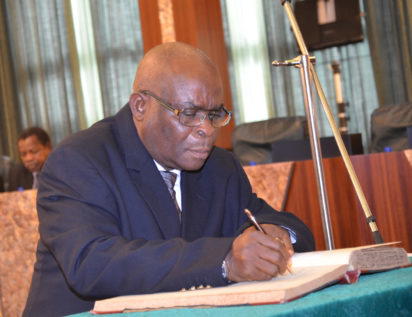
Chief Justice of the Federation, Justice Walter Onnoghen taking the oath of office before the President at the State House, Abuja. Photo by Abayomi ADESHIDA 10/11/201
By Ochereome Nnanna
THE Gestapo-like raids of the judges by operatives of the State Security Services,SSS, coming at the time a change of baton was about to take place in the Judiciary, as objectionable as it was, must have had its positive side, after all. It woke everyone up, especially the leadership of the Judiciary. Even death does have its, perhaps unintended, positive effects. If all the people born since the creation of the world were to have lived, there would be no space for anyone to stand, let alone move around. Life would be meaningless. Despite that, people will still cry when death, which has no respect for “due process”, comes.
Towards the tail end of former CJN, Mahmud Mohammed, the Judiciary had lost much of its self-correctional reflexes, which made it possible for traducers of that arm of government to mount a frontal attack on it. As Mohammed was retiring, the next in line according to the seniority rule which had been followed for over forty years, was Justice Walter Nkanu Onnoghen, the first Southerner to ‘“smell” the post since Justice Ayo Irikefe gave way for the first CJN of Northern extraction, Justice Mohammed Bello in 1987.
Rather than send Onnoghen’s name to the Senate for confirmation, President Muhammadu Buhari courted controversy by swearing him in as Acting CJN, which means he is not sure he would be allowed to stay out his tenure till retirement at seventy. Faced with such uncertainty, many less-endowed mortals would be predisposed to so many frailties.
They could choose to “make hay while the sun shines” by being corrupt. Since many corrupt individuals who have thrown their lot with the ruling All Progressives Congress,APC, Federal Government have tended to be shielded from the ongoing anti-corruption “war”, a CJN who chooses to be corrupt can thrive if he becomes a tool in the hands of the ruling party, its agents and the government in power. That is probably why a particular notorious Abuja High Court judge who has outrageously and relentlessly shambled the law with impunity in favour of those seeking to destroy the Peoples Democratic Party, PDP, remains on seat, unaffected by the SSS “sting operations”.

Chief Justice of the Federation, Justice Walter Onnoghen Photo by Abayomi ADESHIDA 10/11/2016
The fear then was that this relatively quiet Onnoghen might become a tool in the hands of the regime, much like the Independent National Electoral Commission,INEC, under Professor Mahmood Yakubu, which appears to have thrown away the independence which his predecessor, Professor Attahiru Jega, cultivated under the regime of former President Goodluck Jonathan.
All eyes were on Acting CJN Onnoghen as he embraced his first tasks: determining (a) the appeals over the leadership tussles between the two factions of the Peoples Democratic Party, PDP, and (b) the authentic governorship candidate of the party in the Ondo State governorship poll, which the INEC insisted must hold over the past weekend. Onnoghen did not pass the buck to someone else to do the “dirty work”; he took it on personally!
The Supreme Court authorised the Court of Appeal to release its judgement on which faction of the party in Ondo State had the right to produce its authentic governorship candidate. The pro-Makarfi group, led by Clement Faboyede, had produced Mr. Eyitayo Jegede as its candidate in a primary duly observed and certified by the INEC as the law requires. But the pro-Sheriff faction, which produced a member of the Accord Party, Barrister Jimoh Ibrahim (who is seen, rightly or wrongly, by some to be working for the interests of the APC) succeeded, through the Justice Okon Abang Federal High in Abuja, to get the INEC to replace Jegede’s name with Jimoh Ibrahim’s as the candidate of the PDP.
This was not just another routine factional fight for the control of a political party. Rather, it was a fight between a faction that wanted to retain control of the PDP and another which appeared more interested in destroying the party to give way for a rival party to take over Ondo State. The latter (the Sheriff/Poroye/Ibrahim faction) used every dirty trick in the book to smear anyone standing on its way just to achieve its horrible objective.
They took their case to a controversial Abuja High Court judge, Okon Abang. The Court of Appeal, in its Wednesday, 23rd October ruling, essentially said what took place in Okon Abang’s court was a cheap fraud. Abang had cleared Jimoh Ibrahim and forced the INEC to put him on the ballot as the governorship candidate of the PDP in Ondo State. Jimoh Ibrahim accused the acting Director of Legal Services of the INEC, Mrs. Toyin Babalola, of demanding one million US Dollars bribe from him before implementing Abang’s order, a charge the Commission stridently denied. Still, INEC granted Ibrahim’s demand despite another High Court order in Akure issued the same as Abang’s, that Jegede must be maintained as the PDP candidate.
At the Court of Appeal, Jimoh Ibrahim and Poroye continued their onslaught of blackmail against public officials by accusing the three-man panel appointed by the President of the Court, Justice Zainab Bulkachuwa of being greedy and compromised. In particular, they accused the Chairman of the panel, Justice Jumai Sankey, of being “so ill and poor” that she was susceptible to bribery and inducement! The panel promptly resigned from the case, and the Court had to reconstitute another one, this time, led by Justice Ibrahim Saulawa.
Again, Poroye, some of his factional officials, aided by their lawyer, Beluolisa Nwofor (SAN), engaged in cheap and brazen abuse of court processes, all aimed at ensuring that Jegede never got justice. Even when the Court of Appeal panel led by Justice Saulawa ruled that Jegede was the rightful PDP candidate, Jimoh Ibrahim described it as a “one day ruling which was paid for from the state treasury”.
Onnoghen’s verdict of Tuesday, 22nd of November 2016 was clearly meant to serve two purposes: (a) ensure justice was given to whom it was due and in time for it to count, and (b) protect judicial officers unfairly abused by adventurous, self-seeking politicians.
Apart from clearing the way for the Justice Saulawa panel to decide who was the genuine PDP flag-bearer, he slapped massively punitive costs on the person of Barrister Nwofor (SAN), forcing him to pay over N10 million for filing cases that constituted abuse of court processes.
I want to believe that Justice Onnoghen is sounding a note of warning to all politicians (including those in power today and their opposition elements) that the Judiciary under him will no longer condone the perversion of justice. Justice according to the rule of our laws is all that the people want from the Judiciary.
I also hope by this exemplary proactive action taken by Justice Onnoghen, judicial officers will no longer be pushed around by politicians, government and its agents or any other persons in society without the wrath of the Third Arm of government descending heavily on them.
If this is Onnoghen’s mission as our new CJN, then ahoy! The Judiciary is, indeed, the last man in the defence of the ordinary citizen. With the INEC already seemingly compromised by the government of the day, the Judiciary is the only remaining hope. If it also knuckles under Executive intimidation or the lure of corruption, then, it is “To thy tents O Israel” for our democracy.
Disclaimer
Comments expressed here do not reflect the opinions of Vanguard newspapers or any employee thereof.