
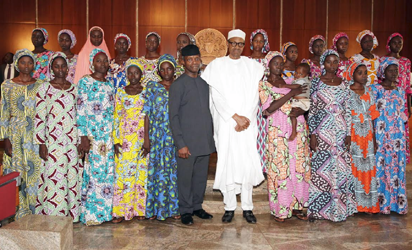
President Muhammadu Buhari and Vice President Prof YEMI Osinbajo with the Released 21 Chibok School Girls as Vice President Prof Yemi Osinbajo presents the Girls to the President at the State House in Abuja
By Denrele Animasaun
“A nation should not be judged by how it treats its highest citizens, but its lowest ones”—Nelson
A crowd gathered to see the brutal lynching of a seven-year-old and the look on the faces of the crowd should give concern as to why they stood by and watch while a child no matter what he may have done, could be seen as a spectator sport. What kind of people just stand by and watch and do nothing?
This happened in Lagos but it could have happened anywhere else in Nigeria. And the sad fact is this does happen on a daily basis in one form or another. In the years that I have been writing my column, my concerns have been mainly for our young people and so I have written extensively about domestic abuse, exploitation of young people, child brides, high illiteracy in young girls, child witch hunt, Ese Oruru, Chibok girls and human trafficking and now, the lynching of this seven-year-old, is one tragedy, too many.
What was the crime of this young child? He was accused of stealing gari and for this, he was stoned and a tyre round his neck then set him alight. This is an outrage and a sad end to a very young life. It is shame on us as a nation and as people. I still believe good people should not allow such atrocities to happen. Some time back, a father tied his son like a dog for many years because he stole some food in his step mother’s pot and if not for the kindness of neighbours who alerted the authorities, this young boy would have been another sad statistics.
It was reported that police watched nearby when the young boy was lynched and did not intervene. What is the point of having police if they cannot protect and serve the community? The baying crowd gathered and participated in the eventuality of the death of the young child. Where in a civilised country does this happen and then people have the gall and temerity to justify the unjustifiable? This murderous crowd was wired up and frenzied that this child did not deserve what came to him. When did we become so unfeeling and so brutal?

Let us face the truth here: we have become detached, lack compassion because can we explain how this crime could happen and it is disregarded and normalised?
How do we explain such violence and abuse against our own young people or anyone for that matter? We are becoming monsters and the good people amongst us should not remain silent and decent people should speak out and actively denounce such barbarity wherever it is going on, and most importantly, the government has to proactively intervene with credible agencies to bang the culprits to rights. This is not the time for hand-wringing and pontificating. Not much has been done to safeguard and protect our young people. The yearly celebration of children’s day does not count. No nation is worthy of honour if they neglect their young. Justice must be seen to be done and yes, I am cynical that anything would come out of this young boy’s death. I am hopeful that the good people of Nigeria will make their voices heard as an attack on a young person is an attack on our future. Every child matters.
I understand that the Nigerian Human Rights Community has implored the Lagos State Governor, Mr. Akinwunmi Ambode to investigate the matter and bring the perpetrators to full justice.
There should be a national outcry, the palpable silence speaks volume; it seems that we do not care much for the young in our society and it is lame to think that as long as our own are fine, it is not our business what happens to other young people. So what happened to “it takes a village to raise a child”? Where has our collective responsibility gone and what gives us the right to deliver jungle justice and be the judge, jury and executioner? This mob mentality has been allowed to permeate our society and it has become the norm. The behaviour that the so-called ordinary people can become enraged and homicidal and no one bats an eyelid. I believe that anyone who partook in hurling stones, beating and watching the child’ murder are equally culpable and no matter how they try to justify their involvement or not, they are responsible and they have the blood of this young child on their hands.
There should be zero tolerance in all our villages, towns, and cities, up and down the land where such grizzly activities take place, if some are capable of taking disgusting pictures on their mobile phones of the lynching of a seven-year-old, and then they could have taken pictures of the murderers and hand the evidence to the law. People have been desensitised and have become chroniclers of grizzly events.
The truth is very hard to bear; most Nigerians do not care about our young. This may sound accusatory but it is true and there are statistics to bear this up. We should protect our young people and set a good example for them. In Nigeria, according to UNICEF, 60 per cent of children, yes, that is right; that is, six in ten children in Nigeria, suffer one or more types of violence before they reach the age of 18.
Its spokesperson said, “A national survey by the National Population Commission, September 2015,also indicated that one in two suffers physical violence, one in four girls and one in 10 boys suffer sexual violence and one in five boys and one in six girls suffer emotional violence. Sadly, most children never tell anyone what happened to them. Less than four per cent ever receive the support they need to recover” so, the number could be higher than reported!
It makes sad reading that majority of our young are emotionally and physically damaged before they begin their adult lives. This is not acceptable in Nigeria or anywhere else for that matter.
I am aware that President Muhammadu Buhari launched the Year of Action to End Violence against Children and has called for states to take action to strengthen their laws, policies, and services to protect children. More needs to be done to protect millions of Nigerian children who are victims of physical and sexual abuse. Sharon Oladiji, of UNICEF Child Protection, acknowledged the alarming increase in the rate of child abuse to the absence of institutions to check the trend and that the perpetrators of violence against children should face the full extent of the law. She also said that the failure of a lot of families affected in such situations to speak out when their children or wards were violated by relations.
She said that “a lot of children fell prey to perpetrators of violence because of the failure of parents or guardians to allow the children to have a say in matters affecting their lives. At the moment,N500,000 fine or five years imprisonment for perpetrators of sexual abuse and unlawful sexual intercourse, among others, enshrined in section 34 of the Child’s Rights Act, is too lenient and a call for stiffer penalty, such as death sentence, for offenders to deter prospective violators”.
I wholeheartedly agree. We have been sold this “spare the rod and spoil the child” mantra for far too long. Those that perpetrate this act of cruelty against children are the ones that protest the loudest and try to excuse their behaviour as traditional. No, it is not. In our tradition, we take care of our children and cherish them even our neighbour’s children and show compassion to the less fortunate. This has always been our ways.
On the other hand, poverty makes people do horrible things, but there are lines decent people do not cross or so you would think. Nigeria has undergone and undergoing numerous crises; corruption, economic upheaval, insurgency, displacement, kidnaping, high unemployment, lack of training or education opportunities for young people, the lack of health and social support and inadequate amenities all affects many in the country and it has had an impact on how people live their lives and the way they treat the young and the vulnerable. Cruelty still is no excuse.
The study is grim reading and definitely shows Nigeria in a bad light and for many that protest too much; it is time to face the facts. If you are not the solution then, you are the problem.
“Those abused mostly know their abusers, Harvey says. They tend to be parents, other relatives or male teachers. “Children revealed that they didn’t know where to go. The majority of children don’t know where to seek help,” But Harvey says the survey was intended to show the violence against children extends beyond these areas. “The purpose of this survey was to bring to the spotlight that violence against children is not just happening to marginalized groups, not just happening in conflict-affected areas, it’s happening in communities, in homes, it’s not someone else’s problem, it’s really everybody’s problem,” she said. Harvey says the abuse becomes “cyclical”; children who suffer abuse often grow up to abuse their partners.
The study shows that majority of children never tell anyone about their experience and less than five % of children who experience violence ever receive the support they need to recover. It found that childhood violence has a long-term impact that lasts well into adulthood, including poorer mental and physical health outcomes. Individuals who experienced physical and sexual violence in childhood were also significantly more likely to perpetrate intimate partner violence. So you can understand that how the cycle of abuse continues and it will take a collaborative and consented effort to break the cycle.
This is not a “them and us “thing as it also shows child abuse occurs across the social strata;” violence against children is not confined to marginalized groups. Violence against children transcends social and economic status – it impacts the rich and poor, urban and rural, educated and out of school children. It is a problem that affects all corners of society. ” Time that Nigerians take care of it young and lead the way that we value our young.
“Sometimes people hold a core belief that is very strong. When they are presented with evidence that works against that belief, the new evidence cannot be accepted. It would create a feeling that is extremely uncomfortable, called cognitive dissonance. And because it is so important to protect the core belief, they will rationalize, ignore and even deny anything that doesn’t fit in with the core belief” —Frantz Fanon
Disclaimer
Comments expressed here do not reflect the opinions of Vanguard newspapers or any employee thereof.