
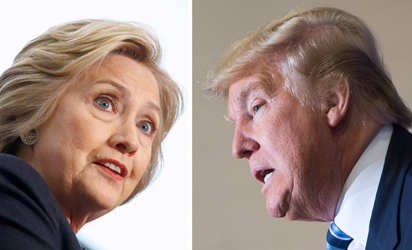
combination shows Democratic presidential candidate Hillary Clinton(L) on April 4, 2016 and Republican challenger Donald Trump on February 16, 2016. November’s US presidential election is taking shape: Republican billionaire Donald Trump and Democratic power player Hillary Clinton look set for an ugly battle for the White House after a bruising primary season. Trump knocked out his only serious challenger Ted Cruz on May 3, 2016 in Indiana’s key primary, winning 53 percent of the vote against 37 percent for the Texas senator, who raised the white flag and surprisingly pulled out of the race. / AFP PHOTO
Only 548 electors will vote for Democratic Hillary Clinton and Republican Donald Trump in the presidential election.
The U.S. election is decided by the Electoral College made up of 548 persons and not a popular vote as it is obtained in most countries.
To be elected a president, therefore, a candidate must score 270 Electoral College vote, representing 50 per cent plus one vote or a simple majority vote.
Patrick Butler, the Vice President, Programmes at the International Centre for Journalists (ICFJ), described the American electoral system as “a confusing system and even most Americans don’t understand it”.
“It’s a very complicated system but in general, what happens is that each of the 50 states awards all of its votes to the candidate who wins a majority in that state.
“So let’s take California for example: if one candidate wins 80 per cent of the votes in that state, they get all of that state’s electoral vote.


This file photo combination shows Democratic presidential candidate Hillary Clinton(L) on April 4, 2016 and Republican challenger Donald Trump on February 16, 2016.
November’s US presidential election is taking shape: Republican billionaire Donald Trump and Democratic power player Hillary Clinton look set for an ugly battle for the White House after a bruising primary season. Trump knocked out his only serious challenger Ted Cruz on May 3, 2016 in Indiana’s key primary, winning 53 percent of the vote against 37 percent for the Texas senator, who raised the white flag and surprisingly pulled out of the race.
/ AFP PHOTO
“If they win 51 per cent of the votes in that state, they still get all of that state’s electoral vote.
“So what matters in this country is not necessarily the popular vote, which is who won the most votes in the entire country but who won the big states.
‘’It is who wins the Electoral College basically, which means that they won the most votes in states that add up to 270 electoral votes.
“It is a very confusing system basically and even most Americans don’t understand it.
Butler on U.S. Electoral College
A Professor of Political Science at the Christopher Newport University, Quentin Kidd, told newsmen correspondent in the U.S. that electorates vote for the Electoral College, not the candidates.
Kidd said each state has “winner takes all” system, adding that “whoever wins popular votes takes all the votes; whoever wins popular votes wins the electors”.
“Americans will not be voting for the president directly in the election; it is the electors that will vote for the president at the Electoral College.
“Technically, by Nov. 9, we all wake up and we know who the president is. That will be accepted, that will be spoken of as the incoming president.
“But technically speaking, because the Electoral College doesn’t vote until December, the outcome of the election is not formalised,” he said.
NAN
Disclaimer
Comments expressed here do not reflect the opinions of Vanguard newspapers or any employee thereof.