
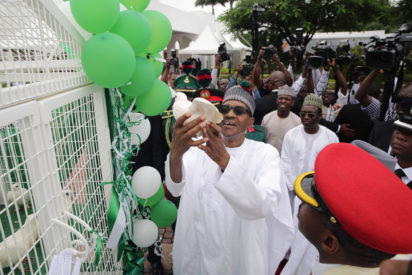
. President Muhammadu Buhari releases the pigeons flanked by the Vice President Prof Yemi Osinbajo during the 56th Independence Anniversary at the Presidential villa State House Abuja.
By Rotimi Fasan
OCTOBER 1, 2016, Nigeria’s 56th Independence Day, came without much fanfare even if many had looked forward to the one-day holiday it afforded. The question on the lips of many was; what was there to celebrate about this day. Many would often wonder if Nigeria’s Independence Day is worth rolling out the drums for. This was even long before the ongoing recession. Each Independence Day in Nigeria has in the last twenty years or more been welcomed with increasing level of scepticism. There has been very little Nigerians thought was worthy of celebration. This is fast becoming the cliché of our lives, to write off Nigeria’s day of freedom from formal colonial bondage as unworthy of attention to say nothing of celebration.
Our political leaders knowing just how much they’ve grounded the country also try not to make so much song and dance of our independence celebration. They try or claim to go low key in order to cut cost even if every other activity of theirs proclaim the contrary. They remain in the safety of their walled mansions ensconced from the anger of the much abused poor and deprived. They run away from real and imagined enemies, the same people on whose back they rode to power. Not that ordinary Nigerians care one jot what the leaders make of Nigeria’s birthday.
And since the people appear to have come to a consensus that there is nothing to celebrate about October 1, shouldn’t we be thinking of what we might do to make future independence day worth looking forward to? Or are we resigned to the unhappy fate that there will never be anything worth celebrating about our independence day or in fact the country? Except we are determined to dismember the country, except we’ve taken the decision to rupture whatever bond of cooperation holds us together, we might do well to change our perception of October 1 as just another to indulge our love for holidays.


President Buhari participates at the 56th Independence Anniversary programme Presidential Change of Guards Parade at the Statehouse on 1st October 2016.
It’s true that for many years now Nigerians see every October 1 as opportunity to call into question the basis for the continued existence of the country as one. But it bears repeating that until and unless we are determined to take this beyond the level of rhetoric, it wouldn’t be a bad idea to see how we can restore a sense of pride to the celebration of our national day. For come to think of it, it was not always the case that Nigerians disregarded the country’s Independence Day celebrations. In the past, Nigerians looked forward to the celebration of October 1 with pride and joyfully infectious expectations. All sectors of the society were mobilised for the celebrations. Celebrating Nigeria’s independence went back to the many years of economic prosperity during which Nigerians had not too much to worry about. These were the years when the naira stood head to head with the strongest currencies in the world, including the British pound and the US dollar.
It was a time of prosperity when the oil market boomed and graduates got employed as soon as they left school with at least one brand new car to start their working life with. Salaries were in these years paid as and when due. Pensioners didn’t spend long hours on queues in order to be paid their entitlements nor did many of them slump to their death while waiting to be positively identified before being paid. True people talked of hunger in those days; they spoke of traffic jams and social insecurity including armed robbery which was then an affair that took place on interstate trips on the highway. Which was why these types of criminals were called highway robbers. Now you don’t have to be on the highway to be a victim of armed robbery. Nigerians then had no idea that a time would come when people would literally scavenge for food in waste dumps; receive letters of unwanted visits by armed bandits that would unleash hours of havoc on several neighbourhoods at a time without a whimper of challenge from law enforcement agents.
No, in those days of yore when Nigerians took to the Race Course, Polo and Parade Grounds, and other venues of national merriment to celebrate independence – in those days Nigerians knew nothing of rogue militias and insurgents who sack towns and military barracks with the ease with which bulldozers level shanty structures. Nigerians celebrated the country’s independence in those years when bread was affordable. Times when the poorest among us could claim all they had left to eat was just garri. But these days garri is so hard to come by it’s no longer ‘just garri’. Rice has gone out of reach, far from the food menu and beans are simply unaffordable. Ever since ‘austerity measure’ entered the national lexicon so has it become difficult to celebrate Nigeria. SAP, the Structural Adjustment Programme, became in Fela’s lingo, Suck African People and sapped what prosperity juice was left in us. As the country bade the 1970s goodbye and trudged into the 1980s, so has the shadow of gloom lengthened around us, taking with it much of the mirth that characterised our typical mood of national celebration.
Gradually Nigerian leaders started finding reasons to celebrate the national day on a low key- right in the vicinity of their self-appointed dungeons misnamed villas and state house. The celebrations would be marked quite all right but with abbreviated fanfare. Important elements of the celebrations from previous years are inevitably removed. The military displays and march past used to be crucial elements of past independence day celebrations. There were sometimes air displays by the Nigerian Airforce as the armed and paramilitary forces in full ceremonial gear take their turns on the fields. School children were not left out. Nor were their teachers or members of the public warned as a matter of safety to keep off the parade venues. The celebrations were preceded by long weeks of preparations and rehearsals that were replicated in all states of the federation. These indeed were the years of prosperity even when people spoke of hunger and joblessness.
Gradually, however, the economic crunch began to hit harder and Nigerians came to the realisation that the days of prosperity were at an end. Venues of celebrations became no-go war zones where bombs are randomly detonated. It’s been six years since the Eagles Square witnessed any celebrations. On that last occasion President Goodluck Jonathan barely escaped with his life. A few days ago, President Buhari marked the national day right in Aso Villa. Like a grief-stricken house, Nigerian leaders have brought gloom into the home and the people now mark the country’s independence in ash and sackcloth. Nigerian politicians have certainly eaten sour grapes….
Disclaimer
Comments expressed here do not reflect the opinions of Vanguard newspapers or any employee thereof.