
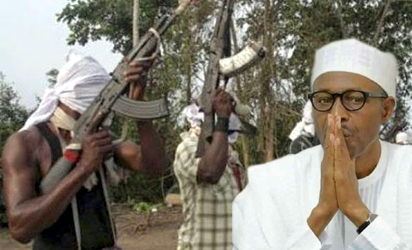
Militants vs Buhari
By Sonny Atumah
President Muhammadu Buhari last Monday solicited Germany’s assistance in the areas of equipment, training and sharing of intelligence with the Nigerian Navy to curb oil theft in Nigeria. He spoke when he received the German Foreign Minister, Dr. Frank Walters-Steinmeier at the State House, Abuja.


Militants vs Buhari
The President said militants engage in sophisticated sabotage, using skills they acquired either from government or oil companies, to vandalise deep sea installations. He stated government’s commitment to understand who the real agitators are and engage to restore confidence in the region. To him the Niger Delta situation was a complex one since the militants have no central command, promising a dialogue with leaders of thought for a solution.
President Buhari’s mien raised hopes for a solution set and is commendable. However salient issues about critical national petroleum infrastructure protection have been in abeyance for some time. For obvious reasons it is not ones intention to dabble into defence and security issues, but one must underscore the need to proffer unpretentious suggestions to enhance genuine national conciliation. The government had painted the picture of an economy that is hemorrhaging money from crude oil theft and low crude oil production for months that led to recession.
The dispute needs to be viewed in its historical context. The strategic thoughts for concerted development have been ignored for reactionary methods of dealing with problems in the Niger Delta. These serious developmental neglects are the immediate national security threats and government had been accused of putting on a false or showy display of importance in finding solutions.
The Niger Delta rivulets, creek, inlets and island residents for instance do not have access to gasoline or petrol to run their outboard boats; they buy a litre even at the best of supplies for as much as N250. The operations of International Oil companies, IOC with aging and rupturing pipelines that cause serious leaks and oil pollution on a regular basis are never sanctioned.
IOCs have a field day in Nigeria in gas flares that pollute the environment. As a result government loses at least US$1.8 million to gas flaring daily with the regulators, the Department of Petroleum Resources, DPR staying aloof.
The Chatham House of United Kingdom Think Tank in September 2013 reported our crude oil was stolen on an industrial scale with ready buyers in the Gulf of Guinea, the United States, Europe and several Asian countries. The Report said that Nigeria loses US$8 billion annually to theft by politicians, security forces, militants, oil industry staff, oil traders, most of who have no interest in stopping it.
In its simplism Nigeria breeds unauthorized quasi-military groups that vandalise petroleum infrastructure in the Niger Delta. In all these, our gallant men and women in uniform are called severally against insurrectional actions of militants and other forms of insurgencies for what ordinarily could be resolved by the political class. The fact must be underscored that any act of rebellion in whatever guises are condemnatory.
At the end of a security meeting convened by Vice President Yemi Osinbajo (who acted when the President was away for medical treatment in the UK) at the State House Abuja, Governor Ifeanyi Okowa of Delta State who briefed newsmen on behalf of his colleagues in the oil producing states, said they received briefings on the situation in the Niger Delta from the security chiefs and the Minister of State for Petroleum.
Governors may be feeling sidelined on security matters in their states stressing that lasting peace in the Niger Delta is beyond cannonades; but in the realm of sustainable development which the people yearningly looked forward to. Protection of critical infrastructure should involve communities and that is when residents are involved.
Government ruminates about security in the Gulf of Guinea but luxuriantly ignore development in the contiguous area in Nigeria. Nigeria bordering the Atlantic Ocean is the continental trigger with vast coastline stretch for a potentially strong economy. Along this coastal corridor building refineries and petrochemical plants could create conurbations’ to stimulate Nigeria’s growth and development.
For self-centredness the political class ignored symptoms or indicators of undesirables and preferred to be reactionary which oftentimes is a negative development approach. Agitations would stop with integrated, inclusive and sustainable development programmes; that would guarantee gainful employment and improved standard of living to majority of the poverty stricken people.
The Niger Delta interventionist amnesty programme may barely be the lasting solution as it has developed a lot of human capital in the region. Many others graduating from various institutions of learning would want to be enrolled in the scheme and may become a circus. The reality of this army of occupation (thousands of highly trained professionals), that are left unemployed after their various programmes may be hopelessness, helplessness, and possibly restiveness as it is today.
Successive administrations have abandoned existing critical national assets in ports for merchant shipping in the region. Utilization of Niger Delta ports could be a potent force to becoming a Gulf of Guinea oil trading hub. Apart from the Lagos ports, others are not functional. Calabar, Onne, Delta ports in Warri, Burutu, Sapele, Koko and petroleum terminals in Escravos, Forcados as well as the Onne and Port Harcourt ports survive on captive cargo; not generating their own cargoes.
The proposed multibillion dollar rail projects from Lagos to Calabar initiated by the Yar’adua administration and now to be executed by the Buhari administration should be pursued with vigour to link Nigerian ports. The effective development of this area is as strategic as the world number one oil trading hub of Amsterdam- Rotterdam-Antwerp, ARA in North Western Europe where we export most of our crude and petroleum products import.
State failings have made communities develop attitudes of disgust from government entreaties for critical oil infrastructure protection. Government must not acquiescently consent to oil pollution in the region but should review joint venture agreements with IOCs. The petroleum industry bill that would have included communities in ownership of critical petroleum assets must not be certified dead in the eighth national assemblies.
The genuine conciliation we fail to have today would be the assaults and wanton destruction of tomorrow. The political class must accept responsibility for mistakes made over the years.
Some Governors and operators of interventionist agencies from the region stole from the people’s tills they held in trust and must be sanctioned To end guerrilla warfare that operates in small groups to harass and carry out sabotage, IOCs operations and regulatory agencies derelictions that made the people victims of deprivations should be sanctioned.
The Federal Government has been soliciting for help from the international community in tackling Niger Delta militancy. As President Buhari ends his state visit to Germany today prospective investors need assurances of peace in the Niger Delta. To do this he must engage the services of securocrats with power to influence government policy from behind the scenes.
Disclaimer
Comments expressed here do not reflect the opinions of Vanguard newspapers or any employee thereof.