
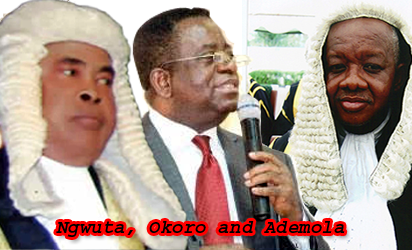
Ngwuta, Okoroand Ademola
By Yinka Odumakin
WHEN Femi Lawson in the dead of the night on Friday posted the newsflash on Core Federalists ,a group of finest minds on Federalism discourse in Nigeria,that DSS operatives were ransacking homes of some High and Supreme Court judges,I found it hard to believe and I asked him to provide a link.Pronto he brought Sahara Reporters.
Though I knew Sowore would not have gone to town with such story without confirmation,I still needed further convincing. The local papers were not forthcoming until Vanguard broke the news of the assault on Governor Wike as he tried to intervene in the attempt to abduct a judge in Port Harcourt.
Later we saw images of broken doors as officials of Department of State Security, DSS, violently gained entrance into the homes of the said judges at that space on the clock when armed robbers go knocking on the doors of their victims.In a country where soldiers now engage in kidnapping,there is no reasonable human being who would open his door to anyone claiming to be from DSS around 1:00a.m.
Reasons for the action later came from the DSS by one Abdullahi Garba who spoke with journalists in Abuja on Saturday.He said that the operations were based on allegations of corruption and other acts of professional misconduct by a few of the suspected judges.
Garba said, “The action is in line with its core mandate, as we have been monitoring the expensive and luxurious lifestyle of some of the judges as well as complaints from the concerned public over judgment obtained fraudulently and on the basis of amounts of money paid.

Ngwuta, Okoroand Ademola
“The judges involved were invited, upon which due diligence was exhibited and their premises searched. The searches have uncovered huge raw cash of various denominations, local and foreign currencies, with real estate worth several millions of naira and documents affirming unholy acts by these judges.”
While saying that some of the judges had made useful statements on the allegations against them, he added that a few of them declined “even with the glaring evidence that were found against them in terms of material cash, documents and property recovered pointing to their compromise.”
He said in one of the states where the operations were conducted, intelligence report indicated that a judge was having the sum of $2m in his house.
He, however, regretted that a governor bungled the operation by obstructing the operatives of the Service from carrying out their job.
Garba said, “In one of the states where the operations were conducted, credible intelligence revealed that the Judge had Two Million United States Dollars ($2,000,000 USD) stashed in his house. “When he was approached for due search to be conducted, he in concert with the state governor, mobilised thugs against the Service team. “The team restrained itself in the face of unbridled provocative activities by those brought in by the governor. Unfortunately, the judge and the governor also engaged the tacit support of a sister security agency.
“The Service surveillance team noticed that upon frustrating the operation, the judge with the active support of the governor craftily moved the money to an unknown location which the Service is currently making effort to unravel.”
He gave the summaries of these to include: N93,558,000.00, $530,087, £25,970 and €5,680 (euro). Let me state clearly that the judiciary like the executive and legislative arms of government boasts of corrupt elements and we knew that from the Esho panel report .Corruption in the judiciary is worse the form of corruption because the only thing being sold is justice. Every reasonable citizen therefore should support genuine efforts at ridding our temple of justice of the ill of corruption .
In this wise, we await explanations from the affected judges explanations on how the huge sums of money ALLEGEDLY found in their homes came about if indeed the allegations are true.
However, we must interrogate the processes that have led to this development. To start with,the core mandate of the DSS does not involve anti-corruption fight. If they were involved in a sting operation,they ought to have submitted their findings to the EFCC and police to do the rightful and needful.
By the way, it is laughable to hear Garba say they have been monitoring the judges and noticed they were living above their means.We are waiting for the DSS to give us list of members of the executive arm of government who are living within their means and how many of those living beyond their means they have gone to break their doors at night. Ditto for their findings on all the corruption scandals against some serving ministers and other top presidency officials.
Let me also make it clear that I am not one of those who say judges cannot be investigated or prosecuted if they run foul of the law. Judges who betray their oath are sanctioned in every jurisdiction. But it is not done outside the ambit of the law.
On May 29,2014 the Federal Bureau of Investigation(FBI) arrested a Puerto Rico superior court judge suspected of accepting bribes in exchange for acquitting a man charged in a fatal driving case.
Manuel Acevedo was detained at his home after he had previously been suspended when the federal investigation began .It was within the ambit of FBI to carry out this arrest and the judge was already suspended by the appropriate organ. A situation where you go to the homes of judges who were not known to be under any investigation to the public and begin to break doors down like Shekau boys destroying a school (Boko symbol)is bound to generate the kind of reaction the DSS action has attracted.
The DSS cannot sustain any action against these judges in any court of justice as it has left too many lacuna with its method even if there is a genuine case against them. A fresh lawyer from Law School can see all the gaping holes! Beyond the seduction of anti-corruption crusade deceit ,the raid on these judges would fetch us no more than the failed State -sponsored kidnap of Umaru Dikko in London in 1984 did for us.
In 1984, the military government in Nigeria despatched agents to London to drug kidnap Umaru Dikko, a minister in the previous government accused of embezzlement. Dikko was indeed a prominent face of sleaze in the Shagari government who fled to London after the December,1983 coup.
The plot was only rumbled when a customs officer at Stansted Airport became suspicious about a crate marked “diplomatic baggage” that was due to be picked up by a Nigerian airliner, and opened it to find an unconscious Mr. Dikko inside.
The incident sparked a major diplomatic fall-out with Britain and saw four men jailed for kidnapping.That was the end of all allegations against Dikko. He did not go to any jail. He returned to the country pointing the way forward for Nigeria.
It is unfortunate that between Dikko and these judges our system has yet to see the futility of employing illegal means to achieve legal objectives .We must learn the patience to go through due process. It might be slower but we will get result.
I learnt from a Senior Advocate of Nigeria,SAN, that a Supreme Court Judge allegedly asked his son lawyer to collect hefty sums in bribe in a case he was adjudicating few years back.He was close to retirement but the crime was found out.When confronted by the NJC process,he committed suicide.Only few people are going to be interested in the crimes these judges have been accused of as most people would focus on the barbaric invasion.
Barbaric invasion
The only thing “We the people” can benefit from this unfortunate saga is that when we approach their Lordships that we have been dealt with in impunity henceforth,they will not see us as pieces of papers and files before them,they can relate now to what we are complaining of.
But the greater reason why we must resist the DSS style is that if unchecked ,we may find ourselves in the days of Idi Amin down the line.
On September 21, 1972 Uganda’s first black Chief Justice was kidnapped from his court chambers in Kampala and four days later shot dead at State lodge Nakasero by President Idi Amin.
This was revealed by the retired 71-year-old Superintendent of Police, Daniel Mulemezi, a resident of Kamuli District in eastern Uganda. The retired police detective was appearing before the Commission of Inquiry into the violation of Human Rights in Uganda from October 9, 1962 to January 25, 1986 when he made the revealations.
Mulemezi, who was witness number 140, had volunteered to appear before the Commission to debunk the mystery surrounding Kiwanuka’s death since 1972.
On October 5, 1988, he revealed for the first time on record how Amin killed the Chief Justice. Although Mulemezi had refused to reveal his source for fear of his personal safety and that of his source, after receiving assurance from the Commission that his safety and that of his source was guaranteed, he was allowed to testify but in camera – which was granted.
Mulemezi indicated that his impeccable source was a Uganda Army (UA) intelligence officer; Corporal Odwori Okoth attached to the Lubiri Barracks in Kampala. According to the Commission report which has since been made public, Mulemezi personally attempted to investigate the abduction and disappearance of Kiwanuka but was intimidated by some soldiers. He also revealed that when he heard that Kiwanuka had been arrested by soldiers, he tried to investigate the matter but was frustrated.
He told the Commission how he went to Lubiri, Jinja and Mbuya barracks and talked to the adjutants to allow him have an identification parade in order to identify the two said soldiers suspected to have been involved in the kidnaping – but was frustrated when the adjutants advised him not to conduct the exercise in the barracks for his own safety.
Exercise in the barracks
His source had confided to him that Kiwanuka would have survived death if he had conditionally accepted to make a statement before Amin and aired on Radio Uganda claiming that he had been kidnapped by the guerrillas – which Kiwanuka adamantly refused.
And the furious Amin pulled out a pistol from his waist and said: “Don’t you think I can kill you?” To which the intrepid Kiwanuka responded: “You can do so, but I am not going to say anything at all. I will die with the truth”.
The infuriated Amin pulled the trigger, shot and killed Kiwanuka. Mulemezi stated.
Mulemezi also revealed that he saw the first arrest of Kiwanuka conducted by the PSU commander Ali Toweli and his deputy Kassim Obura who bundled Kiwanuka into the car and whisked him away – but was later released; and Radio Uganda announced that he had not been arrested as rumoured but had been at State Lodge meeting with the president.
Mulemezi also told the Commission that Kiwanuka’s body was dipped into an acid solution before it was buried at Luzira cemetery – which was done to kill evidence or identification in future. Also, before the burial, Commissioner of the Uganda Prisons, Kigonya and other Baganda prison officers were detained so that they could not know about the burial.
Disclaimer
Comments expressed here do not reflect the opinions of Vanguard newspapers or any employee thereof.