
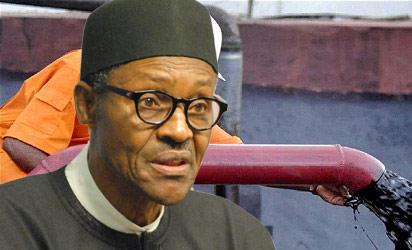
Buhari
By Yinka Odumakin
“Out of the 46 years of Nigeria’s political independence, northern elites had power on their grab for nearly 38 years; what is boggling the minds of northern talakawas is: what had stopped the elites then in making a true resolute effort in the search for oil in north despite the fact that preliminary geological survey had shown evidence of oil existence? Though, no right thinking man of understanding can carry on a white elephant project just to satisfy regional inclination at the expense of greater Nigeria, but has the present crop of northern leaders done to the north what would have freed the poorer of the poor from the prison of poverty to an unlocked future? The answer is anybody’s guess– one may not be out of point to say: nearly most elites in the north have their legs wobbling, now that Obasanjo have systematically shown to them how to use power – despite the hitherto long period of northern elites domination of Nigeria’s political space; the region is virtually crawling behind other regions of Nigeria”
WHEN Zayyad Muhammad penned the above for Gamji in 2006 little did he know that he was writing just ten years ahead of a resentful and spiteful resumption of oil search in the north of Nigeria.
Last week ,the Group Managing Director of Nigeria National Petroleum Corporation, NNPC,Dr Maikati Baru, while receiving a delegation from Benue State, announced that the oil firm is under a marching order to commence exploration activities in the Benue Trough ,a major geological formation underlying a large part of Nigeria, extending about 1,000km North East from the Bight of Benin to Lake Chad following up to the Northern Nigeria Development Corporation’s hiring of a British firm to speed up the process .
When Senator Salisu Ibrahim Musa-Matori came to represent Bauchi South in the Senate in 1999,the major issue he fought throughout his tenure was to get Nigeria to commit resources to the search for oil in the Benue Trough where NAPIMS carried out seismic data acquisition between 1984 and 1989. Chevron, Shell and Elf were even allocated blocks for non-existent oil in the area in 1993 under a Petroleum Sharing Contract.
In December 2001,the Senate Committee on Petroleuem headed by Senator David Brigidi took a tour of Bauchi,Yobe,Gombe and Borno to find out why oil prospecting companies withdrew from the area.They discovered that a sum of $378,977,248.02 had been committed to the project without any result .They had dug about 3,000 meters at the time and they were being told that they needed to go 6,000 meters as the work was approved by NAPIMS without being guided by proper geophysical report .The oil companies who were no arms of Arewa Consultative Forum, ACF, but for-profit groups abandoned the fruitless search since they had cheaper source of oil within the “same” country.
What could be termed the major highlight of the Committee report was that oil blocks allocated in the Benue Trough should be coupled with those of the Niger Delta, and states willing to participate in oil search should be allowed to do so.
The desperate return to this white-elephant project at a time oil is becoming largely irrelevant in our world and when the country is in a “technical” recession is therefore more political than economic and this we need to interrogate.
Many Northern elites,among whom own most of the oil wells in the Niger Delta,have never hidden what they would have done to Nigeria if oil were to be in their region. In a 47-page document marked “Key issues before the Northern delegates to the 2014 National Conference” which has a sub-title: “Northern Nigeria the back bone and strength of Nigeria”, a think tank constituted by Northern Governors, the ACF and the Sir Ahmadu Bello Memorial Foundation made so many provocative claims. They said it was the size of the North that gave Nigeria access to the Continental Shelf and the oil therein.
“The North demands a reversal to status quo ante. All mineral resources should remain under the exclusive rights of the Federal Government as provided for by the International law (1982 United Nations Convention on the Law of the Sea UNCLOS, Article 76 on territorial waters/boundaries which stipulated that 200 nautical miles off the continental shelves belongs to the central government exclusively,” the statement read.
The document said that the funding of the civil war was entirely done by the North at a great sacrifice to its wellbeing, at the expense of investment in human and economic development of the entire region.
The North, it said, sold all its groundnut and cotton for some years, risking delivery contract of three years for all its agricultural products to prosecute the civil war.
It followed on an earlier presentation by one of the lead speakers at the Northern Leaders Conference, Usman Bugaje, who raised a controversial issue on the ownership of Nigeria’s crude oil domiciled majorly in the Niger Delta region.
According to him, it is wrong for any state to claim that it is oil producing because 72 per cent of the total land mass in the country belonged to the North and that by the United Nation’s law, it is only the North that actually has the right to claim ownership.
“Whatever mileage you get in the sea, according to the United Nations Law of the sea, is a measure of the land mass that you have; that is what gives you the mileage into the sea…and the land mass of this country, that gives that long 200 nautical miles or more into the ocean, is because of that 72% of the land mass of this country, which is the the north,” he said.
In 2001, Dr. Bala Usman whom Prof GG Darah described as “the scion of the Katsina feudal aristocracy” and “ideological point-man of the Fulani oligarchy” was the star of the cover story of the Abuja-based Weekly Trust that devoted seven of its 40 pages to him. On the front page story, Dr. Usman declared “Yoruba cannot stop coup”. On page two of the newspaper, he said “There is no Ijaw nation”, while “Igbo politics backfired” occupied page three. On page four, Usman warned: “There may be more violence”. Page six was taken up by “American democracy is a sham”, while page seven carried a familiar theme: “Oil caused the civil war”.
Usman made so many vitriolic comments like : “So, these people who think that you cannot have a coup because the Yorubas will shout or the Lagos papers will not agree or the human rights group will shout is rubbish. You can easily have a coup. How long will it take to crush them and what can they do anyway? The moment they start shouting they will just bomb them off…There is no way ignorant people can lead. Unless something is done these nincompoops will continue to shout true federalism.”
His most comic was his geological postulation that the North was the primary producer of oil as it was the cow bones from the region that turned to oil in the Niger Delta!
From this background, it is clear that at a time when we are paying lip service to diversification and we should be digging for the solid minerals of the North,we are going to be throwing the little we have left in pursuit of a regional mirage borne out of etnophobia.We will be spending fortune searching for what is not there while ignoring what is readily available because of the contradictions of a dysfunctional polity.
This “we also have our own oil” project punctures the whole lie of “one nation,one destiny” that has been peddled (or is it padded?) over the years. The true colours are showing gradually!
To Alan Lennox-Boyd ,Secretary of State for the colonies we return when he wrote in a 1958 memorandum on Nigeria: “The North fears and dislikes the more educated Southerners and if they were not economically bound to the Federation would be glad to be quit of”.
Memorandum by the Secretary of State for the Colonies (1957-1958) — 2 (Continued from last week)
Pattern of self-government in the East and West will largely be followed but because of the backwardness of the Northern Region I shall try—I cannot put it higher— to retain some greater powers for the Governor than those retained by the Governors of the East and West, and to obtain assurances about the incidence of Muslim law and the retention of much of the present structure of the Provincial Administration.
(e) The Question of Independence
- At last year’s Conference I was pressed by all Parties to agree to independence first in 1959 and then, when this was seen to be impracticable, on the specific date of April 2, 1960. After a series of discussions I gave an undertaking in the following form: —
“ I understand that it is proposed that some time about January 1960 the new Nigerian Parliament will debate a resolution asking Her Majesty’s Government to agree to full self-government within the Commonwealth by a date in 1960 which will have been mentioned in the resolution . . . . on receipt of your resolution Her Majesty’s Government will consider it with sympathy and will then be prepared to fix a date when they would accede to the request.
We could not at this stage give any undertaking that the date would be the same date as asked for in the resolution, though we would do our utmost to meet the resolution in a reasonable and practicable manner . . . . Her Majesty’s Government would of course be very much guided in their choice of a date by the way everything was going, by how the two Regions now about to enjoy Regional self-government had taken the strain of this great step forward, and by how the country as a whole had faced up to the problems of minorities, on which a Commission would already have reported.”
The Nigerian delegations expressed their disappointment but did not reject this undertaking and informed me that they would revert to the demand for independence on April 2, 1960. The Prime Minister’s “ national “ Government was formed to work for independence on this date and at the coming Conference.
I shall be under renewed pressure to accede to the date with or without conditions, or at least to go some way beyond the undertaking given last year.
- I propose to reaffirm last year’s undertaking but not to go beyond it. The weaknesses in the North and East that I have described are likely over the next year or two to become more pronounced as overseas officers begin to leave the North after Regional Government next March and as the exodus from the East continues.
- The “ national” Government at the Centre has developed no national outlook or community of interest. I understand that at the Federal elections late next year the Northern People’s Congress and the N.C.N.C. (who are normally kept apart by mutual suspicion and by Northern dislike of Dr. Azikiwe), alarmed by the determination and organising ability of the Action Group, are likely to combine to keep the Action Group out of power. Such a combination would offer no great reassurance for competent or courageous Federal Government. The tribal divisions that remain in Nigeria are so deep that the unity and stability of the country cannot yet be taken for granted.
- All these are reasons for going slowly. But in view of the decline in the number of overseas officers in post and of the mounting pressure for early independence, the freedom of action left to Her Majesty’s Government is small if Nigerian goodwill is to be maintained. I cannot go back on the undertaking I gave last year but it is in my view essential that, before making the final decision to give independence, Her Majesty’s Government should be able to assure itself that the new Federal Government elected late in 1959 can properly claim to represent majority opinion in the country and has a reasonable prospect of maintaining the unity and stability of the country.
- If this undertaking is strictly adhered to it is unlikely, even if all goes well, that independence could come as early as April 1960. Provided that a competent Federal Government is formed late in 1959 there will need to be final discussions between this Government and Her Majesty’s Government early in 1960 and then the drafting and passage of legislation here, so that the second half of 1960 seems the earliest practicable time for independence to come. I expect to have informal talks with the Federal Prime Minister before the coming Conference and I shall discuss this question with him.
The Trust Territory of the British Cameroons
- The Northern British Cameroons is administered as part of the Northern Region and has always declared itself content so to remain. The Southern Cameroons has its own Government which to date has been financially dependent on the Federal Government and has ultimately been responsible to the Governor-General.
The recommendations of the Fiscal Commission are likely to give the Southern Cameroons a fair measure of financial independence and their representatives are committed to asking at the coming Conference for full Regional self-government. With Nigerian independence approaching, this small Government must quickly learn to stand on its own feet and I propose to agree to a substantial increase in its responsibilities but probably not at present to full internal self-government on the model of the major Regions. 17. Before Nigeria becomes independent the people of the British Cameroons will have to make known their wishes for their future. The United Nations Mission, which is making a regular visit to the British and French Cameroons
later this year, is being asked to consider the procedure for consulting the people of the British Cameroons. I hope that as a result of their recommendations there will be separate popular consultations (probably by plebiscite) in the North and South early in 1960, and that we shall be able to ensure that the choice put to the
people is one between joining an independent Nigeria and continuing under Trusteeship pending a final decision about their future. There is little doubt that the Northern British Cameroons will choose to stay as part of the Northern Region.
The choice of the Southern Cameroons is less certain. The Parties supporting the present Government are in favour of becoming a separate Region in an independent Nigeria: the main Opposition party is in favour of continuation of Trusteeship with an eye to joining up with the French Cameroons in time.
- I invite my colleagues to note the present position and seek their concurrence in the course outlined above. The Conference may well be a difficult and possibly a stormy one. A. L.-B. Colonial Office, S.W. 1. 29th My, 1958.
Disclaimer
Comments expressed here do not reflect the opinions of Vanguard newspapers or any employee thereof.