
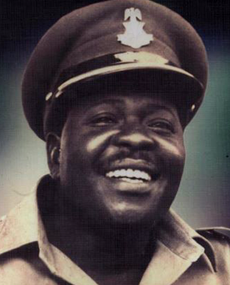
Adekunle Fajuyi
By Pastor Tunde Bakare
It was Frank Rooney who once said: “Immortality is the genius to move others long after you yourself have stopped moving.” Not enough can be said of the contribution of Col. Adekunle Fajuyi to the greater good of our nation. Few in history ascend to the heroic heights attained by this icon. His reported words to his principal, Major General Aguiyi-Ironsi, in that fateful moment in history, are the stuff epoch-making rallying cries are made of:

Adekunle Fajuyi
“I make bold to declare to you that I am with you soul, spirit and body. And mark my words, whatever happensto you today happens to me. I am your true friend like the dove to the pigeon, and by the grace of God, so will I humbly, yet proudly, remain till the very end.”
Whether these words were actually configured in this manner by the subject of our discourse today, or they belong to the class described by the Guest Lecturer, Professor Niyi Osundare, in his brilliant presentation as “fictive recreations or mythic accretions”, the ethos of Fajuyi’s alleged response at that moment in the valley of decision,belongs in the same category as the unforget-table words of his iconic contemporaries when they each stood trial for their convictions. It echoes the courage of Chief Obafemi Awolowo, who, facing sentencing for treasonable felony, marshalled the words of Peter the Hero of Hugh Walpole’s novel, Fortitude: “It isn’t life that matters but the courage you bring to it.”
The great Awo then added:
“It is, therefore, with a brave heart, with confident hope, and with faith in my unalterable destiny, that I go from this twilight into the darkness, unshaken in my trust in the Providence of God that a glorious dawn will come on the morrow.”
The ageless words of Adeku-nle Fajuyi also echo the spirit of Nelson Mandela who, having been condemned to life imprisonment, declared:
“During my lifetime I have dedicated myself to this struggle of the African people. I have fought against White domination, and I have fought against Black domination. I have cherished the ideal of a democratic and free society in which all persons live together in harmony and with equal opportunities. It is an ideal which I hope to live for and to achieve. But if needs be, it is an ideal for which I am prepared to die.”
However, except where the gloom of intellectual darkness has been pierced through by rays of truth, history stands the danger of being viewed through the dark clouds of primordial interests, particularly sectional political motives. Consequently, societies, by their actions and inactions, have tended to accord to George Santayana a prophetic status as they facilitate the self-fulfillment of his indicting words: ”Those who fail to learn from history are doomed to repeat it.”
No greater honour can society accord to its heroes than the reshaping of national psyche and the renewal of national attitudes along the lines of the values such heroes died for. No matter how many roads, stadia, airports, universities and buildings are named after them, society’s failure to imbibe the highest ideals for which they lived and died amounts to a fulfilment of the Biblical truth: “A prophet is not without honour except in his own country…”
Was Fajuyi then a prophet? Perhaps not by any exercise of supernatural powers; perhaps not in the style of the founders of the world’s great religions; perhaps not in any clerical or orthodoxicalorder; but the sacrificial circumstance of his death is laden with answers to the existential crisis that has, for decades, bewildered this nation and, like a prophet, his deeds point the way to the essence and future of our nation. As Prof. Osundare alluded to in his deeply insightful lecture, the sacrifice of Adekunle Fajuyi is central to the resolution of the National Question. In this light, I will examine the import of the heroism of this gift of the Yoruba people to the Nigerian nation in three broad strokes.
Firstly, as alluded to by Prof. Osundare, Fajuyi ought to be a rallying point in our search for a common national identity. The heroic soldier lived in an era that saw a budding nation of multifarious constituents grappling with the challenge of self-definition within the whole. The struggle for identity soon degenerated into distrust and distrust deteriorated into mutual suspicion. That atmo-sphere of extreme sectional sensitivity proved too volatile to sustain the aftermath of the first coup and, in no time, suspicion further congealed into hate which resulted in senseless killings. Adekunle Fajuyi, caught up, as it were, in the crossfire, chose to pay the ultimate sacrifice. By that act, he gave “Nigerianness” a new definition – that to be Nigerian is not to be Ibo, Hausa or Yoruba; that to be Nigerian is not to be eastern, western, mid-western or northern; that to be Nigerian is not to accord ethnic colouration to national challenges; rather, to be Nigerian is to be a person of valour and virtue; one whose word is his or her bond and who would rather die than betray the trust reposed in him or her. Such was the Omoluabi bequeathed to the Nigerian nation in Adekunle Fajuyi by the Yoruba people.
I understand that Prof. Wale Adebanwi, in his brilliant piece titled:”Death, National Memory and the Social Construction of Heroism”,compared the tendency to find inspiration in the deeds of the dead to ancestral worship or necromancy. This point was reiterated by Prof. Osundare as he cited the erudite University of California don. This assertion is culturally accurate. However, in drawing inspiration from the Fajuyi story, I am not in the least influenced by any recourse to ancestralism; instead, I draw inspiration from the Hall of Faith in the Biblical book of Hebrews, the 4th verse of which states of Abel who was murdered by his brother, Cain: “… he being dead still speaks.”
Secondly, in the Fajuyi sacrifice, our nation may find a compass as she navigates the lingering structural challenge. Adekunle Fajuyi served in the government that put the true Federal Republic of Nigeria to death. In the search for unity after the January 1966 coup, the Aguiyi-Ironsi-led government, through the Unification Decree of May 24, 1966, abrogated the federal structure and instituted a unitary system. To this day, Nigeria has not recovered from the structural anomaly that resulted from that action which, ultimately, was a major contributory factor to the deaths of Aguiyi-Ironsi and Fajuyi.Ironically, 50 years later, whereas there is an increasing agitation in the South for the restructuring of Nigeria, this call for restructuring is being downplayed, if not scuffed at, by certain interests, mostly northern, upon the claim that the current pseudo-federal structure suffices.
As Prof. Osundare observed, some of the “neo-restructuralists”, whether of northern or southern extraction, are mere opportunists seeking relevance in a political equation that has dealt them a deficit. The Prof. has already emphasized the need to address the structural challenges from a national, not sectional, perspective. This, I agree with entirely. However, in order to win over the section most averse to the call, I will focus on the seeming northern opposition to the case for restructuring.
Any anti-restructuring position taken by the North would bring to the courts of historical opinion the sincerity of the motives of the perpetrators of the countercoup that led to the death of Adekunle Fajuyi. The elders of the North who, today, are opposed to the call to restructure Nigeria have deviated from the ideals of the founding fathers of Northern Nigeria – the likes of the Sardauna, Sir Ahmadu Bello and Tafawa Balewa; leaders of our nation who were forerunners of Fajuyi in the Nigerian hall of martyrdom. Lest we forget, these great Nigerian leaders from the North made it clear in the series of constitutional conferences that heralded Nigeria’s independence that true federalism with regional autonomy was the only condition under which they would exist within a Nigerian nation. Need we remind those in opposition to restructuring today that one of the main grouses of Nigerians of northern extraction within the army and civil society after the first coup was the abrogation of the federal system by the Aguiyi-Ironsi-led government? This, without doubt, was the main reason the northern leaders and the counter-coupists who took the lives of Aguiyi-Ironsi and Fajuyi demanded a reversal of the unification decree and a return to the federal system of government.Consequently, to oppose restructuring now, 50 years after, is to confirm the words of Aesop, that “the injury we do and the one we suffer are not weighed in the same scales.”
In case it is not clearly understood by the antagonists of restructuring, whether they be from the North or the South, let me make it clear that the call for restructuring is a demand for true federalism; a demand for federating units that can truly self-administer like the regions in the days of our Founding Fathers; a demand for the prosperity of the constituent parts that make up the whole. It is therefore inconsistent with the interest of the North or the South for the current pseudo-federal structure to persist. If the elders of the North are true elders in this generation, I charge them with the words of the wisest king who ever lived:
“Do not remove the ancient landmark which your fathers have set”. –To be concluded..
*Pastor Tunde Bakare presented this speech at the Adekunle Fajuyi Golden Remembrance in Ibadan on July 29, 2016.
Feedback
Re “As it was in 1953..& Col. F. Fajuyi: They want us to forget”
Good morning, our very dear Mr Odumakin. I do hope you and your family are fine. I am indeed amazed and thoroughly impressed with your wealth of knowledge/intellectual prowess that is effectively backed up with very balanced and fair sense of judgement.
Indeed, after going through the two pieces above, I couldn’t agree less with Uncle Dele Sobowale that History and Economics are two basic most important subjects any President worth the name must be well equipped with. It is indeed a very serious DISASTER that we don’t have up to 1% of the likes of Col. Fajuyi in today’s Nigerian Military.
His military discipline/ethics was ‘unAfrican’. And I have always reminded some of the short-memoried Easterners who sometimes refer to the Yorubas as sell-outs just because of Pa Awolowo/Ojukwu ‘failed accord’, of that exemplary valour displayed by the blessed late Col. Fajuyi. Col Fajuyi was indeed and truly a soldier’s Soldier.
Somehow, Gen. Muritala had to pay dearly too for most of the unwarranted murders he undertook in his lifetime all in the name of revenge. And for Generals Gowon and Danjuma..?
Their kinsmen have NEVER slept with their two eyes closed since after the Dimka’s failed coup due to the Jihadist Fulani’s herdsmen…who probably, in a way, must’ve been empowered too to equally revenge that “Middle Belt” coup. Nigeria, indeed a country perceived and built on FALSEHOOD by Britain can hardly know genuine peace.
Bro Odumakin, no one escapes that great law called Karma. May the LORD continue to protect/bless you and your family.. IJN.
Great Ife!!!
Goddy Ikperite- Lagos.
Disclaimer
Comments expressed here do not reflect the opinions of Vanguard newspapers or any employee thereof.