
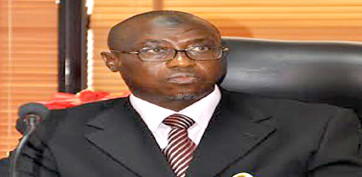
NNPC Boss, Baru
By Sonny Atumah
An anonymous quote has it that self-praise is no recommendation. Once upon a time there was a character out of fable; the widely known and recognized lizard which made a spectacle of itself at the village square when by accident it came down from the heights of an iroko tree. It noticed that nobody applauded it falling from an imagined height of the 200-metre Eiffel Towers in central Paris. It nodded its head three times in self-congratulation.

Baru NNPC Boss
The story has a semblance of the way the human being responds to a specific set of conditions. We indulge in self-glorification which is the promotion of one’s own qualities and abilities especially beyond what is true or appropriate. Even when nobody decorates us we adorn ourselves with garlands. Having played our parts we in positions of authority should be self-effacing and learn that history is the best judge.
Most times leaders refuse to listen; they aggrandize the value of their perceived accomplishments and offend their followers’ sensibilities. They fail to know from the words of British monarch George VI that it is not the walls that make the city but the people who live within them. We continually pray our leaders serve us well for our society to be better.
A week ago one tried to comprehend the NNPC report presented by the Group Managing Director, Dr. Ibe Kachikwu to his successor at the NNPC, Dr. Maikanti Kaccalla Baru. The report gave an impression of an operating profit of N273.74 for the month of May 2016 reversing the losses of N35 billion made by NNPC over the last 15 years. The monthly report stated that PPMC recorded a net gain of N17.69 billion as against the net loss of N6.91 billion in April following complete stoppage of commercially unfavourable swaps and offshore processing agreements (OPA).
We know that on May 11, 2016, the PPPRA announced a price increment of PMS with immediate effect citing extreme difficulties faced by petroleum products importers in sourcing foreign exchange. The NNPC we know had gone cap in hand to integrated oil companies (IOC) for bailed out with US$200 million worth of products from offshore refineries. NNPC then increased the pump price of petrol by 68.60 percent from N86 to N145.
Nigerians were bumped up, down and startled into reality to pay exorbitant rates for imported petroleum products even when international crude oil prices were falling. There were glutted markets for refined petroleum products that led to an armada of over 75 ships around the Lagos quay from non-producing consumer nations in north Western Europe. Household kerosene, HHK has since risen from N50 to over N200 per litre, increment of 300 percent, ditto aviation turbine kerosene, ATK. Automotive gas oil, AGO or diesel now sells for N200 per litre.
The NNPC was not set up as a petroleum marketing company. It increased the prices of imported petroleum products and made super-normal profits at the expense of the vulnerable Nigerian. It raised additional revenue for government but a greater socio-economic problem to the people. The attendant inflation is making manufacturers’ battle for imported raw materials in the floated exchange rates regime introduced almost simultaneously. Many companies including micro-small-medium enterprises that soak up unemployment are closing shops, with some banks retrenching staff members. It was indeed a hollow victory.
What about the refineries? According to Kachikwu, for the month of May, 2016 the four refineries produced 242,053 MT of finished petroleum products out of 301,604 MT of crude processed at a combined capacity utilization of 16.03 percent compared to 19.32 percent combined capacity utilization achieved in the month of April 2016.
The optimum capacity of the NNPC four refineries is 63,571.42 MT (445,000barrels) per day and 1,970,714.29 MT (13,795,000 barrels) per month. NNPC was getting this supply of crude without fail. When processed we have these three products that make up 80 percent of the value chain as follows: PMS or petrol 47 percent giving 29,872.14MT per day (926,036.43 MT per month), DPK 10 percent giving 6357.14 MT per day (197,071.43MT per month), AGO 23 percent giving 14,621.43 MT per day (453,264.29MT) with a total of 1,576,372.15MT per month.
Other 25 percent (including five percent refining gain) products and derivatives like propane, 4 percent; asphalt, 3 percent; and petrochemicals feedstock, 18 percent; are not included in this value chain. Should we rejoice that we lost an aggregate of 85 percent of crude that went into our refineries over the period? One thinks we would have done better since a genuine process of bringing back the refineries would have saved us the agony of importing products.
A manufacturing concern that operated at the level NNPC operated our refineries did not break even. At that level of operations with full complement of process plants, staff members, crude oil and other costs an organization would prefer to close down rather than produce. In micro-economics, it is shut down point. The best we had was the April 19, 2016 advertisement for international bidding for companies to invest in the rehabilitation of the refineries and get their monies as they operate the refineries in joint partnerships. It was like having our cake and eating it which was not possible.
The upstream (exploration and production) petroleum sector has been in the hands of foreigners who own equipment, storage, terminal and export facilities. We have running battles with these super majors over production sharing contracts (PSC). These IOCs recently accused the NNPC of taking more than its share and caused delay in crude loading programmes.
The NNPC owes oil super majors over $5 billion in the upstream joint venture cash calls. In 60 years of petroleum discovery we are struggling in the upstream sector but cannot produce up to 10 percent (about 200,000 bpd) as our local contribution to the till for sharing.
China, India, Japan and South Korea which are becoming biggest users of oil are all benefitting from low crude oil prices saying that it was the best time they have ever had as buyers enjoying an overflow of oil. Gasoline stocks built up off the radar in Europe, United States and Asia with anticipation of car sales rising in the three world’s largest automobile markets of China, India and the United States, to soak up excess gasoline.
Rehabilitating our refineries, would make us self-sufficient in petroleum. We must garner the managerial and technical competences for complex plants. Kachikwu left the scene for the new NNPC management helmsman Dr. Baru to address the problem of idle and decayed refining infrastructure for the needed value addition to have products locally. Nigeria has relative comparative and competitive advantages in oil and gas resource. With Kachikwu’s vast experience and tremendous goodwill from where he came from was he able to attract genuine partnerships to diversify our economy through petroleum vertical linkages? Time will tell!
Disclaimer
Comments expressed here do not reflect the opinions of Vanguard newspapers or any employee thereof.