
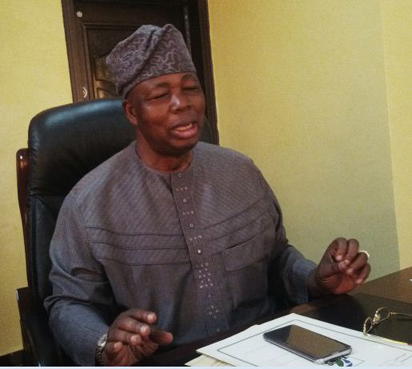
Chairman, Tuns Farms Limited, Tunde Badmus
THE Federal Government recently signed a Memorandum of Understanding, MoU, with Tuns Farms Limited for the National Egg Production, NEGPRO, scheme. The scheme to be financed by the Bank of Industry, BoI, is worth N25 billion .
The Minister of Agriculture and Rural Development, Chief Audu Ogbeh, signed on behalf of the federal government while the Chairman, Tuns Farms Limited, Asiwaju Olatunde Badmus, signed for his company.
In this interview with Jimoh Babatunde at his farm in Osogbo, Osun state, Asiwaju Olatunde Badmus talks about what the agreement is set to achieve as well as plans to create one million jobs through the scheme and produce 50 million table eggs daily by 2018 and other issues. Excerpts.
ON government’s focus on agriculture
It is not just that the government is interested in agriculture , it is the circumstance it has found itself today that has made it imperative for the government to be more serious in developing agriculture because there is need to diversify the economy away from reliance on oil alone .
God has given us in this country mineral resources and fertile land for agriculture . The government is not only interested but committed in making sure that we are able to feed ourselves, by producing enough food to feed about 180 million Nigerians as against the previous government’s lip service to agriculture.

Chairman, Tuns Farms Limited, Tunde Badmus
This time does not call for lip service as the reality on ground favours agriculture. To the best of my knowledge, this government is fully committed to agriculture.
On the NEGPRO, scheme
It is that committment that led to the agreement we recently signed with the government on the National Egg Production, NEGPRO, scheme.
Setting up a poultry farm
The Federal Government asked us to go to the grass roots .
We were asked to go to the 774 local government areas in the country and set up a poultry farm as we are supposed to generate about one million jobs at full capacity, empower as many farmers as possible, increase contribution of the poultry sector to GDP of Nigeria and increase Internally Generated Revenue to the Federal Government of Nigeria.
So we are going to sell a minimum of 20,000 birds for them to produce eggs for the school feeding programme of the government. It is every local government we are going to now and we will not give more than 2,000 birds to one person. 2,000 birds is enough for anybody to manage within a family and feed for one year. So at the end of the day, the person will pay back and have something to feed the family and also have the market for their eggs.
So, we are going to all the 774 local governments in the country. This is not going to be done in one day as it has to be gradual.
On where they are starting from
We will focus on the regions that are not producing eggs currently, there are areas in the country that are self sufficient in egg production , it is not all local government that is self sufficient, there are some areas where one farm alone can supply all the eggs the state needs.
We will start from areas that are not producing now so that the children there can have access to at least one egg in the school feeding programme in a week. But the government is saying at least two eggs per week because of the nutrient values inherent in eggs .
You can see the seriousness of this type of program as the government is serious about it and asking me to start from the grass roots and not asking me to stay in Abuja to buy the products for ware housing .
On the company’s take on the MOU
For us as a company, we have the track records and which we believe informed why the Federal Government decided to have us on. Today, Tuns Farms ranks amongst the top three producers of broiler meat in the country and is a leading figure in the poultry industry in Nigeria which it operates with modern poultry production technologies comparable to what is obtainable in the developed world.
In Osun state, when Governor Rauf Aregbesola’s government came he said he wanted to empower farmers , we told him our area of specialization is in poultry. The Governor asked what he can do to increase broilers production in the state and what it will cost him . I told him with N350 million that he will get the results, which made us to sign an MOU.
He invested N350 million in poultry farming and we divided the responsibilities into three.
The money deposited by the government was for the feeds, we were to provide the chicks and the Poultry Association to provide the vaccines.
The government went beyond that initially by saying they wanted to jump start the program by giving N100 for every chick we gave to the farmers to run the business. The N100 was meant for labour and any other thing needed to raise the birds. That was done in the first year.
And we started with nine farmers , but today we have 550 farmers in the project. But the N100 incentives is no longer there and the farmers have stabilized and are making profits . We have paid about N600 million as profits to farmers in Osun State.
This was what the federal government saw and said they believe in us to handle this school feeding program, but this time around it is not going to be broilers but eggs. If you go for broilers, you must have processors that will process and it is not easy now.
During my tenure as the President of the Poultry Farmers Association in collaboration with then President Obasanjo and Audu Ogbeh we drew the road map for the industry in the country. As most poultry farms then doubled their production by more than 200 %.
The focus then was on broilers, the meat, but this time around it is on the eggs and how to make sure it gets to all parts of Nigeria. . So, we have to be in all local governments now.
Eggs we are producing now makes up about 10% of our national requirements, and under this MOU we will not have a glut again in this county , every time we produce eggs in excess, we are going to process into egg powder as we are going to have six egg powered machines in each zone of the country. That will consume about 100,000 eggs every hour that will turn them into powder and instead of importing egg powder from India or anywhere, we are going to be producing egg powder for children’s meals.
You can see that this is one of the real sector the government has intervened now and as I said it is based on our track records in Osun where you can verify those who have benefited from the project.
On how long it will take the company to fill the egg gap in the country
The MOU is to run for 4 years and the target is for us to produce 50 million table eggs per day in this country by 2018 . So to move forward we need to have people interested in what we are doing. We have received invitations from at least six governors who want to us to start from their states. In that case we will give priority to such states as the governors will give support to what the farmers need there.
Because the money earmarked for the program is not meant to be shared to the farmers , it is meant for those who have enough security to have access to that money. In that case, there is money for anybody who wants to invest in that line, but must meet up with the bank requirements.
So any state we are going into, there is need to have the supports of the government as one of the terms of the MOU is for us to go through the cooperative societies. .Any farmer interested will need to go through the ministry of co-operative in the states , in that case there is going to be assistance to be rendered by the government of the states.
Major stakeholders
Already, we have received about six invitations from the states, but the major stakeholders are meeting on Friday . The major stakeholders are the national inputs suppliers , who are to supply day old chicks; those who will supply the feeds; those who will supply the vaccines and those who will supply the cage and housing. We have designed cage and housing that can take 2,000 birds.
There are some states that might want to design this for their farmers to encourage them or provide loans for them. The major stakeholders are the four key partners mentioned and the officials of the ministry, our company and the Bank of Industry , the financial institution that is to manage and disburse the N25 billion CBN Anchor Borrower Scheme to eligible entrepreneurs.
Since the first year is going to be a pilot scheme for 6-10 states, so these states will be known when we meet the governors of the states formally.
We were supposed to write to the states, but if some of them are writing to us already that show they are interested in the scheme.
After the meeting of the stakeholders, they will know where to take their money and what responsibilities given to them then the next thing is to go to the states that are ready.
The state are expected to have entrepreneur as all those materials that will be supplied by the stakeholders will be given to the states entrepreneur.
Disclaimer
Comments expressed here do not reflect the opinions of Vanguard newspapers or any employee thereof.