
Dele Sobowale
“The law, in its majestic equality, forbids the rich as well as the poor to sleep under bridges, to beg in the streets and to steal bread.” Anatole France, 1844-1924. (VANGUARD BOOK OF QUOTATIONS p120.
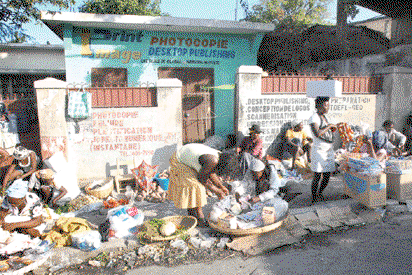
History has recorded that the law, even in today’s Europe (before Brexit) has failed miserably to totally wipe out sleeping under bridges, begging in the streets and stealing bread. Napoleon Bonaparte, 1769-1821, emperor of most of Europe, at one time, once scornfully called the British “a nation of shopkeepers”. If a modern day Napoleon were to come to Nigeria and travel all our thirty-six states as well as the Federal Capital Territory, FCT, he could, with irrefutable justification describe Nigeria as a nation of street traders.
From Abia to Zamfara, with the exception of farming, no other means of employment engages our people than street trading. Having traveled to all the thirty-six states more than ten times each, this columnist and compulsive traveler can state with absolute certainty that if a census of street traders is ever undertaken in Nigeria, it will reveal nothing less than 40 million people involved in what some states now want to criminalize. 
Furthermore, it is the only means of employment available to that large number of people – without which they will simply starve to death. If Nigerian street traders were to be a country, they would be one of the largest nations in the world – the second largest in Africa. Think of that for a moment.
To some extent, the states which had enacted laws banning street trading and begging (that is an issue for another day), although seemingly applying them equally to all, are to some extent elitist. The street trading laws in Nigeria also forbid Dangote, Elumelu, Otedola and Atiku from street trading; just as they prohibit Dauda in Ningi, Ngozi in Onitsha, Ochefu in Makurdi, and Salami in Ibadan from doing so.
To that extent they are seemingly not discriminatory. However, when Madam Ngozi, serving proxy for millions of such traders, opens shop to sell cooked Dangote noodles on the street at Nkpor, Dangote is the major beneficiary of the trade; more than the cook. Cold Coke, Pepsi and Fanta sold to sweating commuters held up in traffic, anywhere in Nigeria, serve several social purposes whose discussion need not delay us here. But, Coca-Cola and Seven-UP, whose managers will never get arrested, benefit more than the vendors of those goods.
Perhaps one fact which had eluded the framers of the laws is the operation of the principle of self-preservation. When the state forbids millions of people who have no other means of earning their daily bread to stop doing so, it is inherently asking them to “go and die” (as one Governor told a street trader in full view of cameras and journalists). Though the governor belatedly “explained” himself, in reality, he uttered what other governors feel about poor street traders. They would rather have clean streets even if it means the traders go and die. That brings us to a question.
Who are the people governments are elected to satisfy? Alfred North Whitehead, 1861-1947, had observed that “Governments are best classified by considering who are the “somebodies” they are, in fact, endeavoring to satisfy.” Applying that principle to the states and the FCT which had attempted to ban street trading without success, one can ask: who are the expected beneficiaries of the laws? There are more street traders than any other class of workers. Certainly, more than the Dangotes and Otedolas. We know the victims of the laws; they include the traders themselves and their dependants which would swell the population of sufferers to over 80 million. That is almost half of our population who would be adversely affected by rigorous enforcement.
Governments are among the major beneficiaries because street trading indisputably promotes monumental environmental problems. A recent global report which ranked Onitsha and Aba among the world’s dirtiest twenty cities, merely confirms what those of us who had spent decades in marketing consumer goods know –Onitsha and Aba constitute the spark plug of trade in Nigeria. Mountains of packaging materials end up in those two cities everyday challenging, and obviously overcoming, States and Local governments. The major beneficiaries of the mountains of filth in Onitsha and Aba are the manufacturers located in Lagos and Ogun States. How Lagos and Ibadan managed to escape being included among the dirtiest cities is a mystery to me. But, be that as it may, governments want to maintain a clean environment and street trading negates all efforts to achieve that environment.
Motorists constitute another segment wanting street trading banned to allow free movement of traffic. But, here there is a clear divergence of perspectives between those driving their private cars and those engaged in commuter transport and their passengers. The drivers want to move as fast as possible but the passengers want to shop on the go. For the passengers especially in traffic hold-ups, on hot days, buying those cold drinks is indispensable. After all, the hold-up was not their fault.
Without belabouring the point, it is clear that governments cannot successfully ban street trading. In fact, the only way any government in Nigeria will succeed is to build gas chambers and ask the traders to voluntarily walk into them. For too many millions of our Fellow Nigerians, street trading is the only means of livelihood and asking them to stop amounts to requesting for voluntary euthanasia. It won’t happen and governments might as well try another approach.
The first step in “thinking out of the box” is to accept that the current approach is not working and for the reasons (too many people involved and no jobs as alternatives) stated above will NEVER work. The recent re-statement of the law by the Lagos State Government and the obvious almost total defiance would serve as the take-off point for how we might collectively manage this monster of a problem. Tough talk will not do it and the second part will demonstrate why we should discard it before government is shown to be powerless.
Why am I starting with Lagos, instead of any of the other cities in Nigeria, all known to me? The reason is simple: charity always begins at home. This is my state and it will eventually face a more difficult task than Onitsha and Aba in the future and might become dirtier.
PDP AND THE SHIP OF FOOLS
Folly is matter, and cannot be destroyed. Destroy its form and it takes another. Horace Walpole, 1717-1797. (VBQ p 61).
One of the mysteries facing historians in the future about our era must be how to explain that the Peoples Democratic Party, PDP, which started with the G-34, a bunch of the brightest and best leaders in Nigeria degenerated to the point where it is now led by bumbling morons called leaders. Dr Alex Ekwueme, former Vice President was the founding leader and he once fondly called the PDP “my baby”. He is not the only founding father still alive today.
One would have thought that the present contenders for leadership, having reached a stalemate, would, like the Biblical prodigal son go to the founding fathers still alive and beg them to take back the party. But, no; they don’t have sense. They want to continue on the path of self-destruction. Ordinarily, that should be no concern of mine. But, they are also driving us towards a one-party and one-man dictatorship. When they do, I hope they will be the first people to be consumed by it.
Disclaimer
Comments expressed here do not reflect the opinions of Vanguard newspapers or any employee thereof.