
Bailout
By Dele Sobowale
“History never repeats itself; man does.” Barbara Tuchmann; Harvard University History Professor on 13th and 14th century European history.
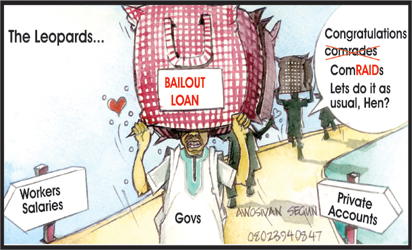
There are two Ministries scaring the hell out of a lot of experts these days the Ministries of Justice and Finance. Right now, it is difficult to know which of the two will finish us in first. This is not the Law page, comments on the activities of the Minister of Justice and Attorney-General of the Federation will be left to others versed in litigation. Finance is another matter and here what is easily discernible is that the Federal Government is setting a bad example in fiscal irresponsibility for the states by adopting a “borrow-and-spend” policy.

The last time the Federal government negotiated loans on behalf of states was in 1993/4 when the Babangida administration imposed the National Water Rehabilitation Loan Scheme on the thirty states then in existence. It became a heavy burden on the states and in the end the scheme was a colossal failure. Mrs Adeosun is embarking on another adventure which will get the states nowhere.
Ordinary elementary school arithmetic suggests that N90 billion for 36 states comes to N2.5 billion per state. Most states owe several months’ salaries — far more than N2.5 billion can liquidate. Obviously, after paying one month’s arrears of salaries, the states will be back where they started. So, what happens next? Another loan? This is not financial management; this is fiscal irresponsibility.
Nothing has supported that view more than the fact that the first six states to apply for loans, under the scheme, have requested for about N60 billion or 66 per cent of what is available. Are the remaining thirty states supposed to make do with 34 per cent when they are ready to apply? Or would the Federal Ministry of Finance get itself involved in allocating the insufficient funds and risk getting the Federal Government accused of favouring some states?
More to the point, Governor Ajimobi of Oyo State after applying for N14.6 billion quickly pointed out that it will not permanently solve the state’s problems. What it will certainly do is to add to the state’s debt burden which will have to be discharged with rapidly declining aggregate revenue. That said; Nigerians need to see the situation in which the nation finds itself clearly. So, a quick summary is necessary. But, before that a brief history is also essential.
When in 2004, Dr Ngozi Okonjo-Iweala, as the Federal Minister for Finance negotiated Nigeria’s exit, “Nexit”, from crippling debt trap, few people were aware that the debt burden of US$36 billion started from a mere US$2.8 billion taken by Obasanjo’s military government in 1978. At the time, acting on the advice of “technocrats”, who assured that the country was “under-borrowed” (meaning we had not borrowed enough), they persuaded the government that the loan could easily be repaid.
The price of crude then was near record (for that era) at over USS18 per barrel. Obasanjo’s exit, followed by the wasteful and corrupt government of President Shehu Shagari, increased the debt burden simultaneously as the price of crude was going steadily down. When late Chief Obafemi Awolowo warned the Shagari administration early in 1983 that the economy was heading for a crash, the sage was asked to shut up. By December 1983, it was clear to all, but fools and liars that the economic crash had occurred. Buhari and his co-conspirators seized power and inherited an economy in distress made harsher by the nation’s inability to pay its accumulated debt.
Babangida, IBB, followed Buhari and introduced the humiliating debt-rescheduling programme under which unpaid debt was rolled over with interest and penalties were imposed by our creditors. By the time Abacha took over from IBB, the debt had amounted to over US$30 billion. Between Abacha and Abubakar another US$6 billion was added. But, the “hand of God” was on the way to help the country out. The last two years of Abacha and Abubakar and Obasanjo’s first term witnessed a steady increase in the global price of crude oil as the world economy expanded by more than 4% annually and the demand for crude grew exponentially.
For once we were earning more than our annual budget and could save and pay our current debts. By 2004, we had accumulated over US$36 billion in external reserves, most of which Okonjo-Iweala used to get us out of debt – with a strong warning to governments which will follow Obasanjos. The warning briefly summarized was: cut your coat according to your cloth; and save. Unfortunately, it was a lesson lost on the next two successors to Obasanjo – especially to President Goodluck Jonathan. His government combined alarming profligacy with unprecedented grand larceny to bring us to where we are today.
Jonathan re-introduced the “borrow-and-spend carelessly” concept of governance and operated as if corruption is a virtue to be supported by government. The country is paying dearly for it. Despite the fact that the price of crude oil reached its highest level, US$143 per barrel, in 2012/2013, and averaged over US$100 per barrel in the five years Jonathan ruled, the country’s external reserves plummeted disastrously. Despite warnings by well-meaning observers that the price of crude was undergoing another cyclical downturn, GEJ went on spending and wasting as if nothing has changed. By 2015, it was clear to Nigerians as well as foreigners that a change of leadership was inevitable if the nation was to survive. The change of leader came, but, unfortunately, the “borrow-and-spend” policy persists till today. That is the problem….
Disclaimer
Comments expressed here do not reflect the opinions of Vanguard newspapers or any employee thereof.