
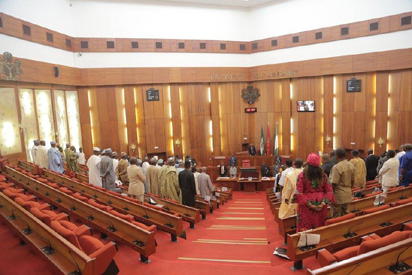
senate chamber
By Emmanuel Aziken, Political Editor
For an administration and a legislature looking for every opportunity to embarrass the other, the issue of constituency projects seems to be a readily available issue for dispute.
Since they were first embedded into the country’s budgetary process, constituency projects have continually been a point of discord between the legislature and executive branches of government.

The constituency projects are line item projects selected by legislators into the federal budget for implementation. In the beginning, under the Olusegun Obasanjo administration, the projects were mostly restricted to water and rural electrification. Even when the projects were put into the budget, the Obasanjo administration almost restricted its implementation of projects to those the executive branch inputted.
It was as such not surprising that the non-implementation of the constituency projects became a sore issue and was one of the items listed when the Ghali Naaba House took the decision to impeach Obasanjo in 2002.
The point of departure between elements in the executive and legislative branches is that the executive knows best what should be meant for the people whereas the legislators on the other hand claim to know the felt needs of their people more than the bureaucrats who fashion the budgets.
Given the negative image that administration officials have sometimes used to stereotype the legislators, it is not surprising that the planting of constituency projects by the legislators have been used as another example of the recklessness of legislators. Critics have frowned that the legislators may be overstretching their arms by dictating projects for the administration.
Indeed, the negative image of legislators has not been helped by reports that some state legislative houses including Bayelsa hand over the money for constituency projects to the state legislators to execute.
The contention is not limited to Nigeria. In the United States, such projects are called pork barrel projects, and they include projects inputted by legislators aimed at drawing federal dollars to their legislative districts.
Given that the budget is a piece of legislation, the recent contention by Mr. Babachir David Lawal, the Secretary to the Government of the Federation, SGF that the Muhammadu Buhari administration would not be able to implement fully constituency projects brought out the ire of senators who compelled him to appear before the Senate last Wednesday to defend his assertion.
At the end of the stormy session, the senators put it to the SGF that the budget was a law which should be respected. The fact laid by the SGF that income into the government accounts has fallen by 40% of expected revenue in 2016, however, cannot be disputed. That it behooves handlers of the SGF and other administration officials to do the needful by seeking amendments to the budget is a fact they almost all seem to be glossing over.
Arising from the appearance and the controversy surrounding the implementation of the constituency projects, some legislators put forward their observations.
By Henry Umoru, Johnbosco Agbakwuru & Joseph Erunke

SENATE CHAMBER
REP. Onyemaechi Mrakpor, PDP, Aniocha/Oshimili Federal Constituency, Delta State.
Constituency project is our obligation as legislators especially given the promises we made during campaigns.
You campaigned to the people that you will get the government to meet their needs. If I come from a place that the people are predominantly farmers, and they have produce, they need to take their produce to the market and the only way they can do that is to have good roads.
If during the campaigns I said if I am elected I am going to put this so, so road in the budget to make sure it is done, I don’t see the reason why the executive should deny me the opportunity. I am not saying give me the project, I am not a contractor, but having to put that project which is the need of my people, the people I represent, I think it will be absurd for anybody to deny us that opportunity.
Award of contracts
If you say we shouldn’t do that, so, who takes care of my place? Is it the minister of works who probably had not heard of my place and of course, there is every likelihood that he is not going to meet the needs of my people.
Let them award the contracts to whoever they want to award the contract to but we are saying as the representatives of the people, we know the needs of the people we represent. While we were campaigning they told us their needs and these needs we must satisfy.
A legislator is the representative of the people, the voice of the people; you are the one that listens and collects information from the people, and when you collect that information, you pass it on. How do you pass it on?
By saying when it is time for budget briefing or before the budget briefing when they come towards the period of budget presentation, you say look, I come from a place where the federal road there is long abandoned, I need this federal road to be put in the budget, that is all the legislator should do, and that is what they are trying to deny us.
If we need a general hospital, I should be able to say we need a federal health centre here. We have a state health centre but is kilometres away from my people, they need a health centre and at a point where the health centre is not able to handle the issues they can be transferred to the General Hospital. I should be the one who should say that because I am the one that knows.
Rep Bede Eke, Aboh Mbaise/Ngor Okpala Federal Constituency of Imo State
I AM surprised anybody would talk about constituency projects not being a priority. The matter is simple. No constituency projects, no dividends of democracy for the people.
The only way the people at the grassroots can have a feel of government or democratic dividends is by having developmental projects at their door steps. It is only the representatives of the people that know what their constituents want and what their immediate needs are.
How many constituencies in this country have directors in government ministries and departments that can bring development to them? The tendency is that those at the top would influence projects only to their areas. A director from a community in Imo State, for instance, would not know the needs of a community in Osun State or Bauchi State and therefore, the director cannot attract development to those areas.
Senator Danjuma Goje, APC, Gombe Central:
I WANT to let the executive know that the budget they are implementing is a law passed by the National Assembly. It is an Act of Parliament which the President willingly accepted and assented to. So, if there is need for any review following challenges in the revenue generation as they are saying, the law in the Constitution provides for a review through the parliament.
We are operating a democracy and therefore we must make sure that we follow the laws in all that we do. So, if the executive feels that the constituency projects should not be there, they should ask us to review the budget and not to hear what they are now saying after the projects were captured and appropriated for in the budget.
Constituency projects are small projects such as rural electrification, boreholes , class rooms, culverts, small hospitals which allow an ordinary man to know that government exists.
What is the worth of constituency projects that the executive would single out not to do? After all, the 2016 budget is over N6.06 trillion, the cost of executing these constituency projects is less than 0.6 percent of the entire budget.
Senator Rafiu Ibrahim, APC, Kwara South
FOR me, I view the SGF’s statement as an attempt to embarrass the legislature.
If the execution of projects is based on prioritization, let me ask them whether the State House Clinic is critical to the situation of Nigeria because we have it on record that in the releases that have been done, the State House Clinic has started getting funding. Is that more important than my boreholes that will feed a hamlet?
Senator Mao Ohuabunwa, PDP, Abia North:
WHEN you talk of the executive, those that have mandate of the people are the president and the vice president but if you put it together, they could be on one ticket. Every person in the legislature, 500 or so, are elected with mandates covering the entire constituency of the executive.
The constituency of the president is Nigeria. And every part of this country is his constituency. We are representing sections of the constituency. So, any project done in Hong, Ipela or anywhere in the country is done in Nigeria. So, indirectly you have covered the president’s constituency because the president cannot go round the country, we are the ones representing the president.
So, I just want to put this point clear for them to know because of the SGF ‘s statement that the executive determines which project to execute and which not to. They must know that apart from the president and the vice president, every other person in the executive is an appointee of the president.
I also want to make something clear, I was privileged to be part of this National Assembly in 1999. I was also privileged by the special grace of God to be part of the inventors of the constituency projects.
It was not easy for the executive to let it go. In short, the first term, from 1999 to 2003 it was all fight; it couldn’t go through but when it came on board, the constituency projects today and what the executive term as zonal intervention are completely different.
The core appropriation of either ministries, departments or agencies is completely different from the intervention. Most of these zonal interventions were moved from different areas where they were moved to all the other areas by the executive.
If you look at the complete budget presentation as signed, there are two documents. If you look at volume two, you would see that zonal intervention is different from, that is what we called constituency projects.
Senator John Enoh, PDP, Cross River Central:
I chair the Senate Committee on Finance, so I understand how the finances are in terms of revenues and all that. But I think the statement of the SGF has more to do with the view or not to want to implement zonal intervention projects. The executive must appreciate the fact that in the budget, the provision for zonal intervention comes under capital supplementation as a lump sum. It’s not distributed by MDAs. The details of this budget and everything that is contained in that document have now become Acts of Parliament, they have become law. So, they should have made their points or observations known to us as a legislature before?
Sen Timothy Golu, Pankshin/Kanke/Kanem Plateau
THE SGF is talking from the
two sides of the mouth. I don’t know which side he belongs to. Today he will say this; he will say that; he was here when the National Institute for Legislative Studies, organised a workshop, he was there.
He commended it but said that the process need to be monitored so as not to breed corruption and we accepted that.
He is the same SGF who said that without the constituency projects, some communities will not witness governance for the next 200 years, he said it by himself.
I am part of the committee that oversights his office, we went to his office and he said so. So, why is he talking from both sides of his mouth?
Let me tell you, without constituency projects, some communities will never feel governance, they will not even know whether there is government in Nigeria or not.
The best approach to budget is through the representative structure of the parliament whether at the local, at the state or at the federal government because there is no village that is not covered by a state assembly constituency that is not under a federal constituency or that is not under a senatorial district, there is no village in Nigeria.
So if you don’t have a permanent secretary, what do you do, if the executive doesn’t want this to continue, then, they must be responsible to their own duties, they must sit up and do what is right, they must make sure that everything is balanced.
Disclaimer
Comments expressed here do not reflect the opinions of Vanguard newspapers or any employee thereof.