
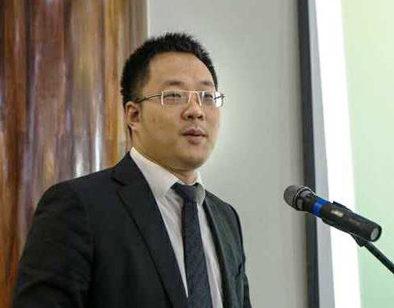
Frank Li, Managing Director, Huawei Nigeria
HUAWEI Technologies, the leading provider of next generation telecommunications solutions, has been conducting business in Nigeria for 16 years. Since entering the market, the company has helped to improve Nigeria’s ICT infrastructure which plays an important role in GDP growth and job creation.
In this interview, Frank Li, the Managing Director of Huawei Nigeria discusses the company’s diversified business with strong heritage and how he’s grappling with the Nigerian digital realities.
HUAWEI has achieved great success, globally. How did Huawei emerge from a small unknown Chinese company to a top player in the global market? How has Huawei eaten away the market share of its competitors, including established companies like Nokia and Ericsson?
The first is that Huawei values R&D investment, technology and innovation. In the past 10 years, we invested more than $30 billion. Secondly, Huawei values the management. When Huawei was still very small, the CEO and founder, Ren Zhengfei, said, “We can learn. We should learn management experience from other companies.”
So Huawei invests heavily in management. The third success factor is Huawei’s employee shareholding mechanism. This enables employees to share the success of the company.
Economic prosperity
We have 84,000 employees that have company shares. And the biggest shareholder is Mr. Ren, our founder. He only has 1.4% of the company shares. ICT market in Africa and the whole world is open and very competitive. Huawei is a global company. We benefit from a growing demand on ICT infrastructure and the economic prosperity. You should say Huawei has worked together with these companies to contribute to the world.
At the time Huawei entered the Nigerian market, what where the signals you saw that made you think you’ll succeed in this market?
Huawei has been in Nigeria for 16 years. We helped Nigeria to improve the ICT infra-structure, which plays an important role in GDP growth and job creation. The reality in Nigeria today is that there is still a digital divide. Therefore there is a huge demand potential on the access to the network from our carrier customers, enterprise customers and devices consumers. Huawei, as a leading ICT solution provider, has a lot of responsibilities to enlarge ICT infrastructure and to build a better connected Nigeria.


Frank Li, Managing Director, Huawei Nigeria
What do you think of Huawei’s growth in Nigeria, and the opportunities and challenges it faces here?
After 16 years of development in Nigeria, Huawei has received an excellent response from the market and aims to expand its investments in the coming years. It sets up strategic alliances with local powerful partners and secures WIN-WIN business partnership. Innovative solutions and dedicated innovation on customers’ needs significantly bring true values to the customers. The challenge here is how we should bring the innovative technologies and affordable solutions and dedicated services to Nigeria. The infrastructure still has room for improvement. This is not just Huawei’s challenge; but it is a challenge for all the players.
What’s the strength that has sustained the Huawei brand in the Nigerian telecoms market?
Innovative, affordable solutions, quick response to customer needs and dedicated services.
How confident are you about growth prospects going forward in Nigeria?
I am very optimistic about the economic growth in Nigeria. I believe the ICT technologies are going to play a more important role in this process. Huawei is committed to deliver innovative, affordable solutions and dedicated services to Nigeria.
What are your plans over the next five to ten years?
We aim to enlarge the ICT infrastructure to build a better connected Nigeria. Our core business here is consistent with our global strategy, which includes carrier business, enterprise business and consumer business. We provide products to the carrier customers to build their networks and provide integrated solutions to the enterprise customers and provide devices, like smart phones, tablets and home devices to the consumers.
What has been Huawei’s most significant contribution to the Nigerian telecoms market?
Huawei is dedicated to bridging the digital divide and promoting broadband penetration.
Backbone transmission networks
Working with Nigerian telecom operators, Huawei has built backbone transmission networks spanning over 7,000 km and constructed over 18,000 mobile base stations. The number of mobile users has increased from 27,000 in 2000 to more than 117 million today. The penetration rate has increased from 0.02% to 83.7%. And voice call charges have decreased from US$1 per minute to about US$0.06 per minute. Thanks to Huawei’s efforts, millions of people have been able to make their first phone call and enjoy affordable communications services.
Could you possibly share your predictions about the trends of the communications industry. How will Huawei set the pace?
Over the next two to three decades, a major technological revolution will take place, with the following features: First, grapheme and similar materials like black phosphorus and diphosphene will dramatically change electronics technology. However, before grapheme is put into use, we can also break physical limits by super imposition and parallel connections on silicon chips. Second, the emergence of Artificial Intelligence (AI) will split society into different tiers and bring tremendous changes.
Higher level of knowledge
After AI is applied to production, simple and repetitive labour will not be needed. Instead, a higher level of knowledge and skills will be required, which makes education even more important. When society is accustomed to AI, there will be no gap in industrial costs between Western and developing countries like China. This will be a great change in the new era. To catch up with changes in this new era, we first need to change our educational system and ensure that all children receive a proper education, specialize in certain fields, and are skilled in these fields.
Third, breakthroughs in biotechnology will bring about tremendous changes to the information society, thus blurring the boundaries between different fields. When boundaries between languages also become blurred, the same will happen to physical boundaries.
Huawei is known for its heavy input in R&D. At your R&D centres across the globe, what types of talent do you rely on to support your R&D. How do you recruit the best talent?
You might be aware that Huawei is the No. 1 Chinese company with the largest number of patents in China; one of the Top 50 patent holders in the US; one of the Top 10 patent holders in Europe. ICT is a high-tech industry. The major driving force behind its development is customer needs and technology. Over the past decade, we have been investing more than 10% of our sales revenue in R&D every year. No matter how the economic environment changes, we believe that only by continuously investing in technology will we be able to provide the highest returns to our customers.
Among the 150,000 Huawei employees worldwide, 45% of them are engaged in R&D. In early September, Forbes did and in an interview with Huawei founder Mr. Ren Zhengfei, he said, “We support these R&D centres, not by narrowly relying on particular types of talent. I once gave the speech Absorbing Energy over a Cup of Coffee with the World’s Leading Talent. We have a long-term strategic goal, which is to adapt to massive amounts of data in the future. With this goal in mind, we just keep opening up. Any scientists who understand this is welcome to join us. We don’t fully understand what these scientists are studying, so we don’t have the capacity to select them. Rather, we let them form a system on their own. Many great breakthroughs are not planned, but happen by chance. Therefore, we are open-minded and inclusive – we don’t try to find certain types of talent. Instead, we attract talent from a wide range of areas, so they can exchange ideas and enlighten each other. Then, we can become strong in many areas.“
We know Huawei employees work very hard in Africa. This is part of the Huawei spirit. My question is, when you recruit non-Chinese talent in different countries during your globalization process, does this spirit still apply?
If you want to earn more, you need to contribute more and provide valuable services for customers. All of our employees understand this, don’t they? Contribute and share is the essence of Huawei’s corporate culture, and it is a basic principle applicable everywhere.
Huawei operates in a strategic industry – telecommunications. Therefore, Huawei’s development must be inseparable from the macro political environment. How do you view China-Nigeria relations? And Huawei’s role in it?
I think there will be more cooperation between China and Nigeria. In 2016, China and Nigeria are celebrating the 45th anniversary of the establishment of diplomatic relations. These two great nations have closer ties in politics, economics, culture and all most all other fields. Huawei will keep playing the role as an active investor and a responsible corporate citizen.
What part of your personal nature do you think has contributed to your success here in Nigeria?
I think the most important one is that once I set up my goals, I spare no efforts to achieve the goals with my team.
Disclaimer
Comments expressed here do not reflect the opinions of Vanguard newspapers or any employee thereof.