
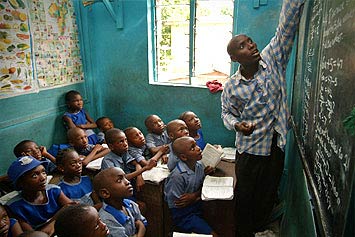
File Photo
By Dayo Adesulu, Tare Youdeowei & Elizabeth Uwandu
Two years after the launch of new educational curriculum by the Nigerian Education Research and Development Council, NERDC, the policy is yet to be implemented as a result of issues raised by some schools visited by Vanguard Learning.

File Photo
The issues include the inability of the new curriculum to meet with admission requirements of higher institutions; misplacement of courses of the departments;
lack of teachers to handle the introduced courses such as Marketing, Physical & Health Education, Vocational Skills etc. Above all, the lack of awareness creation by the Ministry of Education, makes matter worse.
Speaking on the new curriculum, Principal, Oloye Comprehensive High School, Mr Rafiu Ajadi Agboola, said the new curriculum was not feasible because of its inability to meet the admission requirements into colleges of education and universities.
He added that the misplacement of subjects to be offered by the different departments, namely: Arts and Humanities; Sciences; Commercial and the recently created one called New Technology Studies, are issues yet to be addressed. His words: “The policy came only to schools where it will be implemented, while the output of the schools where it will be used are not carried along.
“For example, we are asked to teach some subjects in the curriculum that are not recognised in higher institutions. Such subjects include, Civic Education and Vocational subjects. These don’t have any place in admission requirements into any of our colleges or universities.”
Misplacement of courses
Speaking on the misplacement of courses, Agboola explained that Geography is now placed as one of the core subjects of Arts or Humanities. “What is Geography doing in the Arts?” He asked. Also, Commercial students are no longer asked to study Economics, which formed the basis of Commercial studies.
The principal lamented that in the new curriculum, Economics is placed under Arts and Geography placed under Arts adding: “The courses misplaced have no relevance with the courses they eventually placed.” According to him, if schools were to follow the new curriculum, students would not gain admission into higher institutions.
”The year 2014 would have been the first year of the implementation of the curriculum. If we had followed the curriculum, our students may not have gained admission,” he said.
Way forward
On the way forward, he called for harmonization of the curriculum to be in tandem with universities’ admission requirements. He said: “ I will suggest the harmonization of the curriculum. We are not saying that the curriculum is not good, but the placement should cut across board. If these new courses are included in admission requirements for colleges of education, polytechnics and universities, I will find no problem with it. But, they are not included.“
CRK, IRK merger
The principal, who also spoke on merging of Christian Religious Knowledge (CRK) and Islamic Religious Knowledge(IRK), said there is no controversy on the merger; only lack of publicity by the authorities which led to lack of understanding on the part of schools and other stakeholders.
His words: “There is no controversy and the merger has nothing to do with one’s religion because if you are a Muslim, you take only IRK and vice versa. The only issue is that the questions are merged – IRK and CRK. So if you are to take hundred questions, you will have 110 questions set for Islamic studies and Christian religious studies. That means, you will leave 10 undone.
Lack of publicity
“Lack of publicity on the part of the Ministry of Education made matters worse as information did not get to the grassroot level. It is only information seekers that got it. My school got to know about the new directive after two seminars have taken place in Lagos. “Meanwhile, the directive was all over the country and Kwara State has started its implementation before we heard of it. “
Contributing, Dr. Shina Akintolure, Proprietor, Stokhan Nursery, Primary and Secondary Schools, Isashi, Lagos said: “NERDC has muddled up the whole curriculum thereby leaving the teachers and learners confused.”
Muddled up curriculum
According to him, they brought Civic Education and made it compulsory for all students. He explained that from the course content, it is not relevant to any student who is science-oriented in senior secondary. He pointed out that the topics in Civic Education are very much related to topics in Government and Social Studies.
“The child that studied Moral Instruction in primary school, learned Social Studies in JSS1, 2 and 3, is expected to already know what the moral values are, why bother such a child with Civic Education in Senior Secondary School? Let the student face science subjects squarely. For those in Art, I see Civic Education as duplication because some of them offer Government while others offer History.
“Civic Education is welcome in the curriculum but it shouldn’t be compulsory subject. It should be an elective subject. Now it is compulsory at the senior secondary level, they must do Civic Education, Data Processing, Crafts. It has narrowed down the core subjects that the students are to do. It has muddled up the curriculum and it is not bringing the best out of the teacher, neither is it bringing the best out of the student.”
The Proprietress, Living Kiddies Joy Private Schools, Ikorodu, Mrs Dorathy Agada, said her school had started implementing the new Basic 9 curriculum.
No textbooks for some subjects
She, however, noted that some special subjects like Managing Complexity and Adaptability are not available in textbooks, hence it becomes difficult to teach students. “What we do in our school is to search ‘Adaptability and Managing Complexity on Google and use our discretion to teach the students, since there is no recommended textbooks for such subjects in the bookshops.
On his part, the Principal, Tonia International College, Mr Francis Akintayo Alayo, who agreed that the new curriculum introduced ought to be followed by schools, however, said its implementation demands compromise on the parts of schools handing the policy. He posited that getting able hands as teachers to handle the courses might be a problem to its full implementation by schools.
His words: “Schools are bound to implement it, however, our children whose eyes are on gaining admission into higher institutions don’t know anything about the curriculum. All they know is taking the subjects that will lead them into higher institutions.
Speaking on the challenges faced by his school, Alayo disclosed that before arriving at a compromise on the new policy, especially in the areas of new subjects, teachers of our school were compelled to undergo retraining and surf the internet on the courses. In addition, he said the school had to employ new teachers to handle some courses.
For Mr. Mark Okoh, Principal of Caro Favoured Schools, Awodiora, Lagos; “There is barely any difference between the old curriculum and the new one, thus there is no challenge implementing it. There is no new thing in the curriculum, it is just like putting maggi and salt in the same container, they are both seasoning.
The education formulators are just jumping from one place to another, trial and error to see which would work best. The curriculum has a lot of lapses because the policy formulators don’t carry teachers in the system along. They do it and push it to us, we wrack our brains, and we do a lot of things to ensure that the subjects are equitably interpreted and implemented, even if it is wrongly planned. We make it suit us and the students. Most times, these things are given to us raw.
Disclaimer
Comments expressed here do not reflect the opinions of Vanguard newspapers or any employee thereof.