
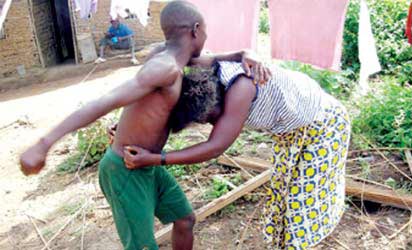
file photo: domestic violence
By Denrele Animasaun
“When a child hits a child, we call it aggression.
When a child hits an adult, we call it hostility.
When an adult hits an adult, we call it assault.
When an adult hits a child, we call it discipline.”— Haim G. Ginott
In my column on December 20, 2015, I wrote; Men do suffer from emotional abuse. It seems they are more men who experience emotional and physical abuse than they dare admit. It generated a lot of debate and I do hope this one on domestic violence would do likewise. The subject of domestic violence is an uncomfortable one, it is uncomfortable to discuss and, not just because of the nature of the violence but there is a wall of silence when it comes to getting people to talk freely about domestic violence. I told my sister, Sola that I was going to write about domestic violence she was worried on how it would be received.
I know it is time to have that discussion even if it is not a popular subject matter. If anyone is affected by the content, I will be discussing below, please contact: Lagos State Domestic and sexual violence response team (DSVT)@info@dsvrtlagos.org or @dsvrt or 0813-796-0048 or be signposted a local equivalent.
I am sure that everyone has heard of the case of the husband who allegedly killed his wife and the pictures of the dead body was splashed across the media. The case is of course, in the courts as I write.
What was shocking was the way that many people reacted in the defence of this case and the others below; that perhaps, the victim had antagonise the perpetrator or maybe she had cheated! No matter what the case may be, it is wrong to use violence. No matter the reason, we can and should not advocate or excuse violence.
The statistics on domestic violence in Nigeria, is shocking- according to National Population Commission (NPC) [Nigeria] and ICF Macro. 2009. Nigeria has one of the highest rates of domestic violence in Africa. I am quite sure that this is a surprise to many. It is said that as many as two thirds of Nigerian women are believed to experience physical, sexual and psychological abuse at the hands of their husbands. A small scale study conducted in Oyo and Lagos states indicated that 65% of educated women are abused and 56% blue collar or market women experience similar attacks. The African Journal of Reproductive Health in 2005 referring to Nigerian men:” a husband has the liberty to “violate and batter” his wife if he feels she has not adequately fulfilled her obligations”.
And Amnesty International calls Nigeria’s rate of domestic violence “shocking,” and has called on the local governments to do something to stem the violence that: “On a daily basis, Nigerian women are beaten, raped and even murdered by members of their family for supposed transgressions, which can range from not having meals ready on time to visiting family members without their husband’s permission.
Domestic violence affects not just the victim but indirectly all those who witness the violence; children, family, relatives and witnesses to the physical abuse and violence. It predisposes the children to trauma and other psychological problems throughout their lives and worryingly, they may learn to become future or victims abusers later on in life and hence the way the cycle continues. Incidences of Domestic Violence cuts across social and economic background and although women are mainly victims and men, mainly are perpetrators of Domestic Violence, women, are increasingly becoming perpetrators of domestic violence too. According to the National Demographic and Health Survey in 20018, over a quarter of the population of all women in Nigeria have experienced domestic violence. This is staggering and shocking.
The recent case of Lekan Shonde, the man who allegedly killed his wife has his case in the courts as we speak. Then there was the case of Oyelowo Oyediran Ajanaku, a 38 year old, killed by him Ibadan. There are also cases abroad with Nigerians as well such as the former Benue State governor, Gabriel Suswam who was arrested by the Metropolitan Police. His wife, Yemisi had called the police report in violence. Domestic violence is taken seriously here in the UK but it has been long time coming and Nigeria will have to do more to take the calls of spouses seriously and have a better way of dealing with victims of domestic violence. In the UK, they have dedicated staff and police who are trained in supporting victims of domestic violence.
The way we treat domestic violence is deplorable and disgraceful and it is high time, that there is a review and a robust public education aimed at households, universities, hairdressers, barbers,market-places,health centres,institutions, workplaces,communities and through to government.
This has got to be a top to bottom approach and many a times the reason why a victim dies and it was not reported is that they are ashamed, they feel that they cannot tell anybody their problems, and if they do tell, they are likely to be told, that it is the victim’s fault and they should bear the pain. People believe that there is prestige in a violent marriage rather the victim fleeing the perpetrator. Of course there is the economic reasons why people stay; because they will lose a roof over their heads, financially worse off and that society does not value a woman who leaves her husband even if it is to save her life and those of her children.
Let us be clear, spousal violence is not particular to Nigeria, no, it happens across the globe but the high level of violence towards women is not acceptable and we can no longer pretend that it doesn’t happen. One out of four people in Nigeria has been a victim or is a victim of domestic or spousal abuse. Men become abusive because they have learnt violence in their families and mainly women tend to gravitate towards abusive men because they saw their mothers being abused. So the cycle is repeated unless there is a break in the cycle.
Research has shown that, in time of economic hardship, the incidence of domestic violence increase exponentially and close to half of the victims was abused because of: they were late cooking the food, burning the food, arguing with husbands, going out without permission, neglecting the children, refusal to engage in intercourse
Disclaimer
Comments expressed here do not reflect the opinions of Vanguard newspapers or any employee thereof.