
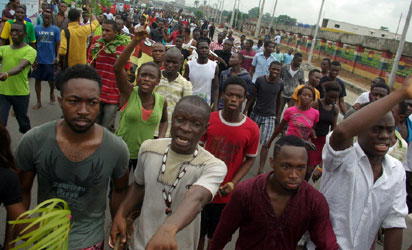
protest by the University of Lagos students over the re-naming of the institution to Moshood Abiola University recently.
By Rotimi Fasan
OUTSIDE the circle of immediate family members one ‘guardian angel’ whose intervention was crucial to the birth of this column is the one generally called ‘Baba’ within the fraternity of Nigerian writers, especially the ‘younger’ ones.
He is a former president of the Association of Nigerian Authors, a poet, politician and lately aspiring governor of Edo State, Odia Ofeimun. Odia, as he is otherwise simply known, as far as I know was the one who suggested my name as the reviewer of Mr. Uwaifo’s book when it became clear somebody other than Reuben Abati would have to review that book. It was through him I would meet Mr. Uwaifo and he played a major role in assuring the author that he had nothing to fear about me being able to fit the bill of reviewer even within the severely limited time left before the public presentation of the book, That Nigeria May Survive.
People who believed in him had taken risks on him at a time many would have been content to ignore him. He in turn is ever prepared to take such risks with others in whose ability he believes. His words to Mr. Uwaifo were no mere attempt to allay the author’s fears. But his conviction in my ability to deliver and his confident declaration of this which was in character no doubt went a long way to clear off any niggling doubt.
Odia had no time to quibble when it comes to writing. In his typically forthright way, he can be depended upon to give a honest account of his assessment of a writer’s competence. Here, he could be brutally honest, often coming off as too harsh to people either unfamiliar with this trait or used to the more sympathetic mentoring of other older writers. With him the matter is very simple. There are no young or old writers. You either know your art or you don’t. So in the birth of this column Odia was a midwife of sorts. He even took time to read a draft of my review and offered suggestions to improve it.
I’ve never forgotten any of this and I knew or hoped there would be space to mention it before the conclusion of this piece even though I was also subconsciously reluctant to say anything that could be considered unduly revelatory about me or others. But Odia probably thought I had forgotten a lot when he sent me his congratulatory message last week on reading the first part of this piece. Of course, I remember all. What I didn’t know was the bit about the publisher who he didn’t name, a fan of sorts, who had read another work of mine, and who also had rooted for me to be the reviewer of Mr. Uwaifo’s book.
I have dwelt this long on Odia’s role because sometimes, I believe, his contribution in the development of Nigerian literature and writing in general, by way of mentoring younger writers, is sometimes too quickly glossed over and insufficiently acknowledged.
More than any other writer or intellectual teaching/writing anywhere such art is taught in Nigeria, Odia Ofeimun has arguably mentored/trained new writers by the keen interest with which he follows development in that sector. There would be very few Nigerian writers of note below the age of sixty (without mentioning older individuals) who began writing after 1990 that didn’t come under the direct or indirect impact of his mentoring. That is a major contribution to the human capital development of a country, especially one as Nigeria that is increasingly noted for its severe deficit of such credible mentors in any sphere of our cultural, political or intellectual practice.
Long before I would even know that I would write for Vanguard, Odia had celebrated my writing in other domains. He has suggested my name as possible replacement to writing events he was invited but couldn’t honour. I believe that is what he does for others. Thus by the time I was to start writing for Vanguard, before Sad Sam’s head-hunting skills came my way, he thinks I was already ripe for the public space. As he put it in his message, ‘You were already on your way to becoming a public intellectual. You just needed to be collared.’ So in marking the tenth anniversary of this column I gratefully acknowledge his contribution and unstinting fellowship over these many years.
A decade since this column made its debut a lot has happened in the wider practice of Nigerian journalism. Much of the developments in this regard are the outgrowth of what might be called the revolution in the spread of social media.
This has enabled the involvement and participation of far many more Nigerians in the business of shaping public discourse, thereby democratising Nigerian journalism in particular and media practice in general. Where public discourse is concerned, there are no longer ‘average Nigerians’. Everyone has an opinion and everyone is an expert of sorts, and people are generally more media-savvy even when there is lot to question about the depth of the ‘insight’ they proffer or when such insight belong more in the domain of gossip and urban legends masquerading as profound wisdom.
But the widespread availability of access to information means that more Nigerians are aware of what goes on in this country and around the world. This in the long run will be salutary for democratic practice. Theoretically people would be less easy to deceive as they are more aware even when such awareness is many times the product of gossips and hearsay. While the media field is more diffuse in terms of sources and practitioners there are certainly more readers today, actual or potential, than at any time predating the advent of social media.
Citizen journalism seems the in-thing and while the number of competent writers without mentioning opinion moulders and/or thinkers may not have increased thereby, there are more people with ability to access what passes for news and make their contribution to creating news than before now. The feedbacks from these diverse sources provide important guide into and means for the calibration of the collective mindset.
This can prove crucial in shaping the kind of opinion and how such opinion is purveyed by the more professional practitioners who, in spite of the explosion in the population of practitioners, are nevertheless still actively sought and engaged for their reading or measurement of societal tempo. The great challenge of the vast democratisation and massification of the media in the last decade is the remarkable absence of sobriety, the verbal anarchy and intolerance of differing opinions and views by the new entrants into the media space. At this present pace the journey ahead promises to be one hell of a ride.
Concluded
Disclaimer
Comments expressed here do not reflect the opinions of Vanguard newspapers or any employee thereof.