
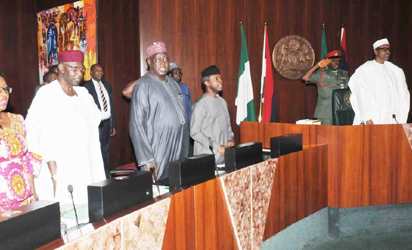
HEAD OF THE CIVIL SERVICE OF THE FEDERATION, MRS WINIFRED OYO-ITA; CHIEF OF STAFF TO THE PRESIDENT, ALHAJI ABBA KYARI; VICE RESIDENT YEMI OSINBAJO, AND PRESIDENT MUHAMMADU BUHARI, AT THE FEDERAL EXECUTIVE COUNCIL MEETING IN ABUJA ON WEDNESDA
Fuel scarcity ends next week —Kachikwu
By Levinus Nwabughiogu
ABUJA—The Federal Government said yesterday it could not give a definite date on when the 2016 budget would be signed, noting that talks to reach a truce between it and the National Assembly on grey areas in the document were still on going.

HEAD OF THE CIVIL SERVICE OF THE FEDERATION, MRS WINIFRED OYO-ITA; CHIEF OF STAFF TO THE PRESIDENT, ALHAJI ABBA KYARI; VICE RESIDENT YEMI OSINBAJO, AND PRESIDENT MUHAMMADU BUHARI, AT THE FEDERAL EXECUTIVE COUNCIL MEETING IN ABUJA ON WEDNESDA
Instead, the government said it had set out the timetable for the submission of 2017 budget, and that the idea was to ensure early delivery of the document. This came as the government also stated that there was no currency deal swap with the Chinese government.
The implication of the no-date-for-signing is that the hope of many Nigerians who are expectant that the 2016 budget would be signed into law anytime soon, had been dashed.
The decision for further negotiation with the federal lawmakers, was taken at the Federal Executive Council, FEC, meeting at the Presidential Villa, Abuja, presided over by President Muhammadu Buhari.
Briefing State House Correspondents at the end of the meeting, the Minister of Budget and National Planning, Mr. Udo Udoma, who was flanked by his colleagues in the Ministries of Petroleum Resources, Ibe Kachikwu; Power, Housing and Works, Babatunde Fashola; Communication and Technology, Adebayo Shittu, stated that ahead of the eventual signing of the fiscal document, the Federal Government had set up a Monitoring and Evaluation mechanism to ensure that the budget was duly implemented.
Udoma also denied that the document was returned to the National Assembly for fresh work on it.
He said: “On the expectation that we will soon have a budget, there is a monitoring and evaluation mechanism to make sure that the budget delivers what it promises. That mechanism was looked at by the Federal Executive Council and approved.
“To make sure that 2017 budget is done on time, a timetable was approved for the 2017 budget. In addition, council noted the report of the Nigerian Economic Summit Group which, in partnership with the National Planning Commission, organised an economic summit last year and made various recommendations. These recommendations were presented and noted.”
Fuel scarcity ends next week —Kachikwu
Also, speaking on the lingering fuel scarcity, the Minister of State for Petroleum Resources, Ibe Kachikwu, said the queues were expected to completely disappear by the end of next week.
Noting that the unhealthy development was a result of sabotage, Kachikwu thanked Nigerians for their patience so far.
“The queues are as a result of sabotage. Some people, rather than sell products, send them into hinterlands where they can sell at ridiculous prices and so you are having these price distortions where people are making a lot of money.
“Some are internal and some are external but a lot of it is marketers trying to make quick returns on their investments wrongly.
“We have asked DPR (Department of Petroleum Resources) to deploy officials to ensure products are sold at the right price because it is only through price stabilization that these system queues will disappear.
“As at today, we are delivering about 1,200 trucks. By weekend, we should be delivering same number of trucks, it will take a bit of days to even out but you can see improvement already.
“I hope by the end of next week, with the refineries helping us to stay on course, every part of the country will get fuel. We thank the President, NNPC staff and ministries who work night and day to enforce discipline.
“We thank Nigerians for their unbelievable level of patience, we are solving problems we met on ground and trying to find long-term solutions to it and urge Nigerians to report sabotage, where people are selling products at higher price because we all need to work collectively to make this thing go for good,” he said.
His brief at the FEC meeting
On his briefing at the FEC meeting, Kachikwu said: “Our intervention today was to give a brief update on the petroleum distribution position and the whole fuel queues crisis that has been in this country for weeks.
“These are as a result of four factors. The first, of course is fiscal. By the time we came on board last year, there were over N600 billion subsidy that was not paid for 2014 and 2015 and marketers were at a point where they were running out of liquidity. They were very challenged, to the extent some had got out of the business and were not importing.
“We were able to pay that money around November (2015) with the intervention of the President, National Assembly and other stakeholders.
“But soon after, there were no credit lines and this put pressure on NNPC to provide product at almost 100 per cent capacity because the private sector was not supplying. This has been largely the problem.
“On the logistic side, refineries were not producing when we came in, meaning we had no reserves.
“When you don’t have reserves, the hiccups hit you right at the belly button because there is nothing to replace with.
“But what we have tried to do in the last one month is to flood the market with products. We are in a position to say between now and October, we have cargo in excess of what we should need, so we have addressed the supply issue.
“Last week, we had about 11 cargoes in, this week we had about 10 cargoes in. For the month of April collectively, we had 38 cargoes, it’s the first in the history of this country.
“On the infrastructure aspect, we deal with the systemic issues. These things will keep coming back. We are hoping that by July, we will be able to sign agreements that will enable upgrades and joint venture of the refineries to take effect.
“We expect that to last for about 12 months, and we expect that by 2017, we should have all the refineries back where they ought to be. The target is that by 2018, we will reduce fuel import by 60 per cent and by 2019, with our refineries producing 400,000 barrles, we will exceed our refined importation and begin to export petroleum products.
“Another thing is that we are targeting by the end of May to create strategic reserves in Lagos, Port Harcourt and Oghara. Once we do that, whatever refined products we have from our refineries will go to the depots.”
Fashola on power outages
Minister of Power, Works and Housing, Babatunde Fashola, who spoke on the current power outages, also explained the causes of the problem.
According to him, the damaged Forcados pipeline is principally what led to shortage of power supply in many parts of the country.
He, however, assured Nigerians that the government was working to remedy the situation, adding that the 10,000 megawatts projected to be achieved by the President was realistic.
He said: “Our intervention today was an update to council on the status of power, the causes of the outages that are being experienced and plans to solve them.
“Essentially, it’s gas supply issue arising from the problems that are now well reported; of the failure of our operational platforms at Forcados, where the repairs are ongoing to restore the petroleum gas lines.
“It is a Ministry of Petroleum issue, they are keeping us in the loop about all of these and when all of these will be restored to normal service.
“As a result of this, our power production has dropped from 5,000 megawatts to about 3000 to 3,200 megawatts, depending on other collateral problems. What was not enough at 5,000 is even now much more difficult to share at 3,000.
“This is a teething problem , it won’t last for long, our determination to overcome it is bigger than the problem and I’m very sure it will be overcome.”
No negotiations with MTN on fine
In the same vein, the Minister of Communications, Adebayo Shittu, while briefing journalists, stated that the Federal Government had not entered into a formal negotiation with MTN over the fine slammed on it for refusing to block unregistered lines within deadline.
No currency swap deal with China
Meanwhile, at a separate briefing, the Minister of Foreign Affairs, Mr. Geoffrey Onyema, said Nigeria, during the trip of President Buhari to China last week, did not formally enter into any currency swap deal with the Chinese government.
According to him, what the government did was to seek ways of partnering with Chinese government to trade on their local currency.
He also said that Nigeria stood to benefit from the anticipated $6bn investments from China, as more jobs would be created for the youths.
He ruled out any provocation or face-off between Nigeria and the West over the partnership.
He said: “It’s not really a swap. What it takes is that as the Chinese economy goes strong, there is some pressure on them from the trading partners, international financial institutions. They agreed that the money should be internationalized.
‘’So, they started that for a while. They were protecting it also. They did not allow it to be fully exchangeable. But now, their economy is fully strong, they are looking for a way to internationalize the currency.”
Now, they were saying essentially that they wanted to segment it.
“For Southern Africa, South Africa is going to be the sort of a hub for the currency. So, they are going to be the focal point for the Chinese to make that available for trade in that area.
“In west Africa, they are looking for a hub. Ghana is interested in being the hub for the currency to circulate for those who want to use it. It is not compulsory but Nigeria is a bigger country with bigger economy.
‘’So that does make sense. And they became a kind of attracted to Nigeria to be the hub. So, for us, the benefit is that it gives us small flexibility.
“So, if Nigeria is buying Chinese goods, for instance, it will be in our interest to use the Yuan because we know there is a lot of squeeze for the dollar. But we’ll still use the dollar. But if it is not enough and there are some people who want to invest in the country, instead of crying that they cannot take dollar out, there might be Yaun that they would be happy to take out because it is now internationalized as a currency and they can use it. So, it gives us a much larger option.
“As you know, a lot of importers now are complaining that they are not able to access the dollars to buy good and things like that. So, if we have in addition to dollar, Yaun, then they can also have it.’’
How Nigeria would benefit from Chinese investments
“It depends on each agreement. If we have an agreement where we insist that there should be much greater local participation if they want to come in and invest in building railway lines, there should be a certain number of Nigerians but I think as a government, we will obviously be looking at that kind of agreement.
‘’ I am sure that the Minister of Labour will have a say in ensuring that any big project we entered into is in the interest of Nigeria, and we are going to get something out of it, not just the infrastructure, but also jobs.
“In relationship with the west, don’t forge that what has helped China so fast in 30 years is because of the investments of the west in China. That is really what has transformed the Chinese economy, the Japanese, Germans and Americans.
‘’So we will not have any problem with the west. China is part of the World Trade Organization and part of the international trading system.”.
Disclaimer
Comments expressed here do not reflect the opinions of Vanguard newspapers or any employee thereof.