
BY EDIRI EJOH & ILOAZE BLESSED-ODIDI
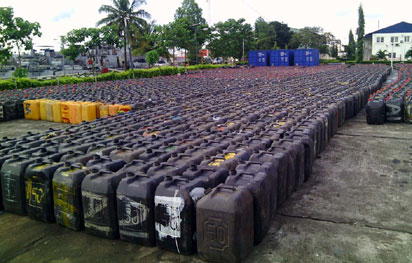
The Nigerian Navy has said that with the provision of machinery called maritime domain awareness (Vector protocols which is a surveillance system), petroleum theft or smuggling would soon be wiped out.

He added that since they started using the system in the Ikorodu area of Lagos, the issue of vandalism has almost been solved completely.
“When you talk about losses, there are products taken outside the country for refining; some others are in the creeks. Those products at the creeks are still being circulated because they sell to trucks. But what we have done is to monitor movement of petroleum products such that if you move these products, you must have clearance from where you are to load and then we monitor you from that point. If suspected of illicit movement, you will be impounded and handed over to Economic and Financial, Crimes Commission, EFCC.
“For now, if you want to refine illegally, you can go ahead but you will have nowhere to sell them. When you don’t have outlet, then you don’t produce. Initially, we do destroy them, after which they build again or relocate, but now we may not bother ourselves destroying but we will make sure it does not enter the market,” Ekwe added.
On security of petroleum assets, the Navy Chief lamented that a Floating Production Storage and Offloading, FSPO, like Bonga, located over 100km from the coast and worth over $2 billion, does not have its own integral security.
He said: “It would be recalled that on June19, 2008, Bonga FPSO was attacked by militants resulting in the shutting down of the platform with losses of over 200,000 barrels per day at the time. Would it not have been better to spare some percentage of the total cost of the FPSO for an integrated security system? Ten percent of what was used to construct BONGA FPSO could easily be used to buy two new offshore patrol vessels (OPVs).”
He argued that crude oil theft is perpetrated through the stealing from pipelines and facilities that transverse the various rivers and creeks. “Nigeria is now facing a relentless economic war waged by greedy Nigerians with international connections and desperate poor citizens exploiting the wrong alternative of pipeline vandalism and illegal refinery operation.
“It must be understood that there is a nexus between crude oil theft, illegal refinery and illegal bunkering in Nigeria. Most of the stolen crude is exported out of Nigeria while some are taken to illegal refineries in the creeks.
“The product from the illegal refineries is mainly low grade diesel which is sold locally to unsuspecting users as bunker fuel or for other domestic use while some are also ferried across Nigeria’s borders,” he added.
To curb these crime in the sector, EkweIbas explained that the Nigerian Navy is anchored on a tripod of actions namely surveillance, response initiative and enforcement.
According to him, “Maritime surveillance of Nigeria’s waters is heavily dependent on the use of the Regional Maritime Awareness Capability, RMAC system.The system consists of radar, camera and Automatic Identification System, AIS, to provide radar information on vessels up to 35 nm from the coast.”
Founder Centre for Value in Leadership, Prof. Pat Utomi, who also spoke, maintained that for growth and development to transcend to economic benefit, Nigeria needs certain policies to ensure that crude oil becomes a source of savings in developing other sectors of the economy.
Stressing the need to drive down inflation the economy, he opined that with the scope and chain of massive refining, the price of refining petroleum product will be much lower than what it is today.
Institutional reform
Meanwhile, a former Company Secretary, Nigeria National Petroleum Corporation, NNPC, Prof. Yinka Omorogbe, and Advisor/Academic Director, Petroleum Economics and Policy, Prof. Wumi Iledare, have argued that Nigeria stands the risk of higher downturn if it failed to address structural reforms in the petroleum industry.
According to them, “We have got to reform the petroleum industry because the structures in place are not sufficient to keep the industry running for greater profitability to the economy. The downstream has been in a state of collapse and anarchy because the structures are not in place. Development in the oil industry is not tied to just the promotion of reform but the reality of that reform coming into play.
“Reform should be with good governance that binds all operators and stakeholders respectively. We need a good rule of law that provides framework for interactions, and also an enabling environment where politics does not influence the judgment of contracts awarding, license acquisition to operators and other politically influenced decisions.”
“When there are structured reforms in the oil industry, job opportunities will rise, the industry will grow, more participation and activities will erupt, local content will grow and there will be vibrant operations in the downstream and upstream,” Omorogbe added.
Disclaimer
Comments expressed here do not reflect the opinions of Vanguard newspapers or any employee thereof.