
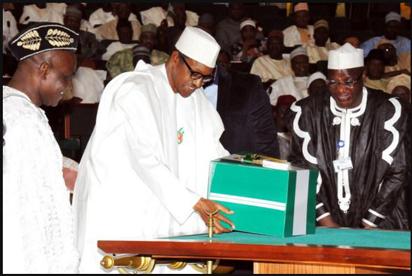
File: Buhari during the 2016 budget presentation to the National Assembly.
By Awa Kalu , SAN
This past week, Nigerians were visited with more uncertainty over the passing of the 2016 Appropriation Bill into law. Having passed the bill on the respective floors of the House of Representatives and the Senate, the countdown to the constitutional deadline for presidential assent, set at 30 days, expired at the weekend. The Appropriation Bill, which is the formal legislative nomenclature for the Budget, has been the inanimate central character in what has turned into a quite animated caper on the national stage in the last few months.
On Tuesday, December 22nd, 2015, President Muhammadu Buhari presented the ‘Budget of Change’ to the National Assembly and Nigerians up and down the country had cause to celebrate the positive event that his early announcement of the budget represented.
Nearly five months later, and the Budget keeps turning up in the murky light of national humour, like the proverbial bad penny. Yet it has not become law, having not received the President’s assent.
Scandalous accusations
The manner in which the Budget has swung back and forth in public debate has forced Nigerians to keep asking whether it will or will not eventually be passed. Numerous pratfalls have been responsible for the as yet unsigned bill as the dailies and tabloids have told us, including the scurrilous claims of a missing budget, the scandalous accusations of a Padded Budget and now the legal conundrum of a Rewritten Budget.
Before we try to delve a little deeper into some of the skirmishes that have excited the public imagination in this process, it must be said that the Budget brouhaha has put one in mind of that unique game of our childhood, remarkable for its test of endurance and of strength, the Tug-of-War.
Many Nigerians can recall this game and some still play it- where a long cord of rope is pulled by two teams until one of them gives up.
The most significant thing about a Tug-of-War is that after it is done with, no matter how much effort one expended in pulling the rope, one looks back and realises that it was, in fact, not a war. It was only a game. Unfortunately, this game has gone on for too long and the outcome is a prolonged economic logjam caused by the ongoing impasse between the Executive and Legislative arms of the government. Meanwhile, the business of public administration has stagnated in the face of absent funding and the hesitation of the civil service mandarins to undertake any projects without the backing of the federal purse.
As a corollary, the private sector being equally dependent on the decisions of the government has been functioning in flux, their operations frustrated by the administrative dysfunction caused by this Tug-Of-War.
History has proven that a stalemate between the decision-making executive and the lawmaking legislature is never good for the country. In 2014, the United States of America was on the verge of a shutdown of government because of the impending ‘fiscal cliff’.
The fiscal cliff referred to the combination of expiring tax measures and spending coming into effect on the 31st December, 2012.
If allowed to happen, the fiscal cliff would seriously affect an economy, already in turmoil and plunge the country into recession as it reduced household incomes, increased unemployment and undermined consumer and investor confidence. The stalemate threw the country into a period of extreme economic insecurity and made the United States of America a figure of derision around the world.
Shadowy backdrop
Nigeria is in the grip of a similar situation as a result of the indecision surrounding the budget.The sooner it is resolved, the better.
What makes the situation more complicated is the shadowy backdrop to the unfolding events. The press, always aroused by rumour and conjecture, continues to make titillating revelations about certain frontliners in the pitched battle between the two arms of government. Senator Bukola Saraki, who was elected Senate President last year, is standing trial before the Code of Conduct Tribunal over charges of failing to declare assets during his time as Kwara State Governor, in disregard of his constitutional duty.
Senator Saraki’s role as senate president puts him in an important position to direct affairs in the National Assembly and, perhaps, leaves him with considerable authority to mitigate the government standoff. Yet his involvement in the trial has sidelined him somewhat and left his credibility in jeopardy at a crucial point. It does not help that the presiding justice in his trial was facing allegations of misconduct relating to a bribery investigation for which he has been cleared by the Economic and Financial Crimes Commission (EFCC).
In the heat of a struggle to resolve economic difficulties and kickstart the new regime’s promise of restoration to the Nigerian people, it appears that the Budget of Change has become the Budget of Despondency. A little while back, news broke in social media that the copy of the Budget which was delivered to the National Assembly for deliberations had gone missing.
While the public grappled with this information, in the first stages of the tug-of-war, it emerged that the Senate President had accused the Presidency of altering the copy of the budget distributed to members of his chamber with a different version.
Piqued by these reports, a number of civil rights organisations and public affairs analysts- as those who crave the limelight are now called- seized upon the notion that some elements of the Budget were inflated. It has long been in circulation that the annual budget includes sums that are well beyond what is necessary to provide for the functions for which they are earmarked.
This is a perennial controversy. However, associating these misgivings with a ‘Budget of Change’ seemed a step too far for interested Nigerians. There was a hue and cry at this Padded Budget, which died down after parties regrouped and reviewed the contents of the Budget.
Bone of contention
It was expected that the Budget would finally process into law. This was not to be as the respective committees on Appropriation in House of Representatives and the Senate led by Honourable Jibrin Abdulmumim and Senator Danjuma Goje respectively disputed claims that the Budget had been rewritten by the Executive.
It appears that the bone of contention was the Calabar-Lagos rail line which the Executive claims was a part of the Appropriation Bill but removed by the Legislature. Further, there was the assertion that some appropriations intended for one region of the country were diverted to another, igniting the incendiary complaint of regional bias.
On their part, the Legislature explained that it was well within their power to adjust the Budget while it passed through readings in its two chambers but that the disputed Budget head had not been presented to them. Accusations flew back and forth both between the two chambers of the National Assembly on the one hand, and between members of the National Assembly and the Presidency on the other hand, to worsen what can only be characterised as a storm in a teacup.
Our legislators found the gravitas to put aside the infighting and pass the Appropriation Bill, then pushed it forward to the Presidency to be enacted as statutory law, to bring temporary reprieve to the sweating participants in the Tug-of-War.
But the scrambling resumed when the President delayed his assent and insisted that the Budget could not be passed as it stood because the nittygritty of the Appropriation Bill was glossed over and details of its various heads inscrutable. In his view, the Budget sent for his approval lacked key ingredients that would make governance unworkable if passed in its existing form.
Constitutional provisions
The constitutional deadline, contained at Section 59 thereof loomed large. It is instructive to revisit the Constitutional provisions for the Budget at this juncture. Section 59 (4) provides that:
“Where the President, within thirty days after the presentation of the bill to him, fails to signify his assent or where he withholds assent, then the bill shall again be presented to the National Assembly sitting at a joint meeting, and if passed by two-thirds majority of members of both houses at such joint meeting, the bill shall become law and the assent of the President shall not be required.”
At this point our political theorists and constitutional lawyers trotted out their arguments about the implications of the Rewritten Budget. The primary question was whether the Legislature would refuse to play ball and instead override the Presidency in accordance with Section 59(4) of the Constitutionaforementioned.
Another argument as to whether the Presidency can re-jig the document and pass it without National Assembly scrutiny raged on the sidelines- although that particular argument is moot considering the specific provisions of the Constitution. Following the expiry of the deadline for presidential assent last week, the country was again placed on the horns of a dilemma.
Further provisions in the Constitution make it that the government will be unable to draw on funds from the Federation Account at the end of six months of the fiscal year should the Budget remain in abeyance. In light of the fact that the two chambers of the National Assembly remain at odds with each other, this scenario remains possible.
The alternative is an Appropriation Act that will shackle the government spending power and hurt economic growth. On one horn, there is the likelihood of government shutdown, and on the other the potential for an economy far more constricted than the present. Neither option augurs well for the people of Nigeria who have been the suffering grass under the feet of fighting elephants.
Appraisingthe deadlock
Late novelist and statesman, Chinua Achebe, captured the aphorism in his work that the elders see sitting down what the young cannot see from the highest tree.
It is possible that our sitting elders in the two warring arms of government have not bothered to look but it has become of the utmost importance for them to take the time to appraise this deadlock and see it for what it is, a game of Tug-of-War which is of no benefit to a country in transition. It would be much better, and a lot less tiring, for them to isolate all the issues which have put them at loggerheads and reach a diplomatic and timely settlement for the greater good. The country is on the verge of its own fiscal cliff and a fall would send shockwaves through the land and beyond.
Now is the time to reconcile differences and keep Nigeria on its feet. President Buhari is a very tall man and he has the capacity to make this country quite as tall.
Disclaimer
Comments expressed here do not reflect the opinions of Vanguard newspapers or any employee thereof.