
Easter: Cleric advises Nigerians to have hope in God
By Sonny Atumah
Inspiration remains an imponderable force in cultural and technological development.This has again driven the world to contemplate what experts believe is a technological agenda called the Fourth Industrial Revolution or Industrial Revolution 4.0.
We do not know when the Fourth Industrial Revolution would take off, but as anticipated it would go beyond the Third Industrial Revolution which started in 1969 with a kernel belief that may never waver in electronics, information technology and automated production model in digital technology, personal computing and the internet.

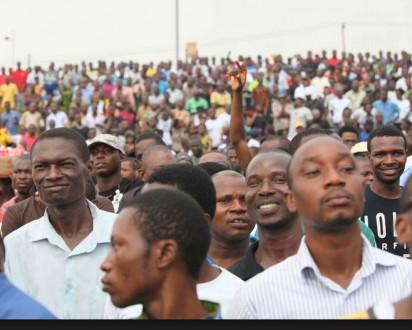
Nigerian youths
Again for record sake the First Industrial Revolution of 1784 had the steam power, mechanical production and equipment as development models with machine replacing human muscle.
The Second Industrial Revolution of 1870 had division of labour, electricity, mass production as key development model in internal combustion engine, aero plane and moving pictures.
The proposed Industrial Revolution 4.0 is in congruent with the philosophical doctrine as proposed by Gottfried Wilhelm Leibniz in his 17th century Leibnizian universe that ours is “the best of all possible worlds”. It was a time when his pessimistic contemporaries thought it was impossible for machine to replace the human muscle.
Transcendental pessimist leader of the 19th century philosophical movement, Henry David Thoreau whose quote was: “Thank God men cannot yet fly and lay waste the sky as well as the earth.” A few years after the air plane came in the second industrial revolution.
As the world look forward with optimism the Industrial Revolution 4.0 it is hoped it would develop a cyber-physical system that may have innovations in driverless smart cars, artificial intelligence and robotics in hospitals, world’s first solar powered air plane, biotechnology, nanotechnology, mobile banking, and 3.D printing.
The World Economic Forum has become a global think tank for economic advancement. The World Economic Forum on Africa (WEFA) holds in Kigali, Rwanda on 11-13 May 2016 with theme: Connecting Africa’s Resources through Digital Transformation.
It would improve investment climate and macroeconomic policy reforms for foreign direct investment flows to grow economies.Nigeria hosted the 24th WEFA in May 2014 in Abuja days after the horrendous, terror-striken Nyanya bomb blasts like those in Paris in November 2015 before the COP 21.
Permanent venue and Swiss resort of Davos hosted the 46th global meeting of World Economic Forum (WEF) from 20 – 23 January 2016. It focused on issues of ending poverty, fostering workplace diversity, and the role of entrepreneurship in creating jobs. World leaders were unanimous that encouraging public and private partnerships would go a long way in solving critical problems. Vice President Yemi Osinbajo led the Nigerian delegation to the WEF in Davos.
The Forum has been a model of world corporate governance founded in 1971 by Klaus Schwab, a holder of two doctorate degrees in Mechanical Engineering and Economics. As a nonprofit organization, the WEF is a foremost international institution for public-private cooperation with values as important as rules.
Legitimacy, accountability, transparency and concerted action are the guiding principles of the Forum that engages political, business, and other leaders of society to shape global, regional and industry agendas.
Klaus Schwab who discussed the effects of the proposed Fourth Industrial Revolution on business said that customers are increasingly at the epicentre of the economy; how customers are being served. To him, new technologies make assets more durable and resilient while data and analytics are transforming how they are maintained.
President Barack might have initiated processes of the Revolution 4.0 in his very last state of the union address to Americans in January.Obama said priority would be to invest in the future and avoids subsidizing the past. He meant America would use solar and wind energy to solve the challenges of climate change. That meant fossil fuel subsidies is now a thing of the past and renewables as the future; It is an American dream he may however not implement as he leaves office in January 2017 with fossil fuels still playing dominant roles in global economies.
But what lessons have Nigeria learnt as the Fourth Industrial Revolution beckons? To the Group of Seven (G7) nations it is a knockout of fossil fuels but should we tag along?We must strive to be in the Industrial Revolution 4.0 party, irrespective of whether the industrialised world ruminate an abandonment of fossil fuels.
It is a wake up call for Nigeria as one believes that divinely a Nigerian would stumble across solution to our liquid fossil fuels for our own industrial take off. We must not for now abandon petroleum; our goose that lays the golden egg. What we have been shying away from is what others are benefiting from and we import. We will continue to have comparative and competitive advantages in petroleum to invest in process plants.
As the Federal Government convenes an economic summit next week, Petroleum should be seen as our takeoff commodity to heavily invest in. We spend $1490.59 importing 80 percent of products in the value chain of petroleum if we were to refine one metric ton of crude.
For every metric ton we sell, we make less than $280. We buy back 80 percent of the byproducts at $1490.59. Adding the remaining 20 percent of byproducts and derivatives it means we buy back what we sell for less than $280 for over $2000. Our national oil company, the Nigerian National Petroleum Corporation (NNPC) should now brace up to the challenge and invest in refineries.
The developed world is thinking ahead, we should follow but tread carefully to achieve our desires. We must start from wherever to be in the revolution. Our lads and lasses are ready for the much talked about fourth industrial revolution. We must harness their potentials in the information and communications technology for the petroleum industry. Who would have thought the Nigerian genres of music would be reckoned with globally; ditto the films?It is a must do spirit for Nigerians.
Disclaimer
Comments expressed here do not reflect the opinions of Vanguard newspapers or any employee thereof.