
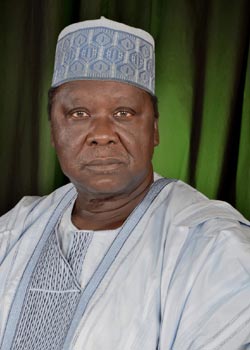
Akau
Second Republic politician, Mr Ishaya Dare Akau served as commissioner in the Lawal Katia administration in the Old Kaduna State, was executive secretary in the National Agricultural Land Development Authority, NALDA, and became the first chairman of the National Assembly Service Commission, NASC before becoming the second and indeed last chairman of the Subsidy Reinvestment and Empowerment Programme, ( SURE-P).
Mr. Akau who was trained as a teacher taught a number of leading northerners in school among whom was former Vice President Nnamadi Sambo. In this interview, Akau reminiscences on his experiences as a teacher, politician and indeed activist including spells in detention during two different military regimes. Excerpts:
By Luka Binniyat
Having committed almost your entire life in public service, what are you doing with your time now in retirement?
As you said, I’ve committed my whole adult life to service. Actually, I started work in September 19, 1970, it’s about 45 years now all of which I spent in public service. More in the classrooms and management positions as well as serving in certain political offices.
Of course, it has been exciting and challenging and, with the help of God I was able to do my utmost. I’ve always looked forward to being my own master; I have to determine what to do and where to go.
I wanted to be on my own long time ago but it didn’t work. Every time I had the proposal to stand as private person, honestly something else came up and knocked it off.
Firstly, I read law because I intended to practice law after retiring from public service. I graduated in law from the University of Abuja. Just as I was about to go to Law School I was appointed as Chairman, National Assembly Service Commission, so that scuttled my ambition. Again, in 2006, I wanted to go to Law School after I finished my tenure as chairman, NASC, it was again scuttled and that was when I was invited to go to Kaduna State College of Education (CEO) Gidan Waya (Jema’a LGA) as a Sole Administrator.
This is the first time I’m left alone to decide what to do with myself.
I’ve been in service for all this while, but this time I want to serve humanity and God. I’m nearing my grave and the only thing I can think of now is serving God. God says we should serve Him in our relationships with brethren we see.
Which of the appointments do you think was most fulfilling of all?
You see, the way I applied myself to assignments, I would tell you I found most of them fulfilling. You see, working with human beings most of them are challenging. But when you achieve some of the targets you set for yourself, you feel happy. When you have caused some change in circumstances of the organization, in the lives of the people and community, certainly you’ll feel fulfilled. As a teacher, I once told the story we had a staff meeting in Kano where I criticized some of the things that my provost did and he was very angry with me.
After the meeting he called me and said Ishaya, “we’re considering your promotion this year, but I don’t see how I can recommend your promotion having behaved the way you did this morning”. So, I told him, “sir, I came to this college to teach and not to be promoted”. I told him that I get promoted every day. If I’m aware that my students have learnt what I intended to teach them, I get fulfilled from seeing my students grow up to be who they’re. And I also told him that my greatest fulfilment is in development of others. Particularly in the classroom, and today, lots of my students have reason to be men of influence; they are professors and in every areas of learning, my students are in every field of human endeavour and many of them have excelled.
But you also had a stint in politics. Can you share your experience?

Akau
Well, I was drafted reluctantly into politics in 1977, when the then Constituent Assembly was convened under General Olusegun Obasanjo, and each Local Government Area, (LGA) elected a representative to the Constituent Assembly. The Jema’a LGA that time led by late Samuel Danjuma Audu nominated and elected me to represent Jema’a Local Government in the Constituent Assembly.
Jema’a LGA at that time included the present Jaba/Jema’a/Kaura/Sanga LGAs of today and I represented them. That was my first foray into politics. With the kind of people in that Assembly and the way things were done, for me it was like going to school. Yes, because if you went and sat with people like Aminu Kano, Shehu Shagari, Sultan Dasuki, Chief Rotimi Williams, Adamu Ciroma and the late Justice Udo Udoma was Chairman. Many wonderful Nigerians who have distinguished themselves including somebody like Chief Simeon Adebo, Chief MKO Abiola, these were the people there. You gained a lot from their wisdom and experience.
I remember one day; there was debate going on, on a particular topic and the late Chief Simeon Adebo left his seat and came and sat by me and engaged me in a discussion. Well, I taught I had arrived and so important that I had to be consulted, I didn’t know that he didn’t want me to listen to what was going-on (laughter), because he didn’t want me to participate on what was going on. So, it was after they’ve finished voting on that, then I heard what it was about, but it was too late. So, that was a trick he played on me.
That means you were very vocal in the Assembly?
Well, I tried not to be too vocal. I was a young man just in my thirties. Actually, I was just 31 years or thereabout when I got there. So, for the one year we spent in that Assembly, honestly it was like going to a post-graduate school. I learnt a lot and from there.
What happened after the Constituent Assembly?
After the stint all of us organized ourselves into groups and you would recall it was from those groups came out the NPN, UPN, NPP and PRP. We were in the NPP together with Waziri Ibrahim. It was at our convention where we were to choose the presidential candidate that there was a problem.
Waziri wanted to be both the party chairman as well as its presidential candidate. But some of us said the two should be separated, that the chairman of the party should be different from the party’s presidential candidate. He would not agree so that was what caused the division. At the convention that day, in one cinema house in Lagos Island there was a fracas and the party split into two and he went ahead to form Great Nigeria’s People Party, GNPP.
You went with him?
No! We stuck to NPP where in the first instance I was elected Assistant Secretary, later on I became the National Financial Secretary and member of the National Executive of the party. So, that was my first foray into politics. We fought the 1979 elections. We campaigned for the elections and lost at both the state and national levels. We were able to draft the late Professor Ishaya Audu to come and be the party’s representative; but unfortunately along the line the federal level wanted him more than us, so he was taken away to be running mate to Dr. Nnamdi Azikiwe. So, we were left at the last minute to look for someone else to replace him here. Well, we lost the election. But in our constituency, that’s Southern Kaduna Zone, we did very well. We won majority of the seats in House of Assembly, lost the Senate narrowly but won 2 or 3 Federal legislative seats. So, that was NPP and the party we belonged to until the coup in December, 1983. After the coup, we went to prison.
You went to prison too?
Oh yes, very well!
Where were you jailed?
In Kaduna here!
But you never had any political position then!
After the 1979 elections, our party went into relationship with the PRP, and honestly they picked some of us from the other party (NPP) to join them. So, from the NPP I was picked and Asandu Garba from Saminaka was picked, he was a UPN supporter. We
joined to form the cabinet under Abba Rimi. So, I was a commissioner from 1981 – 1983. I served as a Commissioner for Education, Economic Planning and Agriculture. After this, we lost the election in August 1983 and we left the cabinet.
But then the coup came four months later. And you know, it was against anybody who had served. We were told to report to the nearest police station (laughter). We did, and police told me they had no problem with me that I should go. I was asked to report to the NSO here (Kaduna) and they said they had no reason to keep me.
But one day I was declared wanted and was brought to Kaduna under police escort. We were first detained in a house along Tafawa Balewa Way.
How many were you?
All of us that were commissioners in Kaduna State, about 14 of us. After staying there for two weeks we were moved to Kaduna Prison where we stayed for eight solid months.
We were released in October. While we were in prison there was a committee set up comprising the Army, Air Force, Police and NSO that probed our activities while in power; our bank accounts, investigated and everything. At the end of the day, nothing was found incriminating against us. We were given letters of discharge to go. No apologies given. You see, we were arrested and kept then they went to go and look for the charges against us, instead of getting the charges first… Right! That was what happened. So, I spent eight solid months inside that Kaduna Prison. The only time we saw the outside was when they came to carry us for investigations.
You were all locked up in room?
Of course, we were locked up in one room. Even inside the prison we were inside another prison because were not allowed to mix with other prisoners. Yes, there is a section for so-called VIPs where we were locked up. Frankly, it was quite challenging because the place was meant for just about 12 persons or so but there were times we were up to 45 – 48. A room that was meant for 4 – 6 persons at most was made to take more than 12 persons. People were lying on the floor; we were lucky to have been the first set to get there, we slept on double bunk beds.
You were all politicians from Kaduna State?
Four or five Ministers joined us there later. And of course some governors too – Abubakar Rimi, Sabo Barkin Zuwo, Alhaji Lawal Kaita, Emir of Suleja now (Awal Ibrahim) , Deputy Governor of Sokoto state, Bachaka, – They were also brought there.
And then a number of other people who for one reason or the other were arrested and brought in there. The federal ministers were also there including Ademola Thomas of Finance, Patrick Bologo of Labour, Chief Yomi Akintola among others.
Later on, even the commissioners of the NPN in Kaduna State that had served for just three months were also brought there.
So, that was the crowd in the prison but many of them were released. The NPN commissioners were released in April but we continued there until October. That was the prize we had to pay for service.
So, that terminated your career as a politician?
After that I went back to the classroom, frankly I didn’t participate in party politics to the extent of going out to solicit for votes or anything.
I went back to my classroom, unfortunately, again I found myself in detention in 1987. I spent 120 days in the CID cells here for trumped up charges of having been the brain behind the riots in Kafanchan in 1987.
The riot started from the College of Education, Kafanchan. It was about a Christian preacher accused by Muslims students of misquoting the Quran. And there were people who believed that I must have a hand in it, simply because I am a prominent indigene of Kafanchan, or for what reason I don’t know. I was arrested again and put in jail and I spent 120 days.
It was my lawyers that applied to the High Court and my rights were enforced because there was no evidence, no charges were brought against me, nothing against me; but unfortunately I had spent 120 days in the cells of the police CID.
My next stint in politics really was just this last elections. I was sort of drafted into party politics since I was a political appointee; and of course I supported my party, Peoples Democratic Party (PDP) and unfortunately we lost, so that’s it.
Disclaimer
Comments expressed here do not reflect the opinions of Vanguard newspapers or any employee thereof.