
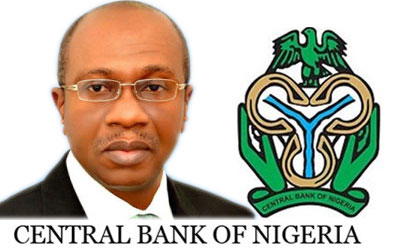
CBN Governor, Mr Godwin Emefiele
Stories by Emeka Anaeto, Economy Editor
Contrary to insinuations that Central Bank of Nigeria, CBN, may have abandoned the plan to inject about N760 billion into real sector special credit facility following last week’s policy reversal, the apex bank has indicated that the plan is still alive.

CBN Governor, Mr Godwin Emefiele
CBN had adopted accommodative monetary policy since July 2015 in the hope of addressing growth concerns in the economy, effectively freeing up some funds for commercial banks by lowering both Cash Reserve Ratio, CRR, and Monetary Policy Rate, MPR, with excess liquidity arising from the lower CRR totalling N760 billion, warehoused at the CBN.
Banks were to access these funds by submitting verifiable investment proposals in the real sector of the economy.
But after over eight months now no real sector operator has received loan from this fund up till last week when the apex bank reversed the policy that gave rise to it, increasing both CRR and MPR.
The development last week gave rise to speculations that CBN may have technically abandoned the funding plan.
However, in its Monetary Policy Committee, MPC, Communique last week the apex bank indicated that it would still go ahead with the plan stating that “the funds have not impacted the market yet because the CBN was still processing some of the proposals submitted by the banks”.
But the apex bank also noted that in the first policy episode of easing which resulted in injecting liquidity into the banking system, the banks did not grant credit as envisaged, a situation which may have partly informed the policy reversal last week.
This and other developments such as the delay in passage of the 2016 Budget, according to CBN, “has further accentuated the difficult financial condition of economic agents as output continues to decline due to low investment arising from weak demand”.
CBN stated, “the cautious approach to lending by the banking system underpinned by a strict regulatory regime conditioned by the Basel Committee in the post global financial crisis era has further alienated investors from access to credit as banks prefer to build liquidity profiles in anticipation of government borrowing.
“In the light of these developments, domestic output growth in 2015 remained subdued as reported by the National Bureau of Statistics, NBS”.
According to NBS real gross domestic product, GDP, grew by 2.11 per cent in the last quarter of 2015, more than half a percentage point lower than the 2.84 per cent recorded in the third quarter and 3.83 percentage points in the corresponding period of 2014.
Overall, growth in 2015 was estimated at 2.79 per cent, compared with 6.22 per cent in 2014.
Disclaimer
Comments expressed here do not reflect the opinions of Vanguard newspapers or any employee thereof.