
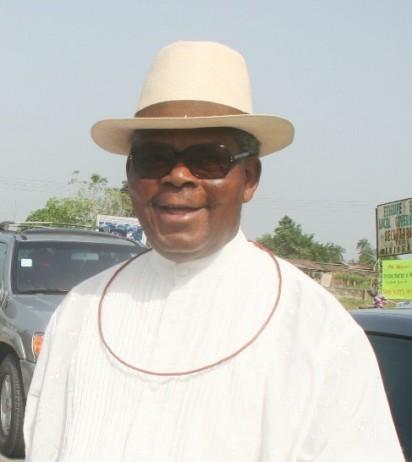
Olorogun Felix Ibru
By Emmanuel Aziken, Political Editor
Senator Felix Ibru, who died, yesterday, at the age of 80, was a pioneer of sorts in several areas of human endeavour. He excelled not only in his studies and professional calling, but also in the public space where he used his office to push through some of the country’s enduring legislations on public probity. Before the recent rush for the Senate by former governors, Ibru had shown how one could harness experience garnered from executive office with legislative duties to project public policy.

Olorogun Felix Ibru
The new pension regime in the country, the new public procurement framework and the Nigerian Extractive Industries Transparency Initiative, NEITI, were some of the memorable legislative accomplishments pushed through by the late Ibru in his one term in the Senate between 2003 and 2007.
Though well accomplished, he was a man who certainly did not take his successes to the head especially as he aged. With a remarkable bouncing gait, he was a man who reached out to all classes of men around him.
While easily remembered as the first civilian governor of Delta State, the renowned architect also had a litany of other firsts to his name that have been subsumed by his political strides.
The second son of the famous Ibru family from Agbara-Otor in Delta State, the late Felix was Head Boy at Igbobi College, Lagos in 1955 and, following his secondary education, he proceeded, on scholarship, to the Nottingham School of Architecture, Britain and qualified as an architect in 1962. He became the first African President of the British Council with responsibility for Nottinghamshire, Derbyshire, Lincolnshire and Leicestershire.
It was in that capacity that he was granted audience by Her Majesty, the Queen, in 1962. Following a master’s programme in architecture at Technion – Israel Institute of Technology, in Israel, he returned to Nigeria in 1963 and was appointed the first resident lecturer in architecture at the Yaba College of Technology.
Following his movement into private practise, the late Ibru was involved in the design of many of the nation’s notable landmarks. He had a particular knack for educational and sporting facilities. He was involved in producing the master-plan of the Universities of Benin, Lagos and that of the Ogun State Polytechnic.
He was also involved in the design of some major landmarks including the Sheraton Hotel and Towers, Lagos, Oguta Lake Resort, The Diette-Spiff Civic Centre, among others.
The late Ibru, however, came to national political reckoning in 1991 when he won the governorship of the newly created Delta State. That accomplishment, though, was after a failed attempt to win the Bendel Central senatorial seat in the 1983 general elections.
As governor, he is remembered for his administrative skills and as one who would always live up to his words.
Senator James Manager, who served in the Ibru cabinet as Commissioner for Social Development, Youth and Sports, recalled that the late governor was dubbed “talk na do”, a colloquial for one who did what he said.
Even though he was in his late 60s when he entered the Senate, he, by most considerations, outperformed many younger senators in the discharge of his duties as Chairman of the Senate Committee on Establishment and Public Service Matters. The present pension regime for public servants, though conceived by President Olusegun Obasanjo, found traction through Ibru’s dedication to the bill that swept off the former pension laws. Ibru was also instrumental in pushing through the new public procurement laws of the Federal Government and the NEITI Act, two legislative initiatives which, when implemented, would clean up public finances.
Ibru’s inclination to political tact was famously shown in the uprising by South-South senators of the Fifth Senate against their leader, Senator Victor Oyofo, in August 2004. When Oyofo helped to kill a bill pushed by Senator Martins-Yellowe, dedicated to maintaining the environment, many South-South senators, including Senator Manager, were enraged and it took the discretion of Ibru who “instructed” Manager to avoid an open confrontation with Oyofo on the Senate floor.
In the end, Ibru’s bent for peace succeeded when the South-South senators, hosted by Senator Udoma Udo Udoma, quietly signed a resolution ousting Oyofo as Chief Whip. However, Ibru who saw himself as a father figure, did not append his signature to the resolution.
He served only one term in the Senate and did not seek a second term in 2007 but his legacy in the legislative branch remains enduring. Ibru would also be remembered by the about 50 constituents he helped to position in public service jobs.
A former Senate staff of Ibru said, yesterday, that, after helping an applicant to find a job, he also often provided provisions to kick start them in their new engagements.
Following his Senate stint, he was elected President-General of the Urhobo Progress Union, UPU, a job he also carried out with aplomb.
Ibru was, undoubtedly, an accomplished architect, businessman, governor, legislator and community leader whose legacies, like his bouncing stride, would endure in the hearts of many of those who knew him.
Disclaimer
Comments expressed here do not reflect the opinions of Vanguard newspapers or any employee thereof.