
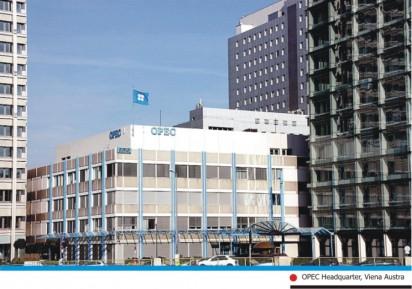
OPEC
By Sonny Atumah
With the Organisation of Petroleum Exporting Countries (OPEC) meeting last week in its Vienna headquarters, members emerged with decision put in escrow for cartel leaders to tidy up agreements on production caps. It means every member (rich or poor) is producing as they can pump into the market to sustain their teetering economies. Most OPEC members seem roiled with incongruous market share control mechanisms espoused, with the rift between high cost producers whose economies are being devastated by low crude oil prices and prosperous producers that stand for market share.

Again, Iran through her oil minister, Bijan Zangeneh, refused to entertain a production cap deal until she gets a clean health bill from nuclear sanctions of the west. Iran, trying to reclaim lost ground, has a sales deal with China’s Sinopec for 505,000 barrels of crude per day, and intends to ramp up supplies for up to 1 million barrels per day.
These scenarios associated with gluts may continue to lower oil prices, reduce revenues and occasion tighter budgets for liquid fossil fuels dependent economies. It therefore calls to question the relevance of OPEC, a cartel that cannot influence market share and price stability for members.
Had hit Venezuela through her Oil Minister, Eulogio del Pino, had last November 22 said that oil prices may drop to as low as the mid-$20 per barrel if nothing was done by OPEC to stabilize the market. Venezuela and Algeria are among the countries that are being devastated and had suggested cuts in output to curb the slump.
Nigeria’s Minister of State for Petroleum Resources, HE Dr. Emmanuel Ibe Kachikwu who presided over the 168th meeting last week in an optimistic laden address, predicted a world oil demand growth of 1.3 million barrel per day next year to average 94.1 million barrels per day.
Kachikwu who completed the tenure of Nigeria’s immediate past Petroleum Resources Minister; Diezani Alison-Madueke’s (elected OPEC president in 2014) presidency anticipated a more balanced market in 2016, with demand for OPEC crude expected to rise by 1.2million barrel per day, averaging 30.8 million barrels per day for the year.
He had told members that non-OPEC members will continue to witness a significant contraction in oil supply considering the drop in the number of newly drilled wells and the reduction by half of active drilling wells. The downward trend stems from investment cutbacks and the drop in US tight oil output which has been declining since May.
But with OPEC reference basket continuous slide from a monthly average of $60 in June to about $42 last week, the growth in world oil demand may not translate to real development in members economic projections. Again Kachikwu’s optimism may have been truncated with Saudi Arabia the world’s largest crude exporter of crude oil, cut prices for January sale to the US before the OPEC meeting.
This, Bob Yawger of Mizuho Securities in a Bloomberg report, considered the Saudis offer of crude oil at a lower price to two most important markets, the US and Asia, two days before the 168th meeting a slap in the face of OPEC. Saudis in a statement lowered its official selling price for all crude grades to the United States.
Leading global consumers have continued to enjoy the confusion of OPEC indecision on production cuts. The defense of market share has reduced feedstock prices and increased refining margins for Asian processors who have continued to receive cheap fuel from the Middle East, Russia, Mexico and Nigeria.
China, India, Japan and South Korea which are becoming biggest users of oil are all benefitting from low crude oil prices. Spokesperson Kim Woo Kyung for SK Innovation Company, South Korea’s largest refiner, was last week quoted as saying that it was the best time they have ever had as a buyer enjoying an overflow of oil.
China and India build their reserves buying crude in the market to fill up huge tank facilities. The IEA estimates that China has already stockpiled 200 million barrels and will add nearly 20 million more this year. Beijing plans to increase the size of its reserve to 500 million barrels by 2020.
Germany, Japan, South Korea, France, Spain, Italy and other big importers also have their own strategic oil reserves and with Iran coming on board buying crude at discounted rates is a sure way to shore up stock including strategic reserves in significant proportions.
Despite current uncertainties, desired stability in the oil market is a prerequisite for the continuity of adequate investments. High level diplomatic descants are on to bring feuding parties to terms in 2016. President Muhammadu Buhari and Angola’s Edwardo dos Santos met at the South Africa hosted China-Africa Forum, to reach out to other producers to find solutions to crude oil price instability.
Disclaimer
Comments expressed here do not reflect the opinions of Vanguard newspapers or any employee thereof.