
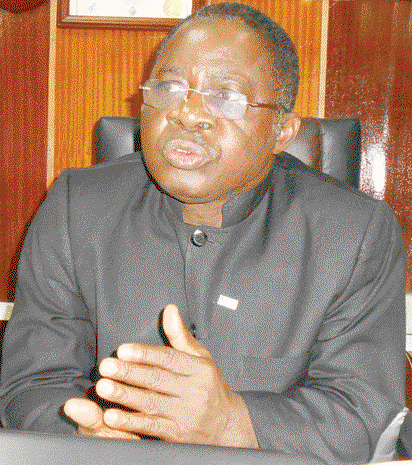
Prof. Innocent Ujah, Director General, NIMR.
Since the withdrawal of some donor agencies supporting access to Antiretroviral, ARV, drugs in Nigeria, there have been allegations and counter allegations on who pays for the drug and how they are paid. Recently, the Network of People Living with HIV/AIDS, NEPWHAN, Lagos state chapter, alleged there is a Federal government directive demanding that all payments must be made through the bank. The directive allegedly caused many of the PLWA to either withdraw from accessing drugs due to discrimination from the banks or inability to raise money for the drugs.
Chioma Obinna spoke to the Director General of the Nigerian Institute of Medical Research, NIMR, Prof Innocent Ujah on the issue and other issues bothering on medical research in the country. Ujah who debunked such notion, said there was no such directive by the Federal government.. He also lamented that lack of funding and insurgency have continued to militate e against quality research thereby affecting better treatment outcomes for terminal diseases such as cancer. Excerpts:


Prof. Innocent Ujah, Director General, NIMR.
NO directive on ARVs: There is no Federal government directive for PLWA to start paying. What happened is that we have to be creative, since the donor agencies are withdrawing. We cannot close down the clinic and let tPLWA go away, and we also have project staff in the clinic that are not NIMR staff that we could not dismiss.
So, I had to write a memo to the then Minister of Health, Prof. Onyebuchi Chukwu, stating that the funding agencies are withdrawing and we still have cases of HIV. Suggestions were made to reabsorb the staff; otherwise if we allow them to go, it means that the clinic will close down. So eventually we had to reabsorb the staff and keep the clinic going.
Regularity of the attendance
Secondly, because we needed support from The U.S President’s Emergency Plan for AIDS Relief (PEPFAR) and other agencies, we need to keep the services going. We run generator 24 hours; monitor the regularity of the attendance with our computer system and drug intake, so we decided to have what we call service charge; a minimal charge. I must state very clearly that no person living with HIV (PLWH) is paying for drugs for HIV. It is still free. The challenge now is the follow-up test. We need to do their haematological profile and ensure that CD4, also called T-cells which is a type of white blood cell that protect the body from infection to evaluate the immune system.
We have to monitor this and because the PEPFAR programme has withdrawn those services, we had to substitute and have to maintain the quality care that they used to have when the programme was in place. That has kept us going and I must say that in the last one year, we have done very well, this call for minimal service charge.
Effects of The Single Account (TSA): The TSA has also created some bottle necks for us. Just like you rightly said that the banks are creating problems for them for payment. We are now redesigning the strategy and discussions are ongoing with the bank to come to NIMR with their staff to collect the minimal service charge from the PLWH or they pay through the Point of Service (POS) to avoid going to the banks. We believe that from this year those things would change. I am undergoing a study regarding some of the challenges among the PLWHA so as to reorganise the clinical system and the means of payment and to let the Federal government know the challenges. This year, we have a bank that will receive their payment, because we cannot do anything without the TSA in place.
We are discussing with the National Agency for the Control of AIDS, NACA, on the funding challenges. The funding must be improved. It is true that many of these people are less-privileged, but that is why the charges are quite affordable. The reason is that if you look at it we have so many diseases, we have HIV, TB and treatment is also free, but what about cancers, nobody pays for that. The patients pay for treatment for cancer, diabetes, hypertension, hepatitis.
We must be grateful to government for taking up the responsibility of ensuring that those who are positive with HIV are being treated to some extent free of charge. You remember when HIV came to Nigeria first in the 90s, one month drug was N50, 000 eventually it was reduced in partnership with Federal government to say that it is free test. Now, drugs are being supplied free of charge and it’s very expensive and these other tests they are not regular. If they have good reason to evaluate you, then you do the test.
Something has to give way, we think that those living with HIV/AIDS should try and see how they can support themselves and government would improve the finances and training. The programme is capital intensive.
Minimal service charge
The PLWA pays for evaluation test, not the drugs; drugs are free, but the minimal service charge is for us to keep the service going. Expectations: This year, 2016, we believe will be in position to disseminate the findings many ongoing research and also do policy brief to the government through Federal Ministry of Health. Once we finish collecting data, we need to analyse the data, we do not want to hurriedly put something in place we want to be sure that whatever we say is what it is. Research is an ongoing process. We intend to build capacity of many of our researchers this year and other support staff. We will recruit in some areas where we do not have sufficient manpower, also complete the e-library this year.
At the moment, we are trying to get approval from National Board for Technical Education (NBTE) to train in the areas of Bio-medical engineering and technicians as well as award some Diplomas in specific areas of Bio-technology and Bio-medical training.
FG’s financial commitment to health: The cancer research centre has already taken off. As soon as we carry out research, the findings will be made known to the public, just as we will provide brief to the government through the Federal Ministry of Health and this will help to shape the magnitude of the problem, to develop a policy issue regarding a specific modalities of treatment and train more people. The truth of the matter is that apart from equipment, we need training and it should be regular as it is practiced in Europe and America.
The problem Nigeria has is funding and research is not being taken seriously. Funding for health is about five or six per cent and that really cannot do anything considering the country’s population. Look at the National Institute of Health of America (NIA), they have billions and they even give grants to developing countries like Nigeria. The Centre for Disease and Control (CDC) form that we are using is from NIA and Medical Research Council (MRC) in the United Kingdom and they vote a lot of money for research. We believe that the government of Nigeria should vote substantial amount of money to health sector. And as for the outcome, health is capital intensive, health research is even more capital intensive, the equipment is not cheap.
NIMR’s mandate under leadership: Yes, the Nigerian Institute of Medical Research (NIMR) has a mandate and it is to carry out research for National development. In my opinion, we have done our best by bringing the public to know about what to prevent and how to prevent some of these diseases.
NIMR is concerned about common causes of death in childhood. We are losing many children early in life and we have done a study on this issue nationwide, and currently writing on the causes. This is because we need to discover what the likely causes are and then advice our partners and government appropriately on how to prevent the incidence of childhood deaths.
The Institute is also involved in nationwide cancer research concerning Human Papillomavirus and its national prevalence. The centre is equipped with a specialize machine, Cobalt 4800 for the characterization of the subtypes of Human Papilomavirus. Another area of study is drug resistance to malaria and mosquito resistant insecticide treated nets. We want to track Artemisinin-based combination therapies (ACTs) that have been in use and study and confirm the magnitude of resistance and discover what to do to prevent this.
Disclaimer
Comments expressed here do not reflect the opinions of Vanguard newspapers or any employee thereof.