
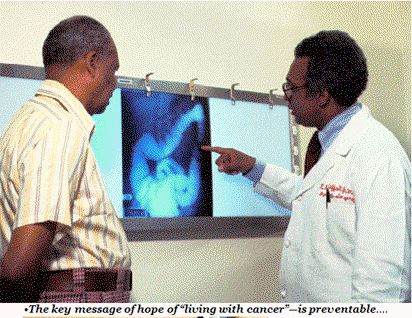
•The key message of hope of “living with cancer”—is preventable….
By Sola Ogundipe
Everyone wants to read about cancer because cancer is about people and people love to read about other people. A cancer story is news (often bad news) and cancer sells more because of the human interest particularly if a prominent personality is involved, and the bigger the personality, the bigger the story. My experience about reporting cancer has been one of enabling people to understand and appreciate the state of affairs (not necessarily the predicament) of cancer patients in order to raise awareness about some of their challenges (and successes).

•The key message of hope of “living with cancer”—is preventable….
But in the real world, getting a compelling cancer story is a challenge in the first place because no one wants to be involved with cancer either as a patient or as a relative. In this environment, cancer is still reported more as a death sentence. There are more reports of cancer deaths and challenges than survivors and breakthroughs. The fear factor still prevails even within the media. Cancer has an associated stigma and finality of death that dissuades those infected and affected from talking about it. This is the issue.
The concerns of cancer patients are similar to concerns of patients with life-long disorders such as HIV/AIDS, diabetes, sickle cell disease and End State Kidney Disease. So you need to break those barriers first. How you go about that depends on you as an individual. The typical person diagnosed with cancer is anxious, fearful, desperate, and often overwhelmed with hopelessness and helplessness. The cancer patient tends to be suspicious and distrustful of the intentions of the reporter, and is usually unwilling to talk about the illness except there is a compelling reason.
It is often a struggle to get the inside story or details from the patient that doesn’t want to be “used” to “sell” the story. It is even more difficult to extract details from the physician who is ethically bound not to talk about the patient, except, of course, the patient permits. One recalls the time prominent personalities die of cancer, and the challenge of obtaining the details. Because few are often willing to talk, the shroud of secrecy around cancer continues to grow.
Cancer is in public interest but it is also private affair of the physician, the patients and their families. So who needs the story? In whose interest is it? Is it just to sell your paper, or to project the patient’s plight in public interest? A balance is usually necessary. To write the compelling cancer story, you need to go out of your way, beyond the tenets of textbook journalism. You need to understand the science and economics of the disease. You need to develop a relationship with the patient, and the medical experts to get their trust and confidence.
Over the years, you tend to become acquainted with cancer support groups, experts and patients. Such groups abound and they are indispensable in demystifying cancer through the media. Every cancer patient needs sympathy, but it is hardly enough. Sympathy is not a bad thing; however, on its own, it doesn’t elicit involvement or engagement. As a sympathiser, you are sorry about the situation, but your sympathy doesn’t necessarily arouse responsibility or motivate action. On the contrary, sympathy often distances you from the situation and perpetuates the patient’s feeling of helplessness.
What would be your attitude if you or a member of your family was struck by cancer? If you were asked to tell your cancer story, or that of your relative, would you oblige? Why would you or why would you not? Put yourself in the position of the patient. Without question, effective reporting of cancer involves empathy. A good cancer story should not damage the patient, physically, emotionally or psychologically. A badly written cancer story could backfire. This is where the reporter’s work is cut out.
It helps to get to know about the disease, and not to ignore the cancer patient’s world. A number of cancer survivors have helped tremendously. There are instances when a cancer story is positive e.g., a cancer survivor tells his/her story, or the discovery of a new drug or prevention strategy.
Some patients do go public, but more about self-preservation than to save others. Essentially, the most compelling reason for a typical cancer patient to want to open up about his/her condition is financial constraint. Cancer treatment is expensive. Much of the time patients are short of money and go public when it is almost too late. Getting their trust and confidence is essential to getting a good story.
It is understandable. Even for the wealthy, cancer treatment is quite expensive, especially at the advanced stages, even though such treatment is often palliative, according to the experts.
I have encountered dozens of patients compelled to go public in a last hope to raise money for treatment. They seek help to raise millions to procure surgical treatment and drugs, usually in an Indian hospital. Such patients will talk about anything and everything at this stage because they have nothing left to lose. No fear, no dignity, no shame, nothing to lose but their lives. Cancer is a deadly disease, but it is preventable. The propagation of this message of hope through early detection is what needs to be emphasised and the key message of hope of “living with cancer”, rather than “dying with cancer”, could be stronger.
Disclaimer
Comments expressed here do not reflect the opinions of Vanguard newspapers or any employee thereof.