
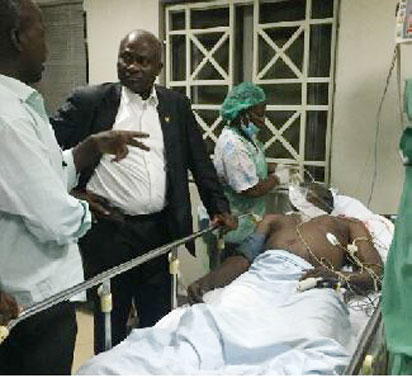
VISIT: The Lagos State Commissioner for Health, Dr. Jide Idris during his visit to fire accident victims at the Lagos University Teaching Hospital, LASUTH.
By Chioma Obinna
The Lagos State Commissioner for Health, Dr Jide Idris has said that a health care system that does not have a proper financing to complement will not work even as he disclosed that health financing, maternal and child health will top the lists of the Lagos State priorities in the next four years.

VISIT: The Lagos State Commissioner for Health, Dr. Jide Idris during his visit to fire accident victims at the Lagos University Teaching Hospital, LASUTH.
In a chat with Vanguard, Idris who was appointed the State Commissioer for the third time also acknowledged that healthcare financing was related to some of the things that the state are facing curretly.
Noting that health insurace was not unrelated to the demand for Universal Health Coverage pledged that his administration would ensure that the health insurance bill that has been passed last June would be implemented as part of the strategies to ensure that Lagosian have unfettered access to quality healthcare.
“We can increase physical access by building facilities, but without staff they become useless. Luckily, we have the health insurance bill that has been passed last June. What I have done now is to set up a committee to look at production of a guideline based on the law, to operate the health insurance scheme.
Idris further noted that in countries where health insurance has worked, it was made compulsory in those countries. “In our law, it is contributory and within that law also, there are specifics for the poor that will be addressed and paid for by the government. The idea is that if we do it properly, we also stand to be benefiting from the National Health Act when it begins to function, especially in the area of maternal and child health.”
The Commissioner, who was convinced that the scheme would succeed in the state, disclosed that the State Governor has increased the state’s health budget to about 9.3 percent. Recounting his achievements during the last tenure, Idris who noted that it cut across all areas of health, from infrastructure, primary healthcare, human resource, healthcare financing, regulation and of course, health promotion and disease prevention regretted that in the last six months the statistics in maternal and child health are not cheering.
“The major one now is healthcare promotion and disease prevention. We have resources we have to enlighten the public, we are going to start in the sense that we cannot rush everything at once. On infrastructure, we have built so many facilities and have increased the scope of services many times. At the primary care level, there are quite a number of Primary Healthcare Centres, PHCs, that we felt were not functioning.
Deliberate attempt was made to revitalise the PHC system and we came up with the idea of Flagship PHC for each local government. “Also, we tried to upgrade some facilities but I don’t think we were able to do as many as we had planned. The fact is that there are still a number of PHCs that still need to be made functional and that is why our secondary facilities are congested.
Unfoldig plans for the next four years, he said: “What is being planned for this session is to continue like that at this level. However, there is the need to address some specific issues. Luckily, the governor even before he constituted his cabinet has earmarked some hospitals for renovation and to increase their scope. What I said to him was that if you look at it over the years, none of our hospitals was purposely built as a general hospital.
So, in this case, if we are to do anything in that line, we must do it properly. Our plan is to knockdown some hospital buildings and put only things that will make their functioning complete. Alimosho will have a full-fledge outpatient services. We will modernise them all. Epe too is going to be addressed and same for Ifako-Ijaye, where we had issues getting NYSC, mosques among others out of the premises.
LASUTH is overwhelmed and we have stopped putting more structures there. Further, the commissioner who admitted that there is gross shortage of medical workforce, lamented that many patients are coming into Lagos as a result, the problem of the state is being compounded. “People come from other states to use our facilities and we cannot drive them. About three years ago when we did our statistics, about 25 per cent of patients in our facilities come from outside of the state.
“A major aspect of the human resources is the inter-professional rivalry among the stakeholders in the health sector. Though it is not peculiar to Lagos but as a priority, we need to address that otherwise it will affect service delivery. We will sit with them to address their issues that are often not unconnected with welfare, remuneration and workload among others,” he added.
Disclaimer
Comments expressed here do not reflect the opinions of Vanguard newspapers or any employee thereof.