
By Charles Kumolu
The announcement of a bailout package for states that could no longer meet their statutory financial obligations, by President Mohammadu Buhari came as a big relief to Nigerians who were already bearing the brunt of the financial crisis in Nigeria.
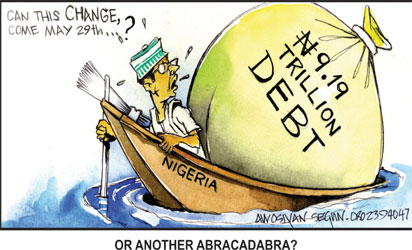
But hardly had the euphoria triggered by the prospects of receiving the funds from the Federal Government fizzled out, than stories that some states had embarked on borrowing moves amid alarming indebtedness, started emanating. For most Nigerians, applying for loan when the current debt profile of most states is very scary, amounted to a misplaced priority. A few others with deep knowledge of the economics of governance, however, hold a different opinion.
State governors who have initiated such borrowing moves maintained that they have no option than borrowing on account of the quantum of debts they met on ground. Other reasons adduced for the borrowings according to checks by Vanguard Features,VF, include the need to improve on the infrastructure and pay backlog of civil servants salaries.
The merit of these reasons notwithstanding, concerns have been raised about the rate and manner some state chief executives are going about fresh loans. According to those who raised eyebrows on the development, more debts would be incurred at the expense of economic development. Many discerning commentators have actually queried the rationale behind borrowing at a time when the revenues accruable to the states have plummeted.
Rivers
For example, the borrowing of N30 billion in two tranches within one month by Governor Nyesom Wike of Rivers State, raised an outcry in the state. The State House of Assembly had approved the Governor’s request to secure a N10 billion loan from Zenith Bank in the first week of assuming office and another 20 billion weeks later.
The House approved the loan after deliberating on the Governor’s request letter read by Speaker Ikuinyi Ibani. According to the letter, the fund would be used to rehabilitate roads and some other projects. The State chapter of All Progressives Congress ,APC, described the development as a plot by Governor Wike to plunge the state into an abyss of debt and economic servitude.
Benue
Governor Samuel Ortom of Benue State on assumption of office, announced plans to borrow N10 billion to pay workers salaries. Part of the money, according to him, will be for the smooth take -off of his administration. This will involve the purchase of cars for the legislature, commissioners and special advisers.
His words: “When we applied to the State Assembly for approval to borrow the money, we gave details of what it was intended for. I said it was going to be used to pay two months salaries because on the average, we expend N3.7 billion on the payment of monthly salaries”. VF gathered that the opposition in the state has since accused Governor Ortom of mismanaging the N10 billion he borrowed.
Niger
The Niger State Government was not left out in the borrowing spree as the Governor, Alhaji Abubakar Sani Bello wrote to the State House Assembly asking for an approval of N1.85 billion loan to pay workers salaries. According to him, the inability of the local government councils to mobilise enough money to pay workers salaries and arrears led to the borrowing.
The Speaker of the House of Assembly, Mr. Marafa Ahmed, read the letter from the Governor requesting for a loan that will make up for the shortfall in the 25 local councils’ 2015 budget.
Plateau
In Plateau State, the Governor said there was need to borrow money to address insecurity and financial challenges facing his state. He had said there was urgent need to get a loan because the debt he met on ground was more than N104 billion. According to Governor Lalong, borrowing became inevitable in order to meet up with the state’s financial obligations.
Abia
The story is also the same in Abia State where Governor Okezie Ikpeazu got the nod to borrow N30 billion from commercial banks, The N30 billion loan was meant to be channeled into construction and rehabilitation of roads and building of bridges across the three senatorial zones of the state as well as dredging of Aba River.
Other developmental projects include the establishment of industrial clusters, a modern hospital in each senatorial zone as well as other developmental projects. Like others, controversies trailed the decision in Abia with the All Progressives Grand Alliance, APGA, condemning the approval of the loan.
Ogun
In Ogun State, Governor Ibikunle Amosun in June, said he would borrow additional loans to complete on-going developmental projects across the state. The Governor stated this during his ‘’Work-in-Progress” assessment tour. The opposition in the state had questioned the borrowing, alleging that the state would be left in debt after Amosun’s tenure. But the Governor justified the borrowings, stating that he borrowed money earlier and repaid substantial part of it when due.
Justification of borrowing
Given the furore generated by these borrowings, many Nigerians have questioned the role of the Debt Management Office, DMO, which is mandated to, among other things, prepare and implement a plan for the efficient management of Nigeria’s external and domestic debt obligations at sustainable levels compatible with desired economic activities for growth and development.
In the light of these misconceptions, DMO tried to clear the air about the country’s debt profile and management. The agency which was established by the Debt Management Act of 2003, convened workshops in Enugu,Lagos and Kaduna for the civil society, media and students.
At the events attended by VF, the message was simple: to further the understanding of Nigeria’s debt profile and management among every segment of the Nigerian society. Prominent among the questions that came up during interactive sessions was the rationale behind current borrowings in the face of mounting debt profile.
The Director General of DMO, Dr. Abraham Nwankwo, who responded to the posers, noted that borrowing is an acceptable practice in governance. He was however quick to state that it is unconstitutional for any state government to borrow funds externally without approval by the Federal Government.
At each fora, he pointedly stated that DMO is not responsible for the disbursement of money neither is it saddled with the duty of knowing how the money is spent.
Public debt knowledge
In Lagos, Nwankwo said the DMO found it imperative to reach out to all stakeholders in the country because public debt management knowledge should not remain mysterious, rather it should be democratised. Such, he said, would help online publishers who are in a position to monitor, shape and influence the thoughts of the people to become well-equipped with information and data of public debt management.
Nwankwo explained that DMO has built a long standing tradition where they create platforms for interactions with various groups. “We started visiting institutions of higher learning to interact with students to ensure that they have adequate knowledge of debt management in Nigeria,” he said.
Continuing, Nwankwo said: “This is because we looked at the job, not from the angle of just earning a living only, but to use our job in a way to contribute to nation building. We are concerned with the future of the country, especially the youths, and how we can help them to reach their full potentials.
“We also have a long standing tradition of interacting with editors of traditional media, such as newspapers, because as the world is evolving, new stakeholders are evolving; so we are committed to monitoring these stakeholders and interacting with them, thereby democratising public debt knowledge.”
Available to corroborate the position of the DMO boss, were some Directors of the agency, who presented various papers aimed at deepening the understanding of public debt management. The Director, Market Development, Mrs. Patience Oniha, highlighted the processes involved in the Issuance of Eurobonds in the International Capital Market, ICM.
She said that the aims for issuing the Eurobond were to diversify the sources of borrowing. ‘’Nigeria’s activities in the International Capital Market, ICM, anchored by the DMO have been very successful in terms of subscription recorded and other objectives for their Issuance,” she noted.
Head of Portfolio Management, Mr. Dele Afolabi, also explained the processes and procedures for borrowing either from bilateral or multi-lateral sources.
Procedures for borrowing
On her part, the Director Strategic Programmes, Mrs A’smau Mohammed, highlighted the benefits of establishing Debt Management Departments, DMDs, in all the 36 states and the FCT.
Going down memory lane, she recalled that after the exit of Nigeria from the Paris and London Club of Creditors in 2006, the DMO in a bid to guard against relapse into un-sustainable debts, came up with the initiative of ensuring that the sub-nationals became sustainable.
To her, the DMO has made a formidable impact in institutionalising debt management practices at the sub-national level. That, she said, is in addition to the existence of a comprehensive and up-to-date domestic debt data of all the states, and FCT which is being published annually.
At a similar event in Kaduna which was convened for students of tertiary institutions in Nigeria, the DMO explained that despite the nation’s huge debts, the economy had remained resilient and diversifiable. In his remarks, Nwankwo explained that the states accounted for 18 per cent of the domestic debts while the Federal Government accounted for 82 per cent.
Misconceptions about debt management
He explained that the decision of bringing the students together arose as a result of the need to address some misconceptions about debt management in Nigeria. Nwaknwo noted that before now, the DMO had engaged the students by visiting their various schools with same message, adding that the need to deepen such information necessitated the workshop in Kaduna. He added that the students were assembled to sensitise them on how to monitor how such borrowed funds are spent.
Nwankwo said: “Presently Nigeria owes domestically, about N11 trillion and externally about N11 billion dollars. Let me emphasise that the debt matter is not just the quantum, what is important is how these resources are deplored to encourage growth, development, generate employment and reduce poverty.
“It matters whether what you borrowed you are in a position to pay back, to service it as and when due. And in Nigeria’s case, I want to assure you that Nigeria’s debt remains sustainable. “As you know, based on current global economic problems, particularly the collapse of oil prices, all of us should be aware that this is having significant impact on economies all over the world.
“But even at that, I can assure you that the Nigerian economy is very resilient because the government is in control, and Nigeria will continue to remain sustainable.
“The debts figure is the total debt of the federation, including all the states governments, and the domestic debts of the Federal Government and all the state governments. So, the debts I mentioned is comprehensive; it is the total debts of Nigeria.
“Let me emphasise to you that Nigerians should congratulate the government and the Central Bank of Nigeria, CBN, who in spite of the shock occasioned by the very drastic fall in the oil revenue, have continued to maintain a healthy reserve, and have continued to stabilise the Naira exchange rate,” he said.
Dr. Chuka Ifediora of the Marketing Consultancy Department of University of Nigeria, UNN, gave what was akin to a pep talk to the students on the subject. He was emphatic on why the students should mainstream what they learnt at the forum, in order to disseminate the information to their peers.
Of particular note, was his call on the students to avoid being used by any one or group to propagate wrongful message about debt profile and management in Nigeria.
Making their contribution, a representative of the students unions, Salahudeen Lukman, advised both the state and Federal governments to ensure that all funds borrowed for development of the education and other critical sectors of the economy were judiciously utilised in order to ensure growth and development.
Disclaimer
Comments expressed here do not reflect the opinions of Vanguard newspapers or any employee thereof.