
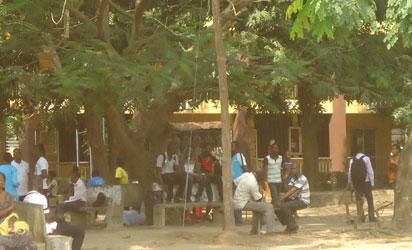
LASU Students
By Dele Sobowale
Blaming our continuing dependence on crude for the coming predicament, he and his Osun State counterpart are urging the people of their states to brace up for harder times – starting now. Others will soon follow.

University students on campus
The average price of crude oil will determine the fates of ALL sectors of Nigerian life – university education included. And the projections for crude oil prices in 2016 are scary; to say the least. Crude oil, if it needs to be repeated, accounts for close to eighty per cent of our foreign exchange earnings. So, it can be regarded as the weather vane of the drift of our economy.
In September 2013, crude sold at average of US$108 per barrel; in September of 2014, it dropped to US$78 per barrel; this year September, the delivery price is averaging US$48 per barrel. That was when Iran had an embargo placed on its crude oil exports and the USA was not a major exporter. By September 2016, crude oil might sell for as low as US$30 per barrel. So, the trend of crude prices point to lower revenue.
Will export volumes reduce the deficit? Not a chance. Femi Asu, writing in PUNCH of September 9, 2015, p 29, in an article titled NIGERIA, NORTH SEA CRUDES TO COMPETE AMID GLUT [capitals mine]. He went on to say that “The expected rise in Nigeria’s crude oil export is coming at a time when output from the North Sea in Europe will reach the highest in more than three years amid a persistent global production surplus.” He went on to say that “the region’s [Europe’s] share of Nigerian crude looks set to fall”. So, volume will also most likely decline.
One does not need to be an economist (a.k.a practitioners of the dismal science) or “prophet of doom” to know that our revenue from export of crude might fall by at least half in 2016 compared with those halcyon years of 2013 and early 2014. Meanwhile, another disaster befell us in the dying days of the Jonathan administration. Over one hundred Nigerian agricultural products were placed on import prohibition lists throughout Europe on account of poor quality. Nothing has been done to get the ban lifted. Increasing Internally Generated Revenue, IGR, in order to make up the short fall will entail increasing taxes, levies, tariffs and reducing entitlements. Certainly, no government can now contemplate increasing minimum wage, So the Nigerian Labour Congress will be faced with two choices – shutting up or doing battle.
From my point of view, the Federal and State governments have no choice but to impose more realistic university fees and levies or watch the institutions, already less than world class, decline even further. One study conducted on Nigerian universities revealed that the Federal Government subsidises the education of each student with amounts ranging from N750,000 to N900,000 per annum. With dwindling revenue, it is doubtful if that can, or should, continue. Political rhetorics notwithstanding, the only question remaining is “who will pay what?” The rest is self-deceit. There is still no such thing as a free lunch.
Disclaimer
Comments expressed here do not reflect the opinions of Vanguard newspapers or any employee thereof.