
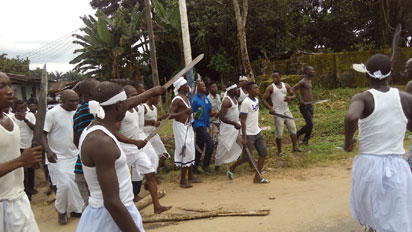
Egba deity devotees
By Ochuko Akuopha
OVRODE — A carnival atmosphere enveloped the agrarian Ovrode community in Isoko North Local Government Area, Delta State, on Friday, September 25. Unquestionably, the festival, said to be the celebration of Egba, a deity in the sleepy town witnessed a colossal turnout by indigenes of the town and neighbouring communities.

Egba deity devotees
It was gathered that the traditional war festival, previously an annual event until 1966 when the community decided to make it a triennial affair, is well-regarded by the people because the goddess allegedly shielded them from gunfire by their enemies during the war in the olden days and still guards them till date.
Neighbouring Ellu, Aradhe, Igbuku, Udoni and others benefited from the power of the deity in those days when inter-communal conflict was prevalent.
It is said that the deity shielded the natives at the sight of opponents in historic times and till date, the people believe the goddess is still at work. The festival is, therefore, seen as time to renew the potency of the protection charm and those who believe in the power of the Egba deity do not joke with the event.
Able-bodied men, youths brandish cutlass
When Niger Delta Voice visited the community at about 2.00 pm, the atmosphere was already charged, as a large crowd of able bodied men and youths brandishing cutlasses were seen dancing towards the community’s shrine. Clad in white wrappers and singlet, the participants were led by the chief priest of the deity whose duty it was to perform the rituals of the day. It is forbidden to wear red attires in Ovrode during the festival.
The previous day, various quarters of the community had filed into the bush in search of animals such as grass cutters, antelopes and others, which were used to prepare delicacies ahead the festival.
A prominent indigene of the community, Chief S Olokor said other communities, which have a common linkage with Ovrode normally come with such animals for the celebration of the deity, adding, “Any segment or community which is unable to kill an animal will provide a live dog in place of the animal they could not kill.”
His words: “As the chief priest dances out of his house to the major road, it is an indication that time is up for the services to take place, and then people, his friends, natives, family, well wishers will dance along with him and from there, he enters the shrine and performs the services.”
Dos and don’ts
According to him, “The shrine is in a particular place made up of two segments. The first segment called Odimodi is a place where the women can go to and they do not go beyond there and anybody, who sleeps with a woman the night before the main day does not go beyond the first segment.”
Thrills of the festival
Olokor explained, “The second segment which is the inner part of the shrine contains the deity where only men, who are pure can go to and take part in the ceremony. The services are done by the chief priest. The highlight of the ceremony the mother deity is washed with concoctions that prevent the firing of gunshots.”
“Once that is done, the leftover of such liquids and concoctions are given to the youths and able bodied people to share. The container with which it is done is a calabash. The advantage of using the calabash is that when the leftover is given to the people to share among themselves, there is always a struggle because of the large number of persons.
“In the process the container gets broken and anybody who is able to take even a piece of the calabash believing that the liquid had sank into it, may chew and swallow it and that is the beginning of the peak of the ceremony, after which the mother deity is carried by the chief priest and he begins to dance with it.” he said.
Testing the efficacy of the medicine
According to him, “There is always a gunman on standby to test the efficacy of the medicine. The gunmen will aim his gun at the chief priest, who carries the deity. At that time, there is a particular song that is raised by the people. Once that song is going on, the gunman will aim his gun at the chief priest and fire the gun. After about three gunshots like that, there will be a change of song.
Evidence of victory
“A particular song will be raised and the moment that song is raised, the chief priest will still be carrying the mother deity and every other subsequent gunshot that is fired at the mother Egba as the chief priest is carrying it, will never fire and that will be the proof of the success of the festival. But if it fires in that process, it will mean that something is wrong which the elders will begin to look into.
Entertainment galore
His words, “After that, the chief priest will come out and dance to his house. When he gets to his house, he will now come back to pay his own homage to the deity. In that process, he will come with a large crowd and he leads the dance, as he is coming he is dancing and demonstrating. Then, he will entertain people and thank the deity and that ends the ceremony for that day.”
Chairman of the community, Mr. Michael Ataibuno, told NDV that after the first day, all the quarters in Ovrode took their turn to dance round the whole town starting from the most senior till the end of the ninth quarter.
High-point
Saying that the festival goes a long way in promoting unity among the people and helping to preserve their rich cultural heritage, he emphasized that the use of a gun, which is shot at the chief priest was the most unique aspect of the festival.
“The gunshot does not affect the juju priest or any other person that participates in the medicine,” Ataibuno said.
Disclaimer
Comments expressed here do not reflect the opinions of Vanguard newspapers or any employee thereof.