
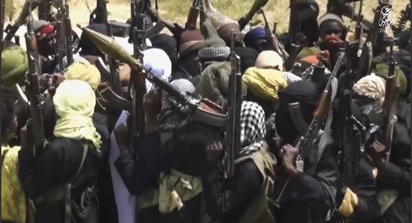
Boko Haram
By Sam Eyoboka with Agency reports
FOLLOWING the failure of Nigeria Inter-Religious Council, NIREC, to forge a common ground to address religious intolerance in Nigeria including violent insurgency in North East region, key stakeholders in a new inter-religious centre in Nigeria have met to plan for the centre and its work, set to launch in March 2016.
The 2-day meeting which ended on Monday at the Ecumenical Institute in Bossey, Switzerland, was attended by representatives from the Jordanian Royal Aal Al-Bayt Institute for Islamic Thought (RABIIT), the World Council of Churches (WCC), the Christian Council of Nigeria (CCN) and Jama’atu Nasril Islam (JNI).
The project has developed as a result of a high-level international inter-religious visit to Nigeria by representatives of the WCC and RABIIT in 2012.
Speaking about the significance of the project, Rev. Dr Olav Fykse Tveit, general secretary of the WCC, said: “Muslims and Christians can, through this initiative, hear each other’s stories, share each other’s pain, and begin to heal. This centre is a significant common project for Muslims and Christian leaders in Nigeria and a pioneering work in inter-religious encounter.”
Attendees shared their vision for the work of the centre, which is intended to act as an impetus for healing and reconciliation in Nigeria, given the recent incidents of conflict in the country. The governance, management and programme of the centre are intended to model Nigerian Christians and Muslims working together on issues of concern to all Nigerians.
The evocative phrase “In the sandals of the other” was proposed as a descriptive title for the centre. In the first year of its operation, the centre will work on supporting victims of violence who are suffering from trauma, with a particular focus on women and young people. It will also share examples of people working together to support each other across religious boundaries, as well as beginning substantial data collection. Participants of the meeting included Dr. Khalid A. Abubakar, Ms Lamya Al-Khraisha, Dr. Clare Amos, Dr. Usman Muhammad Bugaje, Mr. Sulayman Hart, Dr. Gina Lende, Rt. Rev. Prof Emele Mba Uka, Rev. Dr. Yusuf Ibrahim Wushishi, Dr. Yakubu Joseph and Ms Marietta Ruhland.
The conflict of interest rocking the Nigerian Inter-Religious Council made up of the Christian Association of Nigeria, CAN and the Supreme Council of Islamic Affairs, NSCIA, deepened last July when the Christian arm alleged that the Nigerian Supreme Council for Islamic Affairs had scuttled every effort to hold meetings. CAN specifically faulted the exclusion of Sheikh Dahiru Bauchi; astute Islamic preacher, Sheikh El-Zaki Zaki; and the President, Supreme Council for Islamic Preachers in Nigeria, Sheikh Mohammed Ibn Nurain, from an umbrella body of religious leaders like NIREC, whereas CAN comprises all Christians in the country.
A statement by the Director of National Issues in CAN, Mr. Sunday Oibe, claimed that the Secretary-General of NSCIA and ex-Vice Chancellor, University of Ilorin, Prof. Ishaq Oloyede, and the Sultan of Sokoto, Sa’ad Abubakar III, had decided not to allow the meeting of NIREC to hold, “until the expiration of the tenure of Pastor Ayo Oritsejafor as CAN president.
According to Oibe, NIREC cannot function because it is a conglomeration of religious leaders from one group and a mix-grill of politicians and traditionalists on the other hand, pointing out that the “likes of Oloyede have carefully, for his personal interest, with the blessing of his mentor, the Sultan of Sokoto, Sa’ad Abubakar III, refused the true composition of religious leaders, thereby making NIREC ineffective.
“How do we explain the exclusion of respected Sheikh Dahiru Bauchi and astute Islamic preachers like Sheikh El-Zaki Zaki, and an amiable President of Supreme Council for Islamic Preachers in Nigeria, Sheikh Mohammed Ahmed Ibn Nurain, from an umbrella body of religious leaders like NIREC, whereas CAN comprises all Christians in the country?” he stated.
Disclaimer
Comments expressed here do not reflect the opinions of Vanguard newspapers or any employee thereof.