
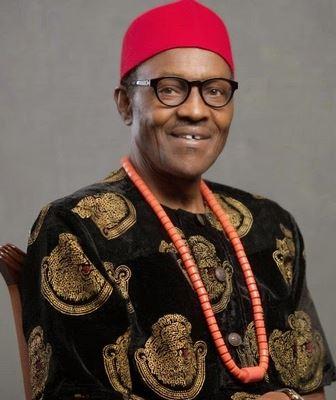
Buhari in Igbo attire
By Rotimi Fasan
PRESIDENT Muhammadu Buhari may have started moving into dangerous territories. He may indeed have begun the process of his own unravelling and ultimately of the destruction of his presidency by his own action.
Considering the constant thrusts of the many criticisms levelled against him before and since he emerged as president, many would argue that the man has always moved and stayed in what I here call dangerous territories, as I would expatiate on shortly. But thirty years, one would imagine, should have been more than enough to wean a person of some of his less desirable propensities.
To hold such a notion is not a demonstration of naivety but of faith in humanity, in the capacity of all thinking beings to change for the better. It is an allowance for ‘second chance’, another opportunity to repair what could have been better handled the first time. But to have that opportunity and insist on frittering it away in the same old way is the real definition of foolishness.


Buhari in Igbo attire
It is such foolishness that must have informed the latest in the series of presidential appointments announced from Abuja last week. President Buhari has been pilloried for the generally slow pace at which his administration is moving with regards to addressing the many problems by which the country is confronted.
He has been criticised for his failure to appoint ministers to assist in driving the vehicle of his administration more than three months after his inauguration. We need not detain ourselves on the details of his response to these criticisms.
Suffice to say that some of us were content to cut him a slack and see things from his own angle, especially as it appeared that some of these criticisms were sour grape abuse motivated by very selfish interests if not a deliberate attempt to distract the government. There were, nevertheless, specific criticisms of the nature of several of the appointments made by President Buhari and what these appointments portended.
Two of these early appointments were those of Amina Zakari, the Acting Chairman of the Independent National Electoral Commission, and Lawal Daura, the Director of the Department of State Security. Both appointments and the appointees were bitterly criticised for potential conflict in interest given the alleged familial connections between the president and the appointees.
The controversy generated by this was yet to blow over, indeed amid this controversy, the presidency made more appointments. But criticisms of the overtly ethnic/regional/religious bent of the series of appointments which were overwhelmingly in favour of the north persisted. The north gave the president the highest votes even if those votes could not have led to his victory without votes from other parts of the country. The north west and north east have no doubt been over patronised in terms of the appointments so far made by Buhari.
Administration officials have sought to explain these provocative anomalies (for that is what they are in an ethnically diverse country like Nigeria) away by saying subsequent appointments would be balanced and would better reflect the ethnic, religious and gender diversity of the country. But they never forgot to add that the appointments so far made were based on merit.
Which leads one to ask if merit only resides in the north and among Moslem men. If the merit yardstick, measurable in terms of educational and professional competence is dutifully applied, it is doubtful if the north would make the scale at all. It was in recognition of this fact that the federal character principle was enshrined in the Nigerian constitution. It was made more to cater to the needs and anxieties of northerners than southerners. To every one qualified northerner (using education as yardstick of measurement), there would be a hundred qualified south-westerners at least to say nothing of other parts of the south.
Which goes to show that Buhari may have other reasons other than merit alone for the appointments he has made so far. Last week’s appointments that included those of the Secretary of the Government of the Federation, the Comptroller General of Nigerian Immigration and Chief of Staff to the president are simply outrageous. The president even bent over backwards to appoint a retired soldier, Hameed Ali, to the career position of Comptroller General of Customs.
That is like appointing a retired navy commander the Inspector General of Police! The appointments ensured a clean sweep of all important positions from the presidency down to the ministries by the north. And the effect of this would go on for many years even after the Buhari presidency. It is as if other parts of the country are conquered territories.
That the president does not feel embarrassed making these appointments is astounding. The appointments show poor judgment and an appalling sense of history. It is even worse that the president has gone on making these appointments without any sign that he is aware of the justifiable criticisms of those who feel left out of the scheme of things. He should not begin to take the support of Nigerians from the north for granted, to say nothing of others from regions outside the north.
Given the nature and number of appointments already made by Buhari, whatever is left by way of appointments are the “leftovers”, more or less the dregs. The stark truth before Nigerians today is that the inner cabinet, key advisers of the president, are from the north. The appointments do not recognise the support of non-northerners who ensured Buhari became president much less those who did not support his electoral quest.
The parochialism that will create is better imagined. Decisions from a government like this have the potential to reflect the views of only one section of the country. It is a shame that these appointments are forcing Nigerians to have the kind of arguments we should have moved beyond. Making appointments that remind Nigerian of their ethnic and sectarian differences is moving in dangerous territories. It was things like this that led to the rise of agitations in the Niger-Delta.
A leader should not be deaf to the complaints of the people. But Buhari seems to be listening now only to his own drum beats, and is arrogating too much wisdom to himself. This ironically was the main thrust of the charge levelled against him when he was overthrown by Ibrahim Babangida in 1985.
He needs to be reminded that his major selling point as president is his reputed frugality and the capacity this has to stem the tide of corruption. Otherwise, there is little to recommend Buhari as an intellectual much less a thinker in the sense in which that word is understood in politics or philosophy.
Disclaimer
Comments expressed here do not reflect the opinions of Vanguard newspapers or any employee thereof.