
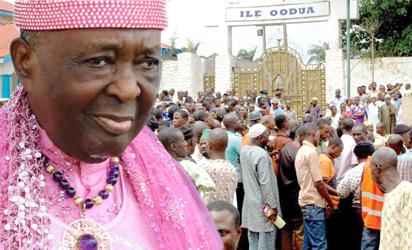
Ooni-ife
By Dele Sobowale
“A man’s real life is that accorded to him in the thoughts of other men by reason of respect or natural love.” Joseph Conrad,
The death of the late Ooni of Ife, like those of many great Nigerians, brought the usual avalanche of tributes from far and wide. Based on the time-honoured principle of never speaking ill of the dead, the tributes were generally positive. I would have loved to join the crowd but, to be honest, I met the Royal Father only once in my life – when he called a small group of Yoruba leaders of thought, to the Palace, to form a Non-Government Organisation.

Ooni of Ife: Oba Okunade Sijuwade, Olubuse 11
The organization was meant to be all-embracing, politically non-partisan (I would not have joined if it was), non-discriminatory on the basis of gender, age, income, state of origin, religion or status in society. It was the sort of NGO for me. Unfortunately, that was all the meeting there was. The NGO itself collapsed two years after for reasons to be disclosed at a later date.
Consequently, all I know about the late Ooni is second hand – certainly not enough on which to write a tribute. But, I know someone who was closer to the late Ooni and on whose words I can bet my life – Obong Victor Attah, the former Governor of Akwa Ibom State. Most people might not be aware of it, Attah is one of the Chiefs of Ife; he became one by virtue of the late Ooni. To Attah I turned and came away with the following tribute to our departed Royal Father.
“I had known the late Ooni of Ife for several years, and right from our first brief meeting, he struck me as one of the most friendly, patriotic Nigerians who related excellently with fellow Nigerians from all corners of the country. He was not just a traditional ruler, he was a national leader.
And he was full of pleasant surprises for those fortunate to be close to him. You can imagine my own total surprise when he took me unawares by calling to inform me of my appointment as a Chief of Ife, the foundation of the great Yoruba nation. Words failed me for several minutes before I could respond with a weak “Thank you” – which was a poor substitute for the joy I felt that a great monarch could reach way across the Niger and offer a permanent hand of fellowship and permanent friendship to my humble self.
May God grant His Royal Highness perpetual peace.”
Now, I know how great the man was.
OPEN LETTER TO PRESIDENT BUHARI ON BEHALF OF LAGOS STATE INDIGENES – 2
“Fiat justina et ruant coeli (Latin), meaning, Let justice be done though the heavens fall.” Lord Mansfield, 1705-1793. English jurist.
Lagos State indigenes have no interest in political appointments in any other state. We don’t covet what belongs to our fellow Nigerians. All we are saying is simple. The WAYO involved in the prevailing situation in which others tacitly proclaim “What is ours is ours; what belongs to Lagos belongs to all of us”, must stop. Unless there is active reciprocity, it cannot be allowed to continue. The ethnic group whose members wrote to Ambode demanding for appointments will not dare such a thing in Borno State. You see the difference?
Lagos State was one of the twelve original states created by the General Gowon regime; it remains the only state that has not been carved up into more states despite the fact that it has a larger population than the four smallest states put together. At the time, Lagos State received one twelfth, or 8.5 per cent of all allocations made on the basis of equality of states. When Murtala/Obasanjo increased the number of states to nineteen, Lagos States share dropped to just over 5 per cent. Babangida increased the number of states from twenty one to thirty over eight years; Lagos State’s share plummeted to 3.5 per cent. Abacha completed the onslaught against our state when he increased the number of states to thirty six; Lagos allocations went down to 2.7 per cent. By contrast all the other original eleven states have been split. Some now receive three times the percentage of allocations. Is it fair?
Going back into history, records would show that political appointments in all the original twelve states went to indigenes of those states. Under the government of Mobolaji Johnson, Lagos State was no exception. Even when under Murtala/Obasanjo non-indigenes were sometimes posted as military governors to states, the pattern was maintained.
The Second Republic, which started in 1979 and ended in 1983, also followed largely the same pattern. Former Governor Jakande’s cabinet consisted of people whose family roots are deep in Lagos. The same was the case in all the nineteen states which constituted Nigeria at the time. In fact, when the Governor of a Northern state wanted to appoint a Yoruba to the judiciary in his state, the lawmakers would have none of it. The change, as far as Lagos is concerned, came during the Babangida and Abacha era when non-indigenes of Lagos State started making appointments, while non-indigene governors of other states continued to appoint only indigenes to political offices.
Since 1999, Lagos State’s political appointments had gone to non-indigenes in large numbers. At one point, close to half of the cabinet came from other states or zones – including South East and North Central. Unless the reader can point to another state where this occurs, sending a text message protesting this article will amount to a waste of time. I never expect those cheating others to willingly give up their ill-gotten gains.
Disclaimer
Comments expressed here do not reflect the opinions of Vanguard newspapers or any employee thereof.